Hot on the heels of the opening of Picasso On Paper, a major new exhibition at London’s Royal Academy of Arts, came pianist Roman Rabinovich’s personal hommage to this artist, the place of his birth and his creative life, in a refreshingly original, colourful and very personal programme of music by Zipoli, Debussy, Satie, Granados, Gershwin and Stravinsky, together with a work by the pianist himself.
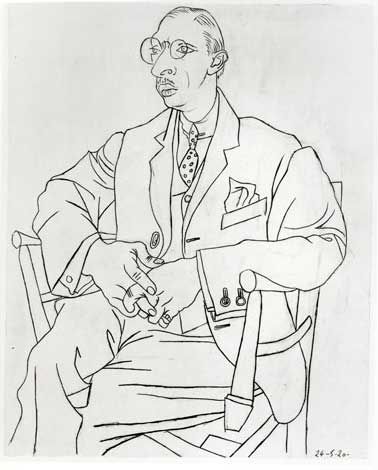
Portrait of Igor Stravinsky, 1920 (Picasso Museum, Paris)
Debussy said that he “loved pictures almost as much as music” and the same may be said of Roman Rabinovich, who is also an artist. Unsurprisingly, many of the pieces in this programme had strong visual narratives (Debussy’s atmospheric Estampes and Granados’ dramatic and engrossing Goyescas, for example). Connections to Picasso’s native country came through Spanish composers (Zipoli and Granados) and also music (‘La soirée dans Grenade’ from Estampes), but there were other, more tangible connections too: Picasso and Granados were contemporaries and both frequented Els Quatre Gats (The Four Cats), a bar in Barcelona; and Picasso encountered both Satie and Stravinsky through Diaghilev’s Ballets Russes (Picasso’s 1920 portrait of the composer hangs in the RA’s current show, and he designed the costumes and setting for Stravinsky’s Pulcinella, and also for Satie’s ballet Parade).
Rabinovich was clearly very at home in all of this repertoire, from the sombre elegance of Zipoli’s g minor suite to the folksy vibrancy of Petrushka, an exuberant finale to the programme, and it’s encouraging to find a pianist who is willing to tackle such wide range of styles and moods with just the right balance of technical facility and bravura. The works by Debussy and Granados were particularly arresting, sensitively sculpted and shaded: Pagodes had the subtle washes and softened hues of watercolour while Granados’ El amor y la muerte (Love and Death) was darkly-hued, passionate and dramatic. Rabinovich’s own piece, its twirling perpetuum mobile outer sections bookending two less frenetic episodes, had the quirky wit of Satie and the rhythmic bite of Gershwin. And what a pleasure it was to hear one of Satie’s curious, haunting Gnossiennes. played with nonchalant grace.
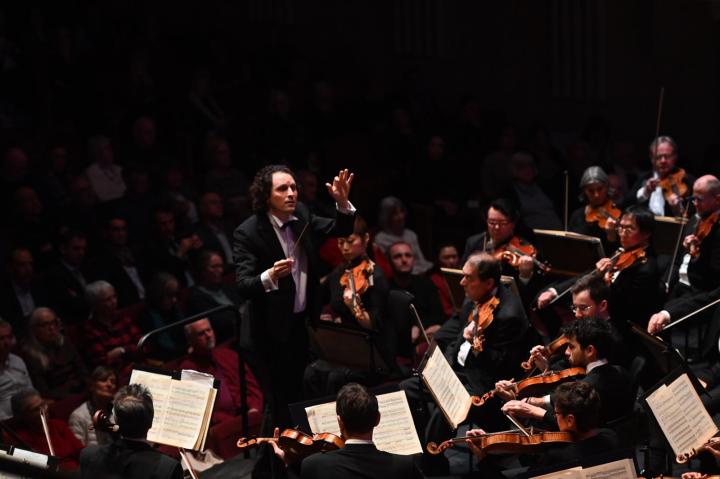
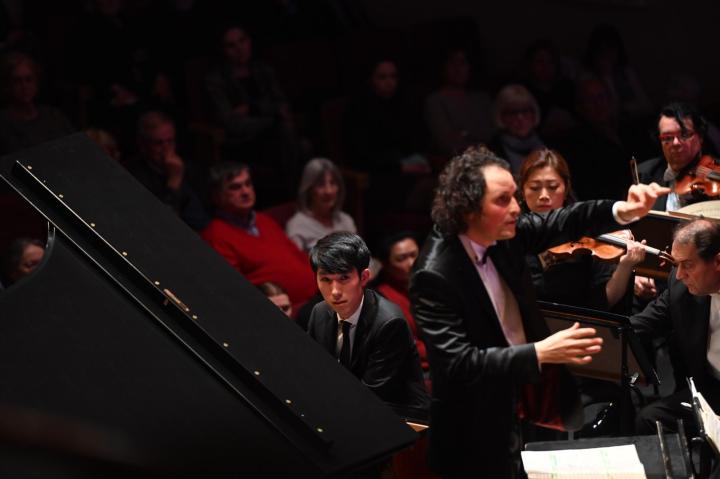
Two days before the UK exited the EU, the Orchestre National de Lille (ONL) performed a programme of European music at London’s Cadogan Hall. They were joined by Chinese-American prize-winning pianist Eric Lu for Beethoven’s Piano Concerto No. 4, the piece with which Lu secured his first prize at the Leeds International Piano Competition in 2018.
The foyer and concert hall reverberated with bi-lingual conversations; unsurprisingly, there were many French people in the audience. In 2020, the ONL is the only French symphony orchestra touring the UK, and its presence here is part of a wider cultural and economic delegation to foster ongoing links with the UK and the Hauts-de-France region, and to further strengthen Anglo-French relations post-Brexit.
The charismatic Alexandre Bloch conducted without the score for the works by Ravel and Debussy, perhaps a sign of how intuitive this music is for him. Opening with Ravel’s Ma Mère l’Oye, a perennial favourite and a gentle opener for this colourful programme, Bloch drew characterful watercolour washes of sound and textures from the orchestra, whose silky transparent strings, haunting woodwind and sparkling percussion elevated these children’s pieces to something far more subtle and sophisticated.
Debussy’s La mer was illustrated in more vivid strokes and colour in an evocative and dramatic portrayal of the mercurial, capricious nature of the sea, from gently lapping waves on a summertime beach to a swelling, storm-tossed ocean. It’s a cliché to say that French musicians truly understand French music, but here one felt a profound appreciation by orchestra and conductor of Debussy’s kaleidoscopic, atmospheric soundworld – those shimmering agitated strings, bright brass and luminous woodwind which brought the music to life in myriad detail and brooding intensity, culminating in a thrilling climax.
Unusually, the concerto opened the second half. This was perhaps for practical reasons, given the amount of rearranging of the stage which was required. Beethoven began sketching his Fourth Piano Concerto in 1804, and unlike many other pieces from his middle period which have become associated with heroic struggle and his personal demons, this work is imbued with serenity and joy, though not without poignancy: this was the last of the composer’s five concertos which he was able to perform himself, due to his increasingly debilitating deafness.
I have been wanting to hear Eric Lu live since enjoying his Leeds competition performance, and I missed his Wigmore Hall solo debut last December due to illness. There are two things which immediately strike you about this young (he’s only just 22) pianist: his modest stage presence and elegant, poetic sound, most obviously demonstrated in his pianissimo touch and Mozartian clarity, especially in the upper register of the piano. There was an intimacy too, in his interactions with the orchestra, and when not playing he turned towards them and conductor, awaiting his next cue.
His quiet presence brought a very palpable tranquility to the second movement, the piano’s tender, hymn-like entries contrasting with the bold, pestering strings. In the finale there was a quiet strength and bravura from Lu in gleaming passages and crisply articulated rhythms, the orchestra matching him with energy and élan.
Unfortunately, I had to leave after the Beethoven, and only heard Lu’s encore (Chopin’s Prelude in B-flat) via the live link the foyer, before dashing for my train. I also missed the final piece in the programme, Ravel’s La Valse, which I don’t doubt was played with the requisite passion and sensuality by the ONL.
JS Bach – Chaconne from Partita No.2 in D minor, BWV.1004 arr. Busoni for piano Busoni – Berceuse élégiaque (Elegy No.7), Op.42 Chopin – Sonata No.2 in B flat minor, Op.35 (Marche funèbre) Stephen Hough – Sonata No.4 (Vida breve) Liszt – Funérailles from Harmonies poétiques et religieuses, S.173; Mephisto Waltz No.4 (unfinished); Mephisto Waltz No.1
Stephen Hough, piano
Tuesday 19 November 2019, Tuner Sims, University of Southampton
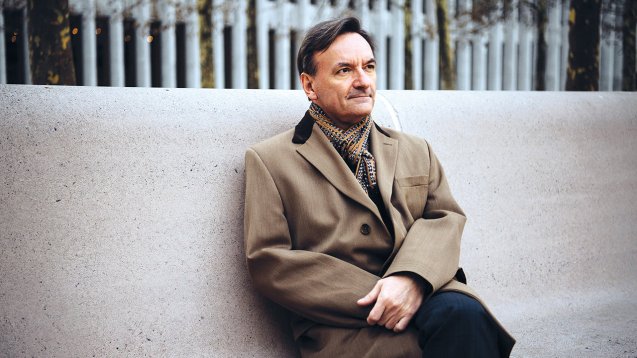
My first visit to Turner Sims concert hall at the University of Southampton, and a treat of an evening in the company of British pianist Stephen Hough playing music by Bach arr. Busoni, Busoni, Chopin and Liszt.
This was a typical Hough programme, thoughtfully conceived and superbly presented, deadly serious, for the theme of the concert was death – pieces inspired by or identified with death, including Chopin’s Piano Sonata No. 2 with its famous Marche Funèbre, and Liszt’s Funerailles, written in the same month as Chopin died and at the time of the violent Hungarian revolution of 1849.
Superlatives quickly become redudant when describing a pianist of Hough’s calibre, whose wide-ranging intellectual acuity always informs his programmes and his playing; therefore this is not a review, rather some reflections on what I thought was a most absorbing programme, especially the first half. In addition to the thematic asssociations between the pieces, there were musical connections too: the dark rumbling bass octaves in the Bach/Busoni Chaconne were reiterated in Chopin’s Marche funèbre – a plangent left hand accompaniment which, in the reprise of the famous theme dominated, with a dark tolling grandeur. And this figure was later heard again in the opening of Liszt’s Funerailles. Likewise, the haunting, unsettling soundworld of Busoni’s Berceuse (more a mourning song than a lullaby) was reflected in the finale of the Chopin Sonata, a curious, hushed fleeting stream of consciousness, and then in the wayward uncertain harmonic language of Liszt’s ‘Bagatelle without tonality’.
The Bach/Busoni Chaconne was a magnificent, emphatic opener for this concert, and Hough gave it a multi-layered, orchestral monumentalism. The Berceuse was a remarkably contrasting work, interior, intimate, mysterious and disquieting, and by segueing straight into the Chopin Sonata, Hough infused this work with a similarly discomforting atmosphere. With agitated tempi the Sonata moved forward with an anxious intensity but Hough lingered over the more lyrical Nocturne-like moments in the opening movement and the Scherzo. Like the Chaconne, the funeral march was magisterial rather than simply funereal and the tender, dreamy middle section lent an other-worldliness to the music’s atmosphere before the tolling bass and mournful theme returned.
Hough’s own piano sonata No. 4 ‘Vida Breve’ opened the second half of the concert, an abstract work constructed of five tiny motivic cells (including a quotation from the French chanson En Avril à Paris, made famous by Charles Trenet) lasting a mere 10 minutes, a comment on the transient, fleeting nature of life, its passions and turmoil. The concert closed with three pieces by Liszt – Funerailles, whose meaning is obvious, and two Mephisto Waltzes, devilish in their whirling virtuosity and frenetic, tumbling notes.
Stephen Hough plays the same programme at the Royal Festival Hall in March 2020. Details here
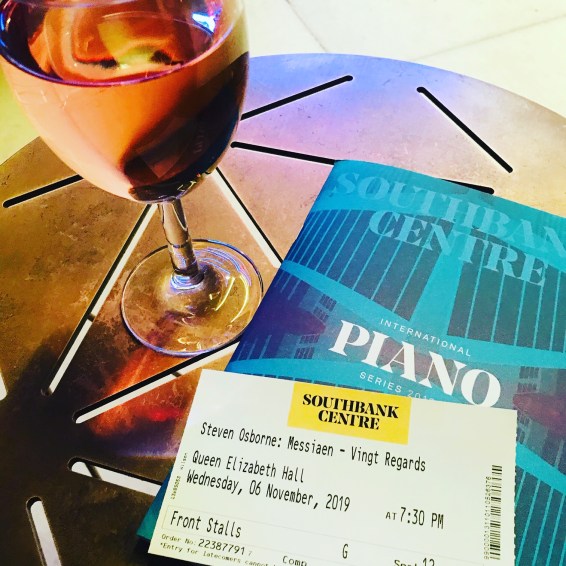
Vingt regards sur l’enfant-Jésus – Olivier Messiaen
Steven Osborne, piano
6 November 2019, Queen Elizabeth Hall, Southbank Centre
Messiaen builds cathedrals in sound. From a single candle gently flickering in a quiet side chapel to the glorious fan traceries of the main transept, the private place for solitary prayer and contemplation to the awe-inspiring painted spaces where the many gather to celebrate the glory of God, his music is monumental in its scale and breadth, a hypnotic Sainte-Trinité in sound.
And if Messiaen is the architect, then the pianist who performs his music is the guide, sometimes tenderly, sometimes violently, always colourfully leading us through the aisles and passageways, the arches and niches, past gilded icons and kaleidoscopic stained glass.
Messiaen’s Vingt Regards sur l’enfant-Jésus is arguably the greatest piano work of the twentieth century, a work which more than holds its own against Bach’s Goldberg’s or Beethoven’s 32 Piano Sonatas in its scale and breadth, its many challenges, technical, artistic and physical. It is a work of immense beauty, sensuous, powerful, sometimes brutal, thrilling, awestruck and awe-inspiring, ecstatic and intimate. It is also deeply personal and emotionally direct in its expression of the composer’s own profound Catholic faith; humble too in Messiaen’s ability to ground the music in a way that makes it accessible through his use of recurring themes and devices, in particular his beloved birdsong. These elements also give this tremendous work a cohesive, comprehensive architecture – and it is only by hearing the work in one sitting, as opposed to listening to individual movements from it, that one can fully appreciate Messiaen’s compositional skill and vision. Like a great symphony, the work moves inexorably through its movements towards a gripping finale.
I adore this music.
It begins with a whisper, barely a heartbeat, delicate chords, softly-spoken yet vividly hued (colour is so significant to the synaesthesic Messiaen) and repeated octaves, occasionally interrupted by luminous bell sounds; a profound, introspective contemplation. And then, some 130 minutes later, it ends in a blaze of glory, bells clanging across in the keyboard in ecstasy, “all the passion of our arms around the Invisible One….”
The extraordinary narrative arc and cumulative power of the Vingt Regards is akin to Bach’s Goldberg Variations, though its message is closer to one of his Passions. The expressive sweep of the work is vast, from the intimate, aching tenderness of Regarde de la Vierge (IV) to primal brutality of Par Lui tout a éte fait (VI) and the concentrated stillness of Je dors, mais mon coeur veille (XIV). As a consequence the work is rarely performed without an interval, but pianist Steven Osborne, who has been playing this incredible music for almost 20 years, believes it should be played as a whole, without a break, to create “a deeper sense of engagement with the work as a whole, for both myself and the listener.”
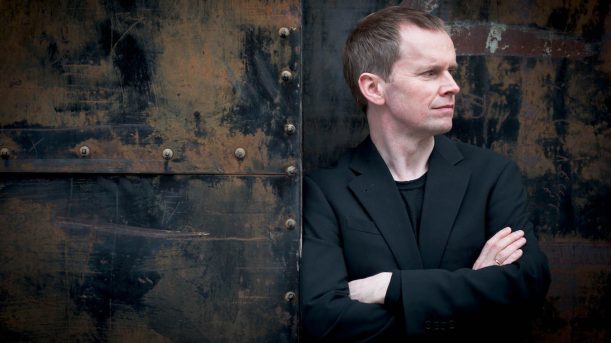
Steven Osborne
The journey is remarkable, immense, exhilarating and overwhelming. Osborne knows this music so well that one feels at once totally at ease with him guiding us on this epic voyage yet also acutely alert, as he is, to every shift in harmony and tonal colour, every nuance and emotion. Speaking to him in the bar after the concert, I remarked that he seems very settled in the music (I first heard him play this work in 2013) and he commented that one just has to “go with it”. Such a modest description of such monumentality!
His virtuosity is restrained, yet his every gesture is freighted with meaning; he creates an extraordinary range of colours and tone – translucent filigree arabesques, shimmering, flickering trills, brilliant chirruping birdsong, plangent bass chords, rumbling, rolling Lisztian arpeggios….. And all despatched with an almost effortlesss sprezzatura, the music freshly wrought, as new sonorities, new meanings are revealed.
The performance was perfectly paced, the silences as poised and significant as the notes themselves, Osborne’s clear sense of continuity allowing each movement to be heard as a single statement in its own right, while also contributing to the cumulative, architectural effect of the whole. Here the rapture and ecstasy of Messiaen’s faith was captured in a profoundly concentrated performance that reverberated with passion, spirituality, awe and joy.
The Cross-Eyed Pianist is free to access and ad-free, and takes many hours every month to research, write, and maintain.
If you find joy and value in what I do, please consider making a donation to support the continuance of the site





 The Cross-Eyed Pianist