“A fresh take on Mozart” – Guest review by Magdalena Marszalek in Amsterdam
cihp9xyw0ai77hm

11 June 2017

Mozart – Sonata in F, KV 332

Chopin – Four Ballades

Debussy – Images (Première série), L. 110

Debussy – Images (Deuxième série), L. 111


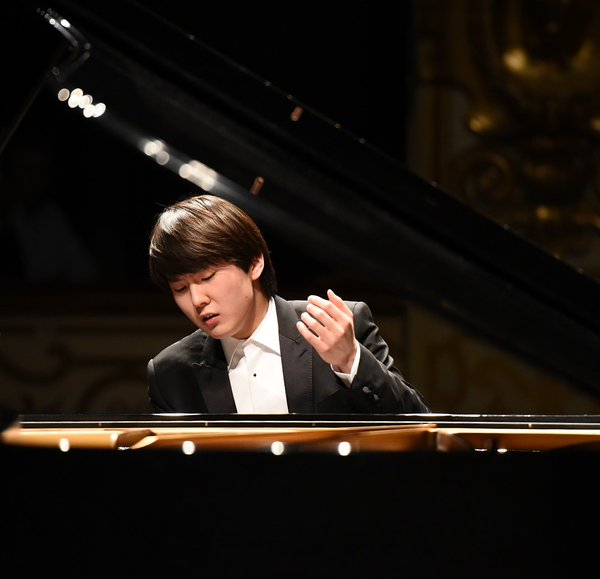
South-Korean rising star and Chopin competition gold medallist Seong Jin Cho made his solo debut in the famous Concertgebouw in Amsterdam on 11th June 2017. The concert was a part of the legendary 30-year series ‘Meesterpianisten’, organized by Marco Riaskoff. His made his debut with the Royal Concertgebouw Orchestra in the Great Hall in 2015, almost straight from the stage of the 17th International Chopin Piano Competition in Warsaw. Not very long after that, in January 2016, he returned to Amsterdam with almost a ‘pop-up’ recital in the Recital Hall and I was really lucky to grab the last seat. He presented himself proudly as winner of the most prestigious piano competition in the world and gave the audience a flavor of what he served to the esteemed jury in Warsaw a couple of months back: a Nocturne, the Sonata in B flat op. 35 ‘Marche Funebre’ and finally the Preludes op. 28, which in my opinion guaranteed him the gold medal already in the third stage.

This time, still at such young age (23), he arrived at the Concertgebouw to rightfully take the stage in the Great Hall and claim his spot among the other master pianists. There was a slight last-minute change of programme, which finally consisted of Mozart’s Sonata in F major K. 332, followed by the both books of Debussy’s ‘Images’. After the break we heard Chopin’s Four Ballades (which also appear on Cho’s latest CD for Deutsche Grammophon, along with the First Piano Concerto).

The opening piece sounded to me like a warm up, a way to test the feeling and acoustic of the hall now filled with the audience. Cho’s interpretation had everything that you would expect from a fresh take on Mozart: clarity, brightness, energy, vigour. I really appreciated that he emphasized a few polyphonic, fugue-like moments, which then later smartly contrasted with romantic fragments. The Adagio was played in an almost meditative manner and I was captivated by the way Cho produced the sound, focusing so much on exerting the right touch to yield the highest quality results. The final movement was the place to discretely show off his phenomenal technique and great control of dynamics of the instrument.

I feel that by bringing ‘Images’ by Debussy to the stage the young pianist made a statement, that he clearly doesn’t want to be labeled as a ‘Chopinist’ (Chopin-specialist – this term actually exists in Polish). Six pieces that are the essence of impressionism were performed pensively, with great confidence and the highest care to produce quality of sound. This wise choice of repertoire presented him as a mature, multi-dimensional artist. It was clear that he spent a lot of time experimenting and searching for his own identity in each of the pieces. Yet, the strongest feeling radiating from the instrument was freshness: fresh to the point that one could forget that it is still classical music – so jazzy and free, the music just flew from beneath Cho’s fingers. He showed the strongest command of the instrument; the precision with which each sound, tone and colour was executed was phenomenal. I felt that by playing Images he could fully express what he is going through, that this is what occupies his mind. His performance at this point was truly stunning, however, it felt that he is not yet done with the search for the key to these pieces and he may still work on them and experiment more. He is already very convincing in his interpretation, but youthful hunger and curiosity may lead to, hopefully, something unexpected on a new recording, perhaps? He was awarded a well-deserved standing ovation before leaving the stage for a break (the Concertgebouw audience does not do it very often).

And although the interpretation of Debussy was something new and captivating, I was most looking forward to Chopin’s Ballades. Sadly, these turned out not to be the pinnacle of the performance. Usually I am very sensitive to Chopin’s music (maybe because we are both Polish people living abroad) and often I shed a tear or two during public performances, but this time I was left just feeling puzzled. In my opinion, Cho set off too fast with the first Ballade and he could not calm himself till the end of the piece. Everything was in its place – the changing moods, the dynamics – but I cannot shrug off the feeling that it was all rushed and even nervous. The second Ballade started softly as it should, and I hoped that he had fought off the nerves after coming back from the break, but the more he got into the piece, the more chaotic it sounded. He lost clarity and brilliance in the high registers and right hand; the heavy chords in the left hand overpowered the piece. Things were back under control for the last two Ballades. Nevertheless, I was rather disappointed with the second part of the concert. However, a warm and sincere standing ovation for the debutant invited him to perform two short pieces for encores, one of them being Debussy’s ever-popular ‘Claire de lune’.

To sum up, it was a very good debut by Seong-Jin Cho, but I got the impression that the young artist felt the pressure of performing at such as prestigious venue and maybe a little overwhelmed, which showed especially in the openings of his pieces. Surprisingly, he felt most at ease when performing the more difficult to interpret Debussy, as if this was so close to him in that particular moment. On the contrary, coming back to Chopin, after the competition and all that buzz, seemed to be something that he would rather leave behind, or put aside for the time being. Seong-Jin Cho is such a young man, it is only natural that he is still searching for who he is or who he wants to become as an artist. The wonderful news is that along that search he leaves behind him beautiful, already very mature piano music for us to enjoy.

Igor Levit, Wigmore Hall, 13 June 2017

Beethoven Piano Sonatas, Opp 109, 110 and 111

I first heard Igor Levit in this sonata triptych back in 2013. It seemed a bold programme choice for a young man, yet Levit’s assertion that this music was “written to be played” makes perfect sense and is a view I’m sure Beethoven would concur with. Then I felt there was room for development and maturity, important attributes for any young artist in the spring of their professional career. Now I hear an artist who has lived with – and in – the music and has crystallised his own view about it.

He crouches over the piano like an animal coiled for attack, yet the sound in those opening bars of the Sonata in E major, Op.109, was so delicate, so lyrically ethereal, it felt as if the music was emerging from some mystical outer firmament, entirely appropriate for these sonatas which find Beethoven in profoundly philosophical mood. It is music which speaks of shared values and what it is to be a sentient, thinking human being; it “puts us in touch with something we know about ourselves that we might otherwise struggle to find words to describe” (Paul Lewis). The Prestissimo second movement, urgent and anxious in its tempo and atmosphere emphasised by some ominous bass figures, contained Levit’s trademark “shock and awe” stamping fortes and fortissimos, only to find him and the music back in meditative mood for the theme and variations, which reprised the serenity of the opening, the theme spare and prayer-like with more of that wonderfully delicate shading at the quietest end of the dynamic spectrum that he does so well.

Read my full review here


(photo ©Igor Levit)

Launched in May with a fine performance by noted fortepianist and academic John Irving, the first tranche of Kingston Chamber Concerts (KCC) closed last night with a recital by the Armorel Piano Trio, who performed works by Beethoven, Schumann and Dvorak.

The KCC formula is quite simple: quality chamber music performed by young professional artists and local musicians in the convivial setting of the East End Café at All Saints’ Church, right in the heart of Kingston-upon-Thames and its historic market place. Tables are set out salon style and the bar serves good wine at a fraction of the cost of a glass of house white at the Wigmore Hall. You can take your drinks to your table and share a bottle with friends, as I did last night.

OLYMPUS DIGITAL CAMERA

The Armorel Piano Trio comprises Kathy Chow (piano), Lucia Veintimilla (violin) and Sebastian Kolin (cello). Their programme, opening with Beethoven’s ‘Ghost’ Trio, Op 70/1 and closing with Dvorak’s ‘Dumky’ Trio, Op 90, B 166, with Schumann’s Op 80/2 the middle of the triptych, demonstrated the development of the piano trio genre, from the strictly classical three-movement structure of Beethoven, though already showing the forward-pull of Beethoven’s vision in its eerily dramatic middle movement which connected it, in this concert, to Schumann’s sweeping romanticism, to the freedom of Dvorak’s six-movement ‘Dumky’ which feels more like a suite than a trio in its organisation highly  contrasting moods and textures.

This was a very committed performance by all three musicians, and extra credit must go to the young players who had had their final recitals for their post-graduate studies at conservatoire the same day: they must have been shattered but they hardly betrayed this, and their playing really came alive in the Dvorak which was replete with folk idioms and fine solos from cello and violin, with vivid colouration from the piano, in particular in the third and final movements. The Schumann was genial, laced with a bitter-sweet poignancy (the work was written in 1847, the year of the deaths of the Schumanns’ son Emil and Felix and Fanny Mendelssohn), and Armorel really caught the fleeting mercurial moods of this music.

The Beethoven, meanwhile, provided drama of a different kind, with much boisterous dialogue between violin and cello in the first and final movements, and colourful interplay between the piano and the other instruments. The slow movement was freighted with Gothic gloom, with its fragmented themes, uncertain harmonies and eerie tremolos in the bass of the piano. This was a movement of great tension, rich in quasi-orchestral textures.

This was a fine end to the first three concerts in KCC’s six-concert first season and the sizeable audience prove the series is already off to a very good start. The series resumes on Saturday 16 September with Ceruleo, an early music ensemble, whose concert entitled ‘Love and Betryal in the music of Handel and Barbara Strozzi’ includes performances on harpsichord, theorbo and Viola de Gamba.

For further information about Kingston Chamber Concerts/join their mailing list, please contact kingstonchamberconcerts@gmail.com, or telephone 020 8549 1960

Guest review by Magdalena Marszalek

 Grigory Sokolov – Meesterpianisten series recital, The Concertgebouw, Amsterdam 7th May 2017

Programme

  • Mozart – Sonata in C, KV 545
  • Mozart – Fantasie in c, KV 475
  • Mozart – Sonata in c, KV 457
  • Beethoven – Sonata no.. 27 in e, op. 90
  • Beethoven – Sonata n0. 32 in c, op. 111
  • Schubert – Moment Musical in C, D 780, No. 1 (encore)
  • Chopin – Nocturne in B (from ‘Deux Nocturnes’, op. 32) (encore)
  • Chopin – Nocturne in As (uit ‘Deux Nocturnes’, op. 32) (encore)
  • Rameau – 4e Concert : No. 2 L’Indiscrète (from ‘Pièces de clavecin en concert’) (encore)
  • R. Schumann – Arabeske in C, op. 18 (encore)
  • Chopin – Prelude in c (from ’24 Preludes’, op. 28) (encore)

There is no need to introduce Grigory Sokolov to anyone interested in the piano world today. He is an implicit giant, who does not seek nor need advertising, unnecessary media attention, flash-bulbs and buzz. He is above all that, yet so powerful in his modesty. His performances do not contain obvious technical fireworks. If you like this kind of showing off, there are other names you should look to. His performance will affect you first from the inside, starting slowly, almost shyly – and then it will swallow you and possess you whole.

Sunday 7th May 2017 was Sokolov’s 19th recital in a row (!) in the famous Meesterpianisten series in Amsterdam, which this year celebrates its 30th annivcersary. He chose to present two piano sonatas by Mozart (C major K 545 and C minor K457 with the Fantasy K. 475) and two sonatas by Beethoven (E minor op. 90 and C minor op.111). The first sonata, known as the “easy one” (Sonata Facile), may be a surprising opening piece. Heard so (too) many times, performed by all manner of child prodigies, only when under the fingers of a mature pianist does it bloom to its fullest. Still, I would consider it as a warm up before the Fantasy, where Sokolov visited every dark corner there was and brought to light every nuance of this piece. Cruising between the different moods, emotions and styles of this work, he immersed the audience in his mystical world. His natural transition to the sonata invoked the feeling of some unspoken deep, dramatic questions. Yet, his interpretation was not overly dramatic, which left the listeners even more emotionally disturbed and intrigued. It made me realized how this classical piece, decorated with almost baroque fugue elements, shyly and unintentionally hints towards a new era. Nevertheless, the genius of Mozart transcended his own time, just as the genius of Sokolov eclipses other performances.

After the first standing ovation and a break, the pianist came back to present the two sonatas by Beethoven, op. 90 and op. 111. My overall impression of the tone and colour was that the Steinway concert piano sounded much better in this repertoire. Multi-dimensional, Beethoven’s voice sounded much broader and bloodier than the rather flat and crystalline Mozart. Sokolov played the sonata E minor in a more contemplative way than I knew it and throughout his performance I realized that slowing down the tempo, even a little bit, might lead to great discoveries. Again, this sonata – like the Sonata Facile which opened the concert – was more like a prelude for the op. 111. A beautiful second movement resembled a ray of sun before the serious C minor piece commenced. Sokolov played the first movement of op. 111 so meditatively that the audience grew a little uneasy, guilty about barging into such a deep and intimate conversation he was having with a piano. But it was so compelling you simply want to be a part of it… I was curious how Maestro Sokolov would interpret the “rag-time”/syncopated elements of this sonata and I really liked the elegant, understated way in which he handled these rhythms with a little swing in a more playful way.

One can only guess at the maestro’s intention in building such a programme, but for me it was a beautiful journey, using the definition of a classical sonata as its point of departure. Sokolov presented the evolution of the form beautifully, and he chose pieces where the composers, even though firmly grounded in the aesthetics of their respective times, were already emotionally climbing on their tiptoes to see and feel what the future could bring. As a performer, he cleverly highlighted these musical fast-forwards and truly let the music shine. And by doing this he actually could not confirm any more strongly the impact that his personality exerts on the music. He shows so much respect to the music that when he touches the keys he gives the impression that he has disappeared and the only thing that is left in the hall is a beautiful, omnipresent sound. And yet this is not true – because he is everywhere, in every soul who is privileged to sit in the room with him.

The Concertgebouw audience cherishes and almost worships Maestro Sokolov, so a great set of encores was obviously going to follow a thundering standing ovation. He started with Schubert’s Moment Musical no. 1 in C major, and then went on to play two Nocturnes op. 32 by Chopin. He played them last year in the Concertgebouw, and I was not the only one with tears in my eyes, especially after the first Nocturne. That was the most emotional moment of the evening and it unlocked a new, deeper level of emotions in many listeners. He then played L’Indiscrete by Jean-Philippe Rameau and Schumann’s Arabeske in C major op. 18, which I also remember from last year. Again, a lesson should be learned that it does not necessarily pay to show off with tempo, even with a relatively easy piece like this, because one can overlook small pearls and diamonds in this charming work. The final encore was the Prelude op. 28 no. 20 (“Funeral march”) and it is impossible to describe what he did with this short piece! Sokolov turned that prelude into a musical haiku, and through masterful use of dynamics he evoked the weight of death with just the faintest shade of hope. No one else is capable of doing that.

Magdalena Marszalek

Amsterdam 8th May 2017
Magdalena Marszalek is an amateur pianist. She taught herself how to play and read music when she was 5 and then graduated to a primary music school in Poland. She did not pursue a professional career in music and went on to become a scientist (PhD in chemistry), however, piano music has accompanied her and inspired her all along. Currently residing in Amsterdam, when not working on new types of solar cells, she spends many hours at the piano practising and playing for pleasure – mostly Chopin, because he was a Polish emigrant, too. Very often she hops on her bike and in 10 minutes she is in the Concertgebouw, enjoying stellar performances by the finest musicians in the world. Realizing how lucky she is, she wants to share her passion for piano music with everybody. 

Magdalena’s piano story on instagram: @princess_mags_piano


