Pianist Igor Levit is one of the heroes of lockdown – a “key worker”(!), if you will, who provided comfort and distraction in those anxious, early days of the pandemic. At a time when the concert halls of the world were shuttered and silent, Levit gave hauskonzerts from his home in Berlin, broadcast live on Twitter. Each day he would announce a programme and a time to tune in. He streamed more than 50 concerts, performing on a 1920s Steinway B that had once belonged to the Swiss pianist Edwin Fischer. He dressed casually and gave a brief introduction to each performance in German and English – no need for the formality and etiquette of the Wigmore Hall here. He played Bach and Schubert (a tear-jerkingly wonderful D960), Beethoven and Feldman, and people tuned in from around the world. His daily house concerts provided an anchor in a troubled sea.

Maybe for the first time do I understand what it means to speak of music as something life-keeping. It really keeps me alive. . . . I don’t care if it’s wrong or right, whatever B.S. that means….” said Levit in an interview with Alex Ross of The New Yorker. His house concerts challenged our notions of what a concert really is, reminding us that we don’t have to sit in stiff, reverential silence in plush red velvet seats to feel the power of the collective shared experience of music. Separated by a global pandemic, confined to our homes, music connected us, delighted, soothed and comforted us.

Levit’s new album, Encounter, which comes just two years after the release of ‘Life’ (my album of the year in 2018), confirms the spirit of his hauskonzerts. Here is music by Bach-Busoni, Brahms-Busoni, Reger and Feldman that seeks to comfort the soul and provide inner strength while expressing a desire for encounters and togetherness in a world fractured by a global pandemic. Like ‘Life’, it is another very personal album for Levit, the repertoire carefully chosen: these are “works in which all questions about love and death, loneliness and the possibility of real love for others are examined“. The pieces on ‘Encounter’ were those which drew especially positive comments from Levit’s online audience.

The entire album has a processional quality, leading the listener to the hushed serenity of Morton Feldman’s final work for piano – and the final work on this disc – Palais de Mari, a 28-minute contemplation, meditation, or what you will, of exquisitely-placed notes and piquant chords that fall upon the ears and mind like the softest of summer showers. It works in the same way as Bill Evans’ ‘Peace Piece’ did on ‘Life’ – the sentiments of the music match the intensity and spirituality of the works that precede it, yet it also provides a contrast in its delicate minimalist textures and hauntingly spacious pauses.

No one questions the spirituality of J S Bach, but Levit thankfully steers away from an overly-reverential approach which colours so many performances of his music. Alert to the contrasting characters of the Chorale Preludes, elegantly and occasionally flamboyantly transcribed for solo piano by Ferruccio Busoni, Levit finds vibrancy and immediacy, authority, solemnity and joy, and draws on the full range of the piano’s sound and resonance to highlight the voices and layers of this music.

Brahms’ six Chorale Preludes, also transcribed by Busoni, are rarely-heard as a set, and Levit successfully sustains the devotional, introspective nature of these pieces, almost to the point of intimacy. Reger’s transcriptions of Brahms’s Vier ernste Gesänge (Four Serious Songs) are similarly pensive, and Levit’s sensitivity of touch and musical imagination save them from becoming overwhelmed by the richness of their textures.

Reger’s Nachtlied, a sacred motet for unaccompanied mixed choir, provides the bridge to Feldman in this transcription for piano by Julian Becker. Its textures are more transparent, its mood gentler and more prayer-like, settling the listener in for Feldman’s music, which gradually retreats into its own world with a sense of closure and inner calm.

The album was recorded in May at Berlin’s Jesus-Christus-Kirche and is best heard in one sitting, as if as a recital – because here Levit manages to create a very palpable, highly concentrated musical presence throughout the recording.

‘Encounter’ is available on the Sony Classical label and via streaming services

Ann Martin-Davis, piano (Guild Music)

519yhdkc-cl._sy400_Maurice Ravel has been an enduring part of pianist Ann Martin-Davis’ musical life and in the liner notes to her new collection of his piano music, she relates an anecdote which gave her a special connection to the composer. Having played the middle movement of Ravel’s Sonatine to the renowned pianist and teacher Phyllis Sellick who was adjudicating a competition, Ann became Sellick’s “newest (and smallest) recruit”. Sellick revealed that she too had played the very same movement to the composer himself (introduced to him in Paris through her own teacher, Isidore Philipp), who had remarked that it was “pas mal” (“not bad”). When Ann asked her teacher what Ravel was like, Sellick replied that he was “all pointy – pointy hair, pointy nose, pointy clothes”. 

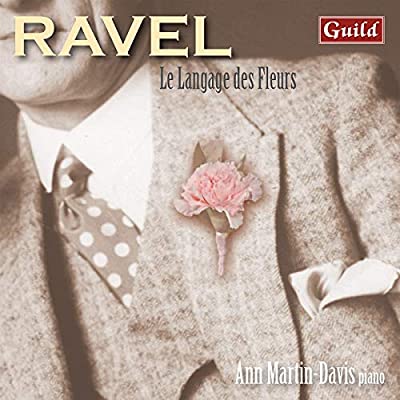
Ravel had a reputation for meticulous dress and reserved social manner. The image on the cover of the CD liner notes shows Ravel in an elegantly-cut tweed suit with a single carnation in his button hole, and this perhaps hints at the musical personality too: colourful, sensuous and flamboyant, but also intimate and tender.

Le Langage des Fleurs, Ann Martin-Davis’ new disc of Ravel piano music includes the much-loved Pavane pour une infante défunte, Sonatine, Tombeau de Couperin and a selection of the Valses Nobles et Sentimentales, as well as shorter piano works and miniatures. As part of her research for the recording, Ann read (and recommends) Professor Michael Puri’s groundbreaking book ‘Ravel the Decadent’, which places Ravel’s music in the context of the late nineteenth-century cultural and artistic phenomenon of Decadence, rather than that of the Neo-Classical or Symbolist labels more normally applied to his music.

This is certainly confirmed in Ann’s approach to the music. While there’s a fin de siècle poignancy and intimacy to the Valses Nobles et Sentimentales, elegance is tempered by an almost naughty playfulness and a hip-swinging sensuousness to the waltz rhythms, suggesting hidden pleasures of a more taboo kind. This is music redolent of the scent of Gauloises, Pastis – maybe even a hint of Absinthe –  cologne, and the heavy heat of the Med in high summer. Ann’s supple tempi and pitch-perfect rubato are balanced by crisp articulation and a lovely translucence of tone.

This is even more evident in the Tombeau de Couperin, Ravel’s hommage to thekeyboard suites of the great French clavecinistes Couperin and Rameau, and also a dedication to friends of the composer who died during the First World War. A bright, direct sound brings immediacy and drama while also highlighting the Baroque structures of this music. But it is not without emotion – far from it, in fact, especially in the Menuet, which is wistful and tender. The final movement Toccata, by contrast, sparkles with vigour, Ann’s airy, fleet-fingered touch bringing its figurations to life with vivid colour and imagination.

The music on this disc represents about half of Ravel’s output for the piano, and the smaller works, such as the insouciant À la manière de Borodine and the Meneut sur le nom de Haydn, sit well with the longer suites. The selection closes with the much-loved Sonatine, utterly beguiling in its delicacy and simplicity, impeccably and imaginatively interpreted by Ann.

If you, like me, were not able to get to the south of France on holiday this year (my holiday, like so many others, had to be cancelled due to coronavirus), this disc is a delightful evocation of the heady scents, sounds and ambiance of that part of France.

Recommended.

British pianist Sarah Beth Briggs has built her reputation on performing and recording the “core canon” of piano repertoire, and she has a particular affinity with the music of Haydn, Mozart and Schubert. Her playing is always elegant and tasteful, intelligent and sensitive, and in this new release she brings all these qualities to repertoire which she clearly adores.

‘The Austrian Connection’ traces the compositional links between four Austrian composers: Hans Gál (1890-1987) was perhaps the last great composer to uphold the tonal Austro-German tradition that began with Haydn and Mozart, and, arguably, reached its apogee in the music of Schubert (and also Brahms). Sarah Beth Briggs is a keen advocate of Hans Gál’s music – she made a world premiere recording of his Piano Concerto in 2016 – and the three preludes included on this disc perfectly complement the three sonatas which precede them.

As the focus of this disc is on Austrian connections, it is perhaps fitting that the opening piece is Haydn’s variations on “Gott erhalte Franz den Kaiser”, Austria’s first national anthem. From a simple hymn theme, a set of four variations follow, and where one might expect grandeur, given the theme’s significance, Sarah instead offers an intimate and charming account which provides the perfect introduction to one of Haydn’s best-known and loved piano sonatas, Hob. XVI/50 in C.

This sonata was written in 1794, during a visit to London, where Haydn discovered and – if this sonata is anything to go by – delighted in the sonorities of the English fortepiano. He fully exploited the instrument’s boldness, resonance and range, and expanded technical capabilities, in a sonata which is rich in inventiveness, characteristic wit and joie de vivre. The quirks and frivolity of the outer movements are contrasted with an Adagio whose beautiful cantabile qualities Sarah fully appreciates in an elegant and spacious reading. The translucent clarity of the piano sound in the upper registers is somewhat reminiscent of a fortepiano (though without the latter’s distinctive “twang”!).

By contrast, Mozart’s Sonata in A minor K310 is restless and urgent, full of striking drama and dissonances, but like the Haydn before it, this sonata has a slow movement of operatic lyricism, interrupted by a turbulent middle section. Sarah is sensitive to the music’s chiaroscuro, responding deftly to Mozart’s mercurial emotional shifts and the underlying intensity of this work.

In the Sonata in A, D664 we find Schubert at his most genial, though that affability is offset by the shadowy poignancy and tender intimacy of the middle movement. However, a sunny mood is soon restored in the finale, a movement of joyful light-heartedness. Sarah achieves a persuasive warmth of tone and sensitive phrasing which highlights the glorious song-like melodies in this sonata. There is chiarscuro and drama aplenty here too, and once again, these emotional voltes faces are handled with an eloquent sensitivity (Sarah is not a pianist who exploits the “psychobabble” surrounding Schubert’s life, preferring instead to focus on the details within the score to allow the music to speak for itself).

Hans Gál’s ‘Three Preludes’, composed in 1944, have classical characteristics interleaved with distinctly modern twists: the pithy quaver figurations and playful cascades, and quicksilver wit in the first and third Preludes are redolent of Haydn, while the middle one, “Lento Tranquillo”, recalls Schubert in its graceful melody and introspective demeanour. Sarah brings virtuosic sparkle to the first, a quiet, reflective poetry to the second, and a beguiling humour and lightness of touch to the third, which disappears into the ether in a delicate flurry of notes.

An enjoyable “recital disc”, which takes the listener on a varied and stimulating Austrian musical journey.

‘The Austrian Connection’ was recorded in January 2020 at The Clothworkers Centenary Concert Hall in Leeds, produced, engineered and edited by Simon Fox-Gál, and released on the Avie label

Meet the Artist interview with Sarah Beth Briggs

71iqtbpqvfl._ss500_John Ireland      Sarnia: An Island Sequence

John Ireland      The Island Spell

Tchaikovsky      The Seasons Opus 37a

Tom Hicks, piano


At first sight, pairing a twentieth-century British composer with a nineteeth-century Russian romantic seems an unusual combination, but in this debut disc by young British pianist Tom Hicks the music of these two composers sits well together, creating an enjoyable recital disc of music inspired by nature and infused with pastoralism.

The disc opens with ‘Sarnia’, whose first two movements were composed in 1940 while John Ireland was staying on Guernsey, shortly before it was occupied by the Germans. There is a nice connection between music and pianist here as Tom Hicks hails from Guernsey; ‘Sarnia’ is the Roman name for the island. This atmospheric, dramatic and expansive work portrays aspects of the island and Hicks’ sensitive attention to detail and understated bravura brings this music fully to life with colour, spacious expression, pungent sonorities, and a tender poignancy when required.

‘The Island Spell’, inspired by Jersey and the earliest of Ireland’s Channel Islands pieces, is evocative and impressionistic, redolent of Debussy’s perfumed harmonies and filigree traceries (Ireland was described as an “English Impressionist”), its delicate textures rendered with grace and clarity.

Tchaikovsky’s ‘The Seasons’ follow, a suite of 12 miniatures which encapsulate the composer’s distinct style in microcosm. These characterful, contrasting works are the perfect canvas for Hick to paint a full palette of colours and expression, capturing their intimacy and wistfulness, with a keen ear for details and textures.

Overall, an enjoyable and engaging debut recording from this impressive young pianist.

Recommended