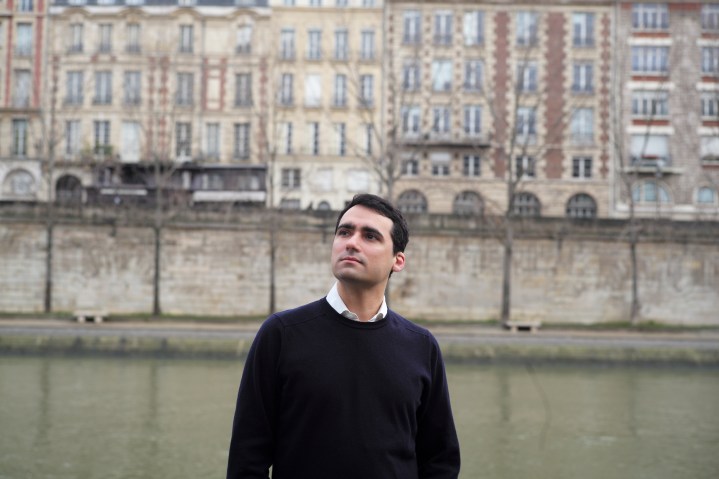
Fauré, Poulenc, Messiaen: Preludes & Nocturnes – Tal Walker, piano

A keen advocate and performer of French piano music, the young Israeli-Belgium pianist Tal Walker explores three masters of French pianism in his debut disc of music by Fauré, Poulenc and Messiaen.

The idea of miniatures (Preludes and Nocturnes) written by French composers at the beginning of the 20th century has always interested me. These are improvisatory-like pieces, rather short and therefore combined in a cycle. These pieces give free rein to the composer’s imagination and reveal a sometimes more secretive side of their personality. – Tal Walker, pianist

The disc takes the listener on a fascinating musical journey, charting these three composers’ exploration of the miniature form and revealing connections within each cycle, while also demonstrating their own distinct musical voices and soundworlds, from the perfumed late romanticism of Fauré to Poulenc’s witty neo-classicism to Messiaen’s mystical harmonies and exotic rhythms.

Fauré composed his set of nine Preludes at the end of his life. Historically overlooked by performers, these miniatures are infused with the richness of late 19th-century romanticism yet look forward to modernism in some of their tonalities and harmonies. Highly imaginative and improvisatory in nature, they hark back to the Preludes of Chopin in their variety, fleeting moods, lyricism and whimsical charm. Tal Walker responds to the mercurial nature of these pieces with fluency and nuance, allowing the listener to enjoy and appreciate the multi-layered textures of these tiny gems.

Poulenc’s Nocturnes were composed between 1929 and 1938, and unlike the nocturnes of John Field or Fryderyk Chopin, these pieces are ‘night-pieces’ more in the manner of Bartok’s The Night’s Music. Some are dream-like, almost childlike in their simplicity. Others are nostalgic, some are humorous and ironic (No. 4 in C minor, for example, is a wry waltz), and many evoke the various personalities of the composer’s friends and intimates, either in the form of a miniature musical portrait or a dedication. There are touches of Stravinsky in the harmonic language in some, while others are richly melodic. The many moods and contrasting voices of these delightful pieces are showcased in Walker’s thoughtful, sensitive playing.

The Eight Preludes of Olivier Messiaen were composed 1928-29. They are clearly influenced by the impressionism of Debussy, with unresolved or ambiguous veiled harmonies, and parallel chords which are used for pianistic colour and timbre rather than definite harmonic progression, but Messiaen’s Preludes are also mystical rather than purely impressionistic, and look forward to his great and profoundly spiritual piano works, Visions de l’Amen (for 2 pianos) and Vingt regards sur l’enfant Jesus. In this suite of early pieces it is already clear that Messiaen was carving a distinct compositional voice of his own with his distinctive modes, birdsongs and a profound sense of mysticism and spirituality.

.

It is perhaps in these pieces that Tal Walker really shines most of all, revealing his skill, musical intelligence and maturity. Whereas in the pieces by Fauré and Poulenc we find a warm lyricism, to the Messiaen Walker brings a slight stridency and brightness of tone (a very ‘French’ style of piano playing) which highlights the many contrasting colours, timbres and textures of this music.

This is an impressive and rewarding debut disc and a fascinating hommage to French pianism by a young pianist who was taught by, amongst others, Madame Françoise Thinat, who herself studied with or was influenced by Yvonne Loriod (Messiaen’s second wife), Marguerite Long (who premiered Fauré’s Preludes), and Yvonne Lefébure. This musical heritage is evident in Walker’s thoughtful, nuanced playing, as if he has fully absorbed the great tradition from the past and melded it with his own personal artistic vision.

Fauré, Poulenc, Messiaen: Preludes & Nocturnes is available on the Collection Cabinet de curiosités record label and also on Spotify

An earlier version of this review appeared on the InterludeHK website

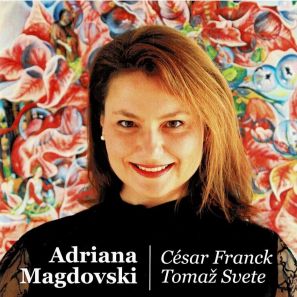
This new release from Slovenian pianist Adriana Magdovski pairs César Franck’s mighty Prelude, Chorale & Fugue with a piano sonata by leading Slovenian composer Tomaž Svete (b. 1956), which is dedicated to Magdovski.

Although composed just over 100 years apart, there are clear musical, textural and thematic connections between the two works; for example, the Svete includes a Passaccaglia, Corale and Fugue, and the Svete Sonata, although unmistakably modernist in its harmonic language, opens with a fantasy-like movement which mirrors the improvisatory atmosphere of the Prelude of the Franck. Magdoskvi handles both deftly: in the Franck, she achieves a wonderful sense of spontaneity in the Prelude, with its shimmering opening arpeggios, balanced by a masterful command of the material. Tastefully-judged rubato is complemented by precise articulation and a range of dynamic colour to bring drama and sensuality to this opening movement.

The Choral opens with a graceful seriousness, the “chorale” theme elegantly presented. The rolling arpeggiated chords which embellish the theme are masterfully played. One has a true sense of the grandeur of this music in Magdovski’s hands, as she allows the music to build in stature throughout the movement. Her attention to detail is impressive, as is her appreciation of the music’s architecture. This is particularly apparent in the Fugue which is virtuosic yet thoughtful. Overall, a very accomplished and authoritative account.

The Svete Sonata provides an interesting, more linear contrast to the voluptuous, polyphonic textures of the Franck, yet shares much of the same seriousness. Magdovski proves to be equally at home in this repertoire as in the Franck. With graceful phrasing, sensitively nuanced dynamics and a clear sense of the music’s structural and emotional narrative, this is an impressive companion to the Franck.

Piano Sonatas D664, 769a & 894 – Stephen Hough (piano). Hyperion, 2022


In his memoir ‘Every Good Boy Does Fine’, American pianist Jeremy Denk says of Schubert, “He likes to let his ideas spread out, like pets that hog the bed.” He’s referring specifically to Schubert’s penchant for length or expansiveness, most evident in his late piano sonatas. This is not a criticism from Denk; later in the same paragraph he goes on to explain how Schubert uses his “heavenly length” to accumulate meaning.

In the first movement of Schubert’s G major piano sonata, D894, which opens this new recording from recently-knighted Stephen Hough, the ideas are certainly spread out, each clearly delineated, from the chordal, prayer-like first subject to the delicately dancing second subject (where the cantabile clarity of the upper registers of the piano is utterly beguiling in Hough’s hands), yet without the longueurs of Richter’s interpretation (and such a slow tempo really only works in Richter’s hands!). Hough favours a molto moderato which moves forward with vigour and colour when required but also allows time to savour all the details and nuances of this wondrous first movement.

The second movement is genial and intimate, a simple aria elegantly sculpted by Hough, reminding us that this is music for the salon rather than the concert hall. Hough really appreciates this, creating intimacy and introspection through supple phrasing and rubato, pauses (so important in Schubert’s music to create drama and breathing space) and tasteful pedalling.

The third movement scherzo revisits the chords of the first movement, this time in B minor, its robustness quickly offset by another dance figure. The trio, almost entirely in ppp, weaves a pretty melody around a handful of notes, with an offbeat bassline, like the memory of a forgotten Viennese waltz. And when the music shifts into the major key, it is almost more tender and poignant than when Schubert is writing in the minor key. The rondo finale is also a dance, graceful yet playful, occasionally insistent, played with an elegant clarity and some delicious bass details.

A curious interlude between two complete sonatas comes with the unfinished sonata fragment in E minor, D769a, a mere 1 minute of music yet profound and inventive in its expression. It finishes on a repeated figure, pianist and listener suspended, wondering where Schubert might have gone next with this music.

The Sonata in A, D664, is wholly delightful, Schubert at his most good-humoured. The affable first movement sings in Hough’s hands, while the second movement is thoughtful, poignant and tender, marked by gently sighing phrases. The sunny mood is soon restored in the finale, to which Hough brings a joyful light-heartedness with its tumbling scales and dance-like passages.

The recording was made on a C Bechstein Model D piano and there’s an intimacy and warmth to the piano sound which perfectly suits Schubert’s introspection, while a bright but sweet treble brings a lovely clarity to the melody lines and highlights Hough’s deftness of touch.

Guest review by Adrian Ainsworth


Edna Stern’s latest release is a fascinating find. Beautifully performed, for sure, but those performances are led by an intriguing, impeccably realised idea.

The pieces on this disc are well-loved and oft-recorded: the first four ‘Impromptus’ (D899) and the ‘Moments Musicaux’ (D780). But Stern, following the courage of her convictions, has arrived at a new way of hearing them. Or perhaps, more accurately, a very old one.

The artist’s sleeve-notes explain the background at length, and if you buy this album, you’ll find they are an excellent read. So I will just try to summarise here. Broadly, Stern became disenchanted with modern digital recording – in particular, the facility to edit performances into ‘perfection’. To the non-expert listener, what can sound like a seamlessly executed rendition of a work is sometimes a painstakingly finessed collage from multiple takes. Flashes of divine inspiration that don’t conveniently occur within the same run-through are made to do so, after the fact.

This came to a head, Stern tells us, when working with a sound engineer who produced an edit that was stitched together to the point where she could barely recognise her own interpretation. For this project, then, each of the ten pieces is represented by a single, intact take. Of course, Stern recorded them several times in order to choose her favourite, but no artificial mix-and-match took place. She picked the versions she found the most interesting or appealing, if not necessarily the most accurate: the integrity and spirit of the performance outweighed the occasional stray note or tempo.

One of the reasons I enjoyed Stern’s booklet essay so much is the extremity of her position. While she acknowledges the value and skills of everyone involved, she calls that game-changing edit a ‘monster’, and likens the studio correction of mistakes to offering a performance from a robot over a human. It’s forcefully argued stuff.

And thought-provoking. Schubert-lovers who are tripping over Impromptu recordings – anyone with shelves (or hard-drives) full of versions of their favourite works: what are we looking for? I realise there’s an element for many of seeking an ideal version that matches the one in their head, of looking for the ‘best’… and I don’t envy critics who have to make these sorts of comparisons all the time. But what it’s really about, surely, is hearing the works you love ‘renewed’, enjoying the surprise and delight of seemingly infinite reinterpretations of the same music.

You could argue that, most of the time, these differences survive modern recording techniques. What must be Stern’s worst nightmare – correcting every error or deviation from the score so that every pianist’s Schubert CD comes out identical to all the others – hasn’t come to pass. But by removing the safety net, Stern has thrown down a gauntlet of sorts – will other classical musicians follow suit and subject their unvarnished playing to scrutiny?

I use the word ‘classical’ here deliberately. Pristine clarity may be the common goal in this genre, but over on the rock side of the fence, many acts have often wanted to go back to the source, in their search for authenticity. There’s the huge number of bands who went through the ‘Unplugged’ rite of passage in the 90s. There are producers like Steve Albini, who seems to carry out the intensive labour upfront, listening to his clients and finding exactly the right place for the microphones in the room – then documenting the resulting live sound, with staggering results. There’s the formidable roster of groups – perhaps most famously, the White Stripes – who have made records at London’s Toe Rag Studios, renowned for their totally analogue set-up.

There is a rock-snob trap here, of course: “when it’s me, it’s authenticity – when it’s you, it’s nostalgia”. But Stern is totally alive to this, seeking to recapture the sound of the recordings she loved most during her early development. Has she succeeded?

When you start ‘Schubert on tape’, you could be forgiven for thinking you’d just lowered the stylus on to vinyl, or pressed the clunky play button on a cassette player. You hear the room before the piano. Instead of a CD’s usual dead silence, you hear an ambient noise that I instantly want to describe as ‘warmth’: it’s not disruptive, there’s no hiss or clicking, just a hushed presence that replaces any potential dryness or sterility.

There’s no doubt about it. I was hit by two waves of entirely pleasurable nostalgia. One, true: my youth, playing records and tapes in my room. Two, false: the feeling evoked by Stern of being at a Schubertiade, hearing the composer perform his work in intimate, informal surroundings.

Because once the music starts, you are there in the room (especially if using a decent pair of headphones). You can hear some of the pedal work – towards the end of Impromptu No. 4, for example, there’s a passage where this almost becomes a percussion feature – and the rise and fall of the keys, even (I think) accompanied once or twice by the click of a fingernail. This sustained, audible ‘physicality’ really brings home the effort involved in a good performance and, in the salon of the imagination, makes you feel genuinely close to the player.

I think there is also a pleasing effect on the dynamics. I was reminded of something the rock writer David Hepworth said on a podcast, when discussing the merits of vinyl over CD – almost his instant response was: “The drums don’t hurt.” Analogue recording as evidenced here has a generosity of scope – I can hear that Stern is across every pp and ff, and all points between, but the sound never becomes a bang or a whimper – it’s all accommodated in the bandwidth.

We hear chiming, keening top notes and a gorgeous bass rumble – particularly in, say, Impromptu No. 2 or Moments Musicaux No. 2 – reminiscent of a fortepiano (I was interested to read that Stern also plays this instrument). The dexterity and sensitivity of Stern’s playing is still immaculately conveyed, shining through – while benefiting from – the tape’s ambience.

As a result, I think Stern’s particular strengths and this style of recording are perfectly aligned. A successful experiment, then – I look forward to seeing the research continue, and hearing which composer becomes its next subject.

Schubert on Tape is available on the Orchid Classics label

This review first appeared on sister site ArtMuseLondon.com


105491206_266430451442172_334752493078903436_nAdrian Ainsworth is, by day, a copywriter specialising in plain language communications about finance and benefits. However, he spends the rest of the time consuming as much music, live or recorded, as possible – then writing about it, often on Specs, his slightly erratic ‘cultural diary’ containing thought pieces, performance and exhibition write-ups, playlists, and even a spot of light photography. He has a particular interest in art song and opera… and a general interest in everything else.

Twitter @Adrian_Specs