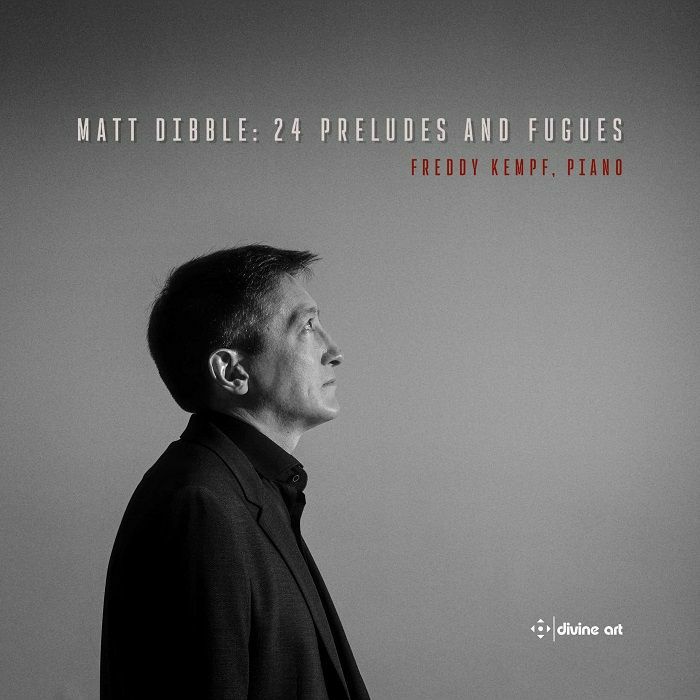
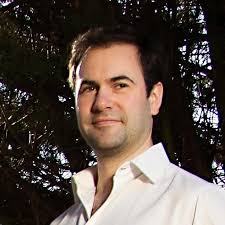
British composer and multi-faceted musician Matt Dibble died tragically in 2021 at the age of 40 from complications following the AstraZeneca covid vaccination. His untimely death left a void in the classical, jazz and pop worlds: he was a musician of great breadth, versatility, talent and innovation, and his 24 Preludes & Fugues, released posthumously, are a testament to this, blending neo-Baroque, jazz, easy listening pop, klezmer and folk music, and modernist influences into a deeply personal collection created over six years.

Only a handful of close friends knew of the ‘Preludes and Fugues’, which Matt began in 2015 and composed very privately, completing the set within mere weeks of his passing. Such was his devotion to this project that, when he first went to hospital, he told those with him where the compositions could be found, should anything happen to him. With the secrecy and longevity of the project, and the incredible timing of its completion, the story behind this music is akin to a romantic tragedy.

Read the full story on ArtMuseLondon.com


This site is free to access and ad-free, and takes many hours to research, write, and maintain. If you find joy and value in what I do, why not

Mozart wrote 18 piano sonatas and American pianist Orli Shaham has recorded all of them for the Canary Classics label, the final two volumes of the series being released in February this year. These sonatas have an enduring appeal, for players, both professional and amateur, and audiences alike.

For Orli Shaham the fascination with Mozart’s piano music began at an early age: this recording is the result of an exhilarating 40-year journey through the sonatas, getting to know them intimately, studying them deeply to appreciate their individual characters, and to understand the composer’s musical methods and motivations. “Was he trying out that piano? Was he writing for someone’s daughters? I want that something from every single one of them.” (Orli Shaham)

The recording was made in August 2019 and August 2020, at Mechanics Hall in Worcester, Massachusetts. The timing was deliberate to ensure consistent humidity in the hall: the result is a wonderful clarity and evenness of sound.

The piano sonatas reveal Mozart’s compositional genius in microcosm – from big orchestral gestures and brass fanfares to chamber music textures and eloquent operatic arias. Shaham pays great attention to the changing textures of Mozart’s writing but also his chiaroscuro – those remarkable emotional shifts from light to dark and back to light which occur in phrases or indeed a single bar. This is most evident in the slow movements where Shaham finds particular intimacy, poignancy and depth of expression – for example, as here in the Adagio from the sonata no. 2 in F Major, K.280:

There’s a delightful clarity too, in Shaham’s approach, with impeccable attention to details of dynamics, phrasing and articulation combined with tasteful use of pacing and rubato to create drama (take the opening movement of the sonata K.310, for example, where she takes time to appreciate the increasing operatic tension). There are moments of wondrous spaciousness, especially in the slow movements, where the contrasting hues of Mozart’s compositional palette are really brought to the fore.

I interviewed Orli Shaham to find out more about the pleasures and challenges of recording the complete Mozart piano sonatas

Congratulations on completing your recording of Mozart’s piano sonatas. What have been the particular challenges and pleasures of recording this cycle?

From a pianistic point of view, the greatest pleasure has been feeling Mozart’s hand at the keyboard and the way that he must have used his musculature, the technique. When you play all of these sonatas you feel like you know how it felt to be inside his hands and some of the brilliant ideas that he came up with of getting your fingers around the keyboard in virtuosic and delightful ways.

The complete sonatas run from his earliest maturity to quite late in his output. Therefore, the musical trajectory of how he put together notes, how he was thinking from a formal point of view, how he was thinking of the storytelling of a sonata and how the audience would be engaged throughout that whole time, that’s been a tremendous pleasure to learn from him.

The challenges are many. Mozart had a tremendous technique, so the sonatas are challenging to play because he was such a master of the keyboard and was so free to express himself in so many different ways. Internalizing what that is and getting to the place where I felt comfortable to convey as many of his intentions as possible, was certainly a wonderful challenge from the beginning.

There’s no question that part of the challenge of playing his sonatas is the fact that I’m playing them on a beautiful modern Steinway, which of course he didn’t have access to. While I love that, and it is a pleasure, the question of how do I make this as close to what I think he would have done if he were around in 2020 to record it is definitely challenging and something that I put a lot of thought into.

In terms of the recording sessions of the sonatas, we had a great challenge. Our first session was in August 2019. The world looked quite different when we recorded the second session in August 2020, during the first months of the Covid pandemic, and we came up against quite a lot of challenges. This was before any of the technologies were available for remote recording and remote engineering. We had to use 27 different apps and programs to make that second recording session possible.

Orli Shaham in the recording studio

A particularly tough moment was when I had just finished playing the first movement of the C Minor Sonata, which is so emotional and such a moment of vulnerability for the performer. I played my heart out, and then there was radio silence from my wonderful producer Erica Brenner hundreds of miles away in Cleveland, because the internet service for the entire neighborhood had failed. Luckily, the audio was captured, and a few hours later, using a lot of workarounds, we were able to continue recording.

Schnabel said of the sonatas “too easy for children, and too difficult for artists”. What do you think he meant by this statement?

It’s a really interesting commentary. I’m not sure I entirely agree with “too easy,” but there are places in those sonatas where the writing is something that makes sense for a student to play because it’s so idiomatic for the keyboard. It will teach you how to use your hand correctly at the most basic level. But at the same time, he’s doing it with such grace and artistry and intelligence that there are layers and layers of meaning to unpack, even with the simplest phrase.

Why, in your opinion, do Mozart’s piano sonatas have an enduring popular appeal, with both artists and audiences?

They have an enduring popular appeal because Mozart had an enduring popular appeal in mind. I love that that’s so, so true. You see it in his letters. He writes to his father, “Don’t worry. I’m putting something in for the really super educated. I’m putting something in for the ones who really don’t know anything about music yet. I’m putting something in for the ones who want to play themselves but aren’t that good.” He thought about everybody and he tried from very early on to consciously put all of that into every sonata, into every work of music that he wrote, actually. I love that he was very mindful of his audience. Of course, that’s part of where he was in time. He was one of the first composers to try to get by without the benefit of somebody’s patronage, meaning he had to appeal to the audience.

Do you have a favourite sonata out of the entire cycle?

Yes. The one I’m playing at the moment.

Orli Shaham’s complete Mozart Piano Sonatas are available in 6 volumes on the Canary Classics label and via streaming

Photo credit Karjaka Studios

Schubert Lieder: Love’s Lasting Power – Harriet Burns, soprano, and Ian Tindale, piano

This is the first joint recording from longtime musical partners Harriet Burns and Ian Tindale, and it celebrates not only the last ing power of love, in its many guises, but also the lasting appeal of Schubert’s lieder. Harriet Burns’ voice is wonderfully expressive and operatic, with a golden tone and clear diction. This is complemented by Ian Tindale’s sensitive, supple playing. Together they highlight all the contrasting colours, nuances and moods of Schubert’s lyrical writing. Recorded at St Mary’s church in Haddington, near Edinburgh, the overall sound is at once resonant and intimate – perfect for this music.

This has been a thrilling opportunity to curate and record a powerful sequence of songs that speak strongly to some of the relationships Schubert held dearest in his life. It is also deeply meaningful music with which we have a close affinity as a duo, and it is a world of repertoire in which we have come to feel at home over the years. 

Ian Tindale, pianist

Harriet and Ian are giving the album’s launch recital at Oxford International Song Festival on Tuesday 30th January at Wolfson College, Oxford. Further information

Released on the Delphian label and via streaming


Mendelssohn: Lieder Ohne Worte (Songs Without Words) – Igor Levit, piano

More lieder, this time without words, and another set of romantic music which has a lasting appeal. Released digitally before Christmas, the CD is released today. This is a very personal project for Levit: the album is his own artistic response to the 7th October atrocities in Israel and the current rise of anti-semitism worldwide.

I made this recording out of a very, very strong inner necessity. I spent the first four or five weeks after the attack on October 7th in a mixture of speechlessness and total paralysis. And at some point, it became clear that I had no other tools than to react as an artist. I have the piano. I have my music. And so, the idea came to me to record these works, the “Songs without Words

Igor Levit

Levit and his team gave their time pro bono for this recording and proceeds from CD/download sales will be donated to to two German organisations fighting anti-Semitism – OFEK Advice Center for Anti-Semitic Violence and Discrimination and the Kreuzberg Initiative Against Anti-Semitism.

Perhaps it is the context in which this recording was created which gives it so much depth and poignancy. There’s strength and passion too, often in the more intimate or tender pieces.

Available on the Sony Classics label and via streaming

Letter(s) to Erik Satie

Bertrand Chamayou, piano


French pianist Bertrand Chamayou’s latest album features works by two musical mavericks, Erik Satie and John Cage.

Erik Satie and John Cage are UFOs in the world of music, because they envisioned music through a completely different prism,” says Chamayou. “They are pioneers in the sense that, for many people, they changed the very idea of what music must be.” With this album ‘Letter(s) to Erik Satie’ – named after a 1978 work by John Cage, conceived for voice and tape loops – Chamayou pays tribute to these two idiosyncratic, innovative and influential composers, one born in Normandy in 1866, the other in Los Angeles in 1912.

Satie is best known for his otherworldly Gymnopédies and the hypnotic Gnossiennes; Cage for his works for prepared piano and the infamous 4’33”. Both composers challenged tradition and received wisdom in composition, and their influence and legacy is very present today. Cage admired Satie, to the extent that he put on a festival devoted to Satie’s music and was responsible for the first performance of Vexations, where a short piano piece has to be repeated 840 times, over the course of 18 hours.

There is nothing vexatious about this collection: it is dreamy and haunting, intimate and intriguing. The album opens with a rarity, John Cage’s All Sides of the small Stone, for Erik Satie, which was rediscovered in 2015 among the papers of the late composer and Cage pupil James Tenney (whose piece Three Pages in the Shape of Pear is included on this album). It’s a very Satie-esque work, recalling the serenity and harmonic simplicity of the Gymnopédies, with a bass line pattern that is a direct nod to Gymnopédie No. 1. It provides the perfect opener, setting the tone of the entire album in which short works gently segue into one another. And while none of the other works by Cage on this album come quite as close to Satie’s soundworld, pieces like In a Landscape and Dream share Satie’s contemplative, introspective character, his beguiling harmonic language and hypnotic metres.

The challenge of these deceptively simple miniatures and enigmatic musical aphorisms lies in creating balance and weight, contrast and continuity, with a clear sense of the melodic line and pulse. Chamayou, a master of the intimate, achieves this brilliantly, bringing poise and poetry to music that is both very well-known (the Gymnopédies) and that which is not. He avoids cliché in his performance of the most well-known of Satie’s works and is not afraid to bring a more robust clarity of tone to the Gnossiennes, highlighting the idiosyncrasies and nuances of this fascinating music. We find a similar sparkling clarity in Cage’s In A Landscape, where bell-like motifs in the upper register chime like gamelans over an ethereal soundscape which takes the listener to another place and time.

There is one of Cage’s works for prepared piano too, in which the instrument is given a curious, otherworldly sound – something which I am sure would have intrigued and amused Satie.

The juxtapositions between the Cage pieces and those by Satie creates an organic, intriguing homage from one composer to another, sensitively and imaginatively curated by Chamayou. The album works beautifully as both a recital disc but also as a continuous loop of music where new and different aspects of the music are revealed on repeated listenings.

Letter(s) to Erik Satie is released by Erato and is available on CD, vinyl and streaming