Guest review by Michael Johnson

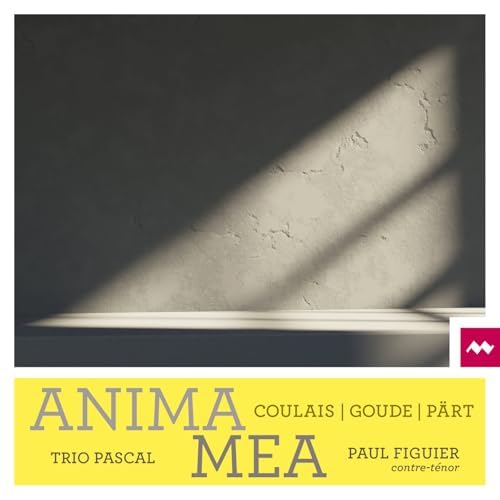
It is a rare occurrence for me to slide a CD into my player and fall immediately under the spell of haunting, hypnotic music I had never heard before. But “Anima Mea” (La Musica LMU 094), performed by the Pascal Trio and the young counter-tenor Paul Figuier, did just that. I replay the full 72 minutes almost every day and have not yet tired of it.

Denis Pascal, pianist in his family trio and a leading promoter of the CD project, tells me this music “creates a space in which one can get a glimpse of another world.”

The recording marks a few important firsts. Composers Bruno Coulais and Jean-Philippe Goude created their contributions expressly for this disc, and thus can claim World First recordings. In addition, the Goude version of Gerard Leane’s Salve Regina is reworked for this recording.

Taken together, the spiritual and sacred themes, beautifully vocalized by Figuier, leave the listener transported into a poetic melancholy mood suddenly shifting to a brisk and lively piece by Arvo Pärt.

The over-all style is a unique form of minimalism. The sustained repetition is evident in the most surprising selection, “My Heart’s in the Highlands” based on the words borrowed from Scottish national poet’s work of the same name and set to the haunting music of Pärt.

Figuier renders the score in English, in a powerful but controlled high-pitched voice – long passages on a single note, backed up by the Pascal brothers and their father. The heartfelt strings and piano interpretation would leave a modern Scot an emotional wreck.

Denis Pascal has been close to Figuier since the beginning of the singer’s career. Now Pascal calls his counter-tenor performance “magnificent”, a voice with “very great expressivity”. Figuier’s growing reputation places him alongside such counter-tenors as Philippe Jarousky, Alex Luna and Andreas Scholl.

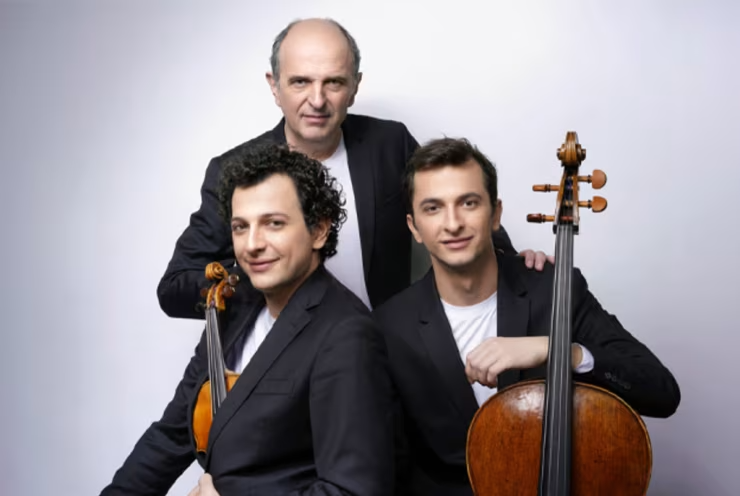
The trio comprises a rare family gathering of accomplished musicians. Pianist Denis Pascal and his two sons – violinist Alexandre and cellist Aurélien – form a unique ensemble bonded by years of common musicianship from childhood onward.

The title of the CD, “Anima Mea” (“My Soul” in English), was chosen to evoke spirituality, religious or not, evanescence, invisibility and the meaning of Salve Regina – thee traditional Magnificat in praise of the Virgin Mary, love and devotion.

An exceptionally thoughtful booklet accompanies the CD including biographies of players and composers, analysis by Yutha Tep, and the full texts in Latin, French and English.

As one French critic put it, “For anyone who loves meditative music chiseled in crystal, ‘Anima Mea’ is a stop not to be missed.”


MICHAEL JOHNSON is a music critic and writer with a particular interest in piano. He has worked as a reporter and editor in New York, Moscow, Paris and London over his journalism career. He covered European technology for Business Week for five years, and served nine years as chief editor of International Management magazine and was chief editor of the French technology weekly 01 Informatique. He also spent four years as Moscow correspondent of The Associated Press. He is a regular contributor to International Piano magazine, and is the author of five books. Michael Johnson is based in Bordeaux, France. Besides English and French he is also fluent in Russian. In 2024, he co-published with Frances Wilson ‘Lifting the Lid: Interviews with Concert Pianists’

American pianist James Iman continues to release groundbreaking albums which challenge convention (his previous recording with music by Debussy is a case in point) and which present lesser-known or rarely-performed repertoire written since 1900 and specifically post-1945. He’s one of the few pianists I know who seems completely at home with composers whose music is often challenging to listen to – yet James has the ability to make these less accessible works engaging and clear, in part due to his meticulous preparation and a genuine affinity with this repertoire.

His third album on the Metier label was conceived during the Covid-19 pandemic and was intended to be recorded prior to the United States going into lockdown. That didn’t happen, leading to a period of reflection about the programme of pieces featured on the album (works by Klaus Huber, Alban Berg, Morton Feldman and Betsy Jolas). The result is a thoughtfully conceived recording where the pieces connect, not via an overall narrative or general theme, but rather through traits and contrasts and “tendrils of musical abstracta” (James Iman). I wasn’t aware of the album’s initial conception (I hadn’t read the liner notes when I first started listening to it), and yet I sensed a certain separation and introspection, not only in the choice of music but in its actual performance.

The opening piece Ein Hauch von Unzeit II (“A Breath of Non-Time”) by Klaus Huber (1924–2017) quotes Dido’s Lament by Purcell in its opening measures and shares some of that work’s melancholy tone, though the ambience overall is one of calmness rather than sorrow. After the initial statement, the music grows more fragmented, with silences which create moments of separation rather than expectation or resolution between notes and phrases. In this way, it anticipates the works by Morton Feldman, which come later in the album. It requires control and concentration, which Iman certainly has, each note or phrase carefully sculpted.

Alban Berg’s single-movement sonata provides more florid textures and richer harmonies, a good contrast to the pieces which bookend it. Scored in B minor, the same key as that other great one-movement sonata by Franz Liszt, the music is firmly rooted in late Romanticism, despite its bold harmonic wanderings, at times redolent of Scriabin. The music feels curiously tethered; it aches to be free yet continually hovers around its home key. I wondered if this sense of yearning has anything to do with this album being conceived during lockdown….? In any event, Iman gives a convincing account, alert to the work’s shifting emotional palette and climactic episodes.

Morton Feldman’s Last Pieces date from 1959. They are not valedictory, farewell works, despite their title, nor do they quote other works or pay homage to other composers. Formless, the duration of notes and chords is left to the discretion of the performer. Thus, sounds emerge, hang suspended, merge or recede. Feldman called these ‘sound events’, and the skill of the performer lies in discerning a particular sound or nuance for each note or tone. Iman captures this brilliantly, allowing the music simply to “sit”, recalling the Japanese concept of ma (間), whereby the silence between the notes is as much music as the notes which actually sound.

The final work on the disc is another single-movement sonata by Betsy Jolas (b.1929). The music inhabits much of the same world as Feldman – and once again, certain decisions are left to the pianist. It’s more textural than Feldman’s writing, with its filigree gestures and multiple lines which stretch and contract. Rhapsodic in nature, it harks back to the Berg sonata in this respect, and Iman’s account is masterful, replete in colour, wit and spontaneity.

Iman: Album III is available on CD and via streaming on the Metier label

(This review first appeared on the Interlude.HK site)

Guest post by Karine Hetherington


With, ‘Variations’, pianist Joanna Kacperek has chosen to focus on the humble variation. Like many other composers before them and since, Beethoven, Robert and Clara Schumann, Brahms and Chopin, composed many variations. On this album, Kacperek artfully displays the creative possibilities of these variations, which were a way of exploring a theme for these composers, often not their own, and taking it to the next sublime level.

Variations have also been the means by which one composer honoured another. Thus, we hear Robert Schumann’s little-known variations, based on a theme by Beethoven, in this case, Beethoven’s Symphony no.7 and more precisely the Allegretto movement. To hear Beethoven’s solemn theme being repeatedly played and tweaked and then transformed by Schumann, is a thrill and gives the much-loved Beethoven melody a new mesmeric quality.

Clara Schumann’s variations meanwhile, celebrate the rich relationship (musical and emotional) she enjoyed with her husband, Robert. These intimate variations reveal every facet of their emotional life; joy, pain, yearning, eventually unfolding into a marvellous resolution where gratitude seems the overriding emotion.

Impressed by Kacperek’s debut album, Karine Hetherington from ArtMuseLondon went to interview this breakthrough artist.

Had you always planned to have a musical career and become a professional pianist?

Actually, yes! I started my private piano lessons at the age of 6. From the age of 7 onwards, I was educated in state music schools in Poland that are quite strict and take your musical development very seriously. 

Of course all this wouldn’t’have happened without the support of my parents. 

What led you to the idea of doing an album of musical variations? What does it bring to the listener?

I really love the idea of taking something really simple, like a 16-bar theme, and developing it in any way possible; I find it really exciting from both a pianistic and musical point of view. In a way, it feels like pushing the boundaries – how far can we go? How creative and expressive can we be, starting with such simple musical material? 

The album started with my obsession with Clara Schumann’s Variations Op. 20 which she composed on her husband’s theme – I just knew this piece was special. The other thing that influenced this programming was my discovery of Robert Schumann’s Studies on a Theme by Beethoven – a composition that survived (thanks to Clara) and was not published during Robert’s life. It is such a tremendous set that deserves more spotlight! Then, I started adding other sets of variations that complemented the ones by the Schumanns – hence Beethoven Op. 34 (which links to Schumann-Beethoven Studies), and Brahms Op. 18b (the birthday present from Brahms to Clara Schumann). 

Because all of the works I have mentioned had a personal story behind them, I decided to add Dutilleux’s Choral and Variations from his Sonata Op. 1 – the piece dedicated to, and premiered by his wife, concert pianist Genevieve Joy. Then – Cecile Chaminade’s Thème varié Op. 89  – a little gem, so rarely performed and recorded (my recording is only the 4th in the world!) showcasing yet another brilliant pianist-composer; finally Chopin – which is not only a nod towards my Polish roots, but at the same time it links to Dutilleux and Chaminade through their Paris residency. 

Where are you performing next? What musical projects do you have in the pipeline?

2025 looks exciting. I have performances planned in France, Germany, the Netherlands, Poland, Ireland and of course in the UK. January will start with two performances in West London of Beethoven’s 3rd Piano Concerto with an incredible arrangement for a string quintet.

How do you relax?

Playing the piano can be a lonely profession, so to relax, I love being around people.I enjoy the gym and group fitness classes that involve cardio, boxing or dance. Apart from that – quiet evenings with my cat on my lap is also one of my favorite things. 

Joanna Kacperek’s album Variations is available on the Rubicon label and via streaming

joannakacperek.com


This article first appeared on The Cross-Eyed Pianist’s sister site ArtMuseLondon.com

(Artist photo by Paul Marc Mitchell)

Duncan Honeybourne (piano) & Leora Cohen (violin)

This interesting new release from British pianist Duncan Honeybourne, with British-American violinist Leora Cohen, introduces the hitherto little-known music of Jessy Reason, known somewhat cryptically during her lifetime as “J. L. Reason”.

A long-forgotten, enigmatic figure, Jessy Lilian Reason, née Wolton, was born in London in 1878, the daughter of a wealthy hop merchant. In 1902, in Cornwall, she married a gentleman of private means twenty years her senior, with whom she settled firstly in Devon and later in Tonbridge, Kent. In the late 1920s the couple made a final move, to Reading, where Jessy died in 1938.

In May 1992 a writer called Alan Poulton discovered a large stack of handwritten music manuscripts in a second-hand bookshop. He purchased the collection and during the 2020 Covid lockdown, now retired and with time on his hands, he set about exploring and cataloguing the manuscripts, and researching the life of the woman who had composed 70 handwritten works in the early decades of the twentieth century. The paperwork accompanying the collection reveals that Mrs Reason studied composition with the renowned composer and conductor Eugene Goossens; she was then in her mid-40s, her tutor some 15 years younger. How much of Reason’s music was performed during her lifetime remains unclear: all that has come to light so far is a performance of a single song at London’s Wigmore Hall and a song cycle given at a minor concert in West London, all in the early 1920s. (The current catalogue of Reason’s music, compiled by Alan Poulton, can be found on the British Music Society website.

Pianist Duncan Honeybourne is a passionate advocate for lesser-known and rarely-performed music, and this new release by Prima Facie Records reflects his unerring ability to unearth really fine music and bring it to a wider audience by recording and performing it (see also his release, also on the Prima Facie label, of piano music by William Baines). On this recording he is joined by young British-American violinist Leora Cohen. She brings a wonderful range of colours and nuance to the Three Poems for Violin and Piano, matching Honeybourne’s playing with a remarkable sure-footedness, sensitivity and musical maturity.

This disc presents Jessy Reason’s entire output for solo piano, together with the Three Poems, and as such is a wonderful introduction to Reason’s writing. She was clearly a highly-skilled yet largely self-taught composer and musician (her writing for piano reveals an intimate knowledge of the geography of the keyboard): in his biography of his mother, Richard Reason describes her as “an ardent musician, with a fiery style of violin-playing . . .teaching herself the whole technique of writing for full orchestra”. Her scores, some of which I have seen, thanks to Duncan Honeybourne, are elegantly crafted and neatly laid out.

By turns richly romantic, impressionistic, darkly lyrical, sensuous and harmonically complex, there are hints of late Brahms, Debussy, Ravel, even early Messiaen in Reason’s sophisticated, inventive music. This inspiring legacy of work is brought vividly to life by Duncan Honeybourne on a piano contemporaneous with the music, a 1922 Bösendorfer.

Piano and Chamber Music by Jessy Reason

Duncan Honeybourne (piano) with Leora Cohen (violin)

Prima Facie Records, July 2024

leoraviolin.com

duncanhoneybourne.com