LISZT – The importance of Liszt in the piano world is reflected in two articles devoted to his life and work. The first is by Conor Farrington:

The great Hungarian composer and pianist Franz Liszt was born on 22nd October 1811 in the village of Raiding, in present-day Austria. In the course of his long life Liszt gathered to himself an unusually generous share of achievement and adulation, bestriding the Romantic nineteenth century like a musical colossus and dominating artistic circles from Paris to Rome and from Budapest to Weimar. As a child prodigy he held all Europe spellbound, and later, as probably the greatest concert pianist in musical history, his particular brand of iconoclastic brilliance astonished and bewildered all who attended his concerts. Inspired by Paganini and Chopin, Liszt developed a pianistic technique that was simultaneously transcendental and lyrical. By inventing the solo piano ‘recital’ and by playing only from memory, he also transformed concert practice and elevated the role of the interpretive artist.

In his role as itinerant virtuoso, Liszt travelled the length and breadth of Europe, even visiting Istanbul as a guest of the Sultan; but it was in Weimar that he settled in 1848, having retired from the concert platform at the height of his power in order to focus on serious composition. From then until his departure in 1861, Liszt composed a series of masterpieces – most notably the Piano Sonata in B Minor and the Faust Symphony – while somehow finding time to conduct the court orchestra in world premieres of operas by Schumann, Wagner and many others. In this period, Liszt also developed the orchestral genre of the Symphonic Poem in works such as Les Preludes, Orpheus and Hamlet, and pioneered the masterclass as a method for teaching the many piano students who flocked to Weimar.

Following Weimar, Liszt charted new musical and religious waters in Rome and Budapest, although he frequently returned to the city of Goethe and Schiller in order to teach. In this last third of his life, Liszt worked tirelessly to promote young pianists and composers such as Hans von Bülow and Bedrich Smetana, composed many significant works (including his choral masterpiece Christus), and, in his final years, ventured into new realms of musical impressionism and even atonality with pieces such as the choral work Via Crucis and piano works such as Nuages Gris, the Mephisto Polka, and the Bagatelle sans tonalité he composed in 1885, the year before he died.

Liszt bridged the worlds of Czerny and Debussy, and was at the forefront of many significant artistic developments; the child prodigy whom Beethoven had kissed became Wagner’s friend and colleague and an inspiration to Ravel and Bartok. Liszt excelled as virtuoso, composer, conductor, and teacher, not to mention his activities as writer, correspondent, and benefactor, and it is no exaggeration to say that he singlehandedly changed the course of musical history. Liszt garnered many tributes from figures such as Chopin, who once remarked that ‘I would like to steal from him the way he plays my studies’, while Wagner (grudgingly) admitted that his own treatment of harmony had been transformed by his knowledge of Liszt’s works. Even Brahms, in many ways implacably opposed to Liszt, held that Liszt’s many operatic piano paraphrases and transcriptions represented the ‘true classicism’ of the piano.

Yet he also attracted a weighty measure of opprobrium. Some found his extreme virtuosity distasteful – Schumann described it as ‘showing too much of the tinsel and the drum’ – while for others his compositions themselves were the stumbling block. Schumann’s wife Clara condemned Liszt’s works as ‘stilted, impotent weeds’, while the young Brahms dealt Liszt the ultimate insult of falling asleep during Liszt’s own performance of the Sonata in B Minor. Others railed against Liszt’s personality and his (admittedly somewhat lurid) lifestyle, objecting variously to his relaxed morals, his undeniable vanity, or the contradictions between these enduring character traits and Liszt’s devout Catholicism – contradictions that became even more marked, at least in the eyes of the world, when Liszt was ordained as an Abbé, or deacon, in 1865.

Liszt felt these criticisms very deeply, and told his biographer Lina Ramann that he carried with him ‘a deep sadness of the heart.’ Yet he also frequently declared ‘Ich kann warten’ – ‘I can wait’ – and hoped that true appreciation of his compositions might come about after his death. The extent to which this has happened is debatable. Some of his works, such as the Sonata in B Minor and the Hungarian Rhapsody No.2, have become standard repertoire, and some of his more ‘Romantic’ works such as Un Sospiro and the third Liebestraüme are often played on popular classical music radio stations. Nevertheless, the majority of his vast output is performed only rarely, if at all, with many important and beautiful works known only to specialists and members of the various Liszt Societies dotted around the world. In many ways, Liszt is still waiting.

Conor Farrington

Conor Farrington is a writer, composer and academic researcher, based in Cambridge

 

Further reading


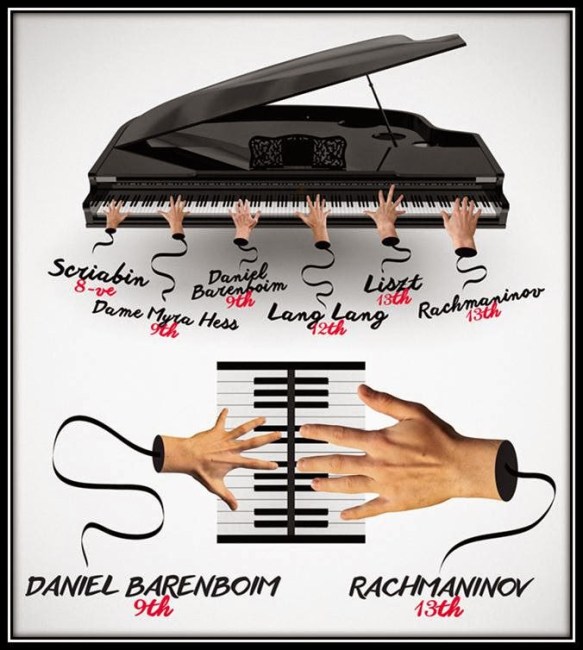
Hands

You can’t be a pianist without [at least one] (http://nicholasmccarthy.co.uk/). But what do you do if you are a small-handed pianist (barely an octave in the right hand, and that just at the edges of the keys) and want to play Chopin Op. 53 (the “Heroic” Polonaise”)? Your teacher looks at you with consternation, and then tells you that you must learn Chopin Études in a certain order, and that it will take a couple of years.

Fast forward two and a half years; my right hand span is now a centimetre longer than it was at the beginning of this saga. That single centimetre has been enough to allow me to play an octave right on top of the keys, enabling me to get a lot closer to the Op 53 ambition. I still can’t play the piece, but I can now play all the notes. It’s taken a lot of patience and trust in the sometimes non-intuitive ways of breaking down the Études; for example, I spent a couple of months practising the right hand of Chopin Op. 25 No. 9, shaking out my wrist after every half bar, to learn the feeling of playing octaves without stiffening my wrist.

I am well over the age that people stop growing, so the improvement is entirely down to the practise regimen. The increase in ability is not just down to the increase in span, but also increase in flexibility of all the fingers. When I play chords spanning an octave, I can now get the fingers out of the way that aren’t playing anything, avoiding hitting extraneous notes. I am not familiar with hand anatomy, but it feels as though the ligaments inside the palm have had to stretch the most.

As I progressed through the different exercises, I have felt my hands and arms up to the elbow ache in strange places. I am fortunately quite body-aware so have never done any damage; if the ache persists in the same place for a few days, I stop and work on something else until it goes away. (Incidentally, my typing speed has increased considerably, and I can now take dictation in almost real time.)

It’s tremendously motivating and every few months I take out a couple of octave heavy favourites to retry – every few months I am able to play big chords that bit more cleanly. There are no short cuts and this slow and steady progress feels more satisfying than if I were to magically be able to do it overnight, because I know that it is sustainable.

Mentally, it’s required the ability to trust that the practise will bear fruit, and to stop when it starts to hurt- not to push through to the point of damage (Probably a useful skill in any physical endeavour).

Obviously, my fingers aren’t going to grow any longer, but I hope that this will offer hope to other small-handed pianists. But a word of caution: It’s probably a bad idea to embark upon such a programme without the supervision of an experienced teacher, so as not to end up like Schumann.

Petra Chong
Petra Chong is a computer programmer as well as a pianist and so is perpetually bashing keyboards of one form or the other. She is a student of Marina Petrov

Philip Glass

As a string player who can make a claim to only the most rudimentary pianistic ability (accompanying On the Dodgems in a pupil’s ABRSM preparatory test really did make me go cross-eyed), I embarked on this Pianist’s Alphabet entry on Philip Glass with the fitting trepidation of the interloper.

Why do I want to write about Philip Glass’s piano music? The answer is envy. There are many marvellous tricks that we string players can execute – vibrato, portamento, flying staccato – but one thing that is harder for us is the motoric or raindrop ostinato which is so integral to Philip Glass’s music. We can try, in pieces like Arvo Pärt’s Fratres, but various physical impediments stand in the way of pellucid purity, the bow being the major one; therefore, in Pärt’s Spiegel im Spiegel, we are far better suited to the long notes, which can be made expressive with different bow pressure, or judicious vibrato No doubt there are also many difficulties inherent in Glass’s piano music, which require the same attention to the voicing and spinning out of its long harmonic lines as a piece of Bach, but the results are marvellous: mesmeric, crystalline, resonant, and eloquent, despite the ‘limitations’ Glass places on his musical palette.

Like many people – I assume – I first became properly acquainted with Glass’s music through film scores (specifically The Hours and Notes on a Scandal) and when I came to know more of his music, I began to wonder how it was that his minimalism possessed such rhetorical power. I also wondered why so many people, hearing similar styles of music, by composers less aesthetically adept than Glass would tut ‘Sounds like Philip Glass’ with a dismissive, mirthless laugh.

In Tristian Evans’s Music, Multimedia, and Postminimalism (Ashgate: 2015), the author’s more positive and open-minded analyses explore why Glass’s music possesses such infinite adaptability, moving between the spheres of absolute music and ‘film music’ with ease – an ease which, as Edward Strickland writes in New Grove, has led to Glass becoming ‘one of the most commercially successful, and critically reviled, composers of his generation.’ You can read an example of such criticism by Justin Davidson, in the New York magazine. However, the ways that Davidson, amongst others, censures Glass, are precisely the reasons why I like his piano music: Glass is famous for his musical intertextuality (mainly quotations of his own ideas) and references to other music. In his Etude No. 2, there’s a clear referential link to the first Prelude of Bach’s Well-Tempered Clavier, and it is pursuing the twisted paths of motivic reference – through the repetition that Davidson finds so distasteful – that I love.

Finally, performance. As an encore to Mozart’s Concerto for Two Pianos in E-flat at the 2015 Proms, the Labèque sisters played the fourth of Glass’s Four Movements for Two Pianos. Witnessing the intricacy of their interaction, the delicacy required to balance the musical texture, and extract its essential melodic trajectory, was a masterclass in communicative, rhapsodic piano playing.

Corrina Connor

F is for Fingers – the pianist’s tools for the job. Crucially, most pianists use all 10 fingers when we play the piano, the thumb being labelled as a finger for fingering purposes, whereas a violinist officially just has 4…and a trumpeter a mere  3 to contend with. The occasional unlucky pianist will have less than 10 available, and even more rarely, a fortunate individual may have more. As with many things in life, it’s not so much about how many you have, it’s about what you do with them.

Fingers come in all shapes and sizes. Slim, long fingers have a natural advantage for finding their way between the black keys and reaching over and finding awkward stretches. Shorter, stubbier fingers have a natural efficiency for playing rapidly and can be more robust in moments of strength and force. Some fingers are straight, some fingers are bendy. Depending on the note to be played, a bendy finger can be a help or a hindrance.

Some fingers sweat profusely in performance. Others remain dry as a bone. Some shake uncontrollably under pressure. Others remain as sturdy as an iron girder. Some fingers fly over the keys in a blur of lofty movement, other fingers gain a similar end result but whilst appearing to glide over the keys with barely a ruffle in the process.

Fingers come in all different shapes and sizes, with different strengths and weaknesses. But with the right instructions, most, if not all can be trained to produce the most beautiful sounds to the human ear.

There is of course a common misconception that we play the piano with our fingers. This isn’t strictly true…… We really play the piano with our brain, of course, which happens to control our fingers. Our fingers are just the final point of contact between thought and realisation of that thought…and a lot happens in between.

So it’s essential that our fingers are kept in excellent shape to ensure that they are flexible, supple and strong enough to do exactly what we ask them to. Finger exercises are designed for this very purpose.

Liszt at the piano

With 10 fingers flying around, the pianist has a serious amount of possibilities on his/her hands. Deciding which fingers to use for a note is an issue that preoccupies many a piano lesson or practise session. Often an individual finger on a particular note will lend itself to creating a particular quality of sound.  A particular finger will, more often than not be dictated by the notes on either side of it. The ‘correct’ fingering is one which encourages both the best effective musical effect and creates the least difficulty for the pianist. Often a pianist will need to make a choice between these two factors when deciding on which fingering to use. Fingering is therefore likely to vary depending on the dimensions and strengths of an individual’s fingers and on what musical effect is intended.

Given how important fingers are to the pianist, they need to be carefully looked after and maintained. Activities such as Taekwondo, carpentry and tree surgery are not recommended for the serious piano student. 

Essential finger accessories for the budding pianist would include a nail file and some leather gloves. (And handcream in the winter – editor)

Warren Mailley-Smith, concert pianist

Warren’s survey of Chopin’s complete piano music continues at St John’s Smith Square. Further details here