beyond-the-page-letter-wThe Well-Rounded Pianist

In a recent article, violinist Nigel Kennedy bemoans the “narrow” approach of the conservatoire system and its focus on technique over individuality. He also cites Yehudi Menuhin (who paid Kennedy’s fees at the Purcell School) as a major influence in encouraging him to explore other genres of music, including jazz.

I do not believe music should be studied in a vacuum, separate from other arts or life-experience, but in our desire to seek perfection in what we do, to practise so that we never play a wrong note, I think there is a danger of losing sight of where the music we play comes from. It is not just thickets of notes on a page, but the expression of emotions, hopes and desires, of another sentient human being – the composer.

And so in order to transmit the composer’s intentions to our audience, I believe we should take a well-rounded approach to our music making. Cutting oneself off from normal life by spending hours and hours in the practise room is not healthy. Aside from the law of diminishing returns (after about 3 hours you stop taking in information and are simply “typing” the music), it is important to remember that the composers whose music we love and revere were normal people too – they too had love affairs, went out drinking with mates, and enjoyed a good meal with friends and colleagues – and we can connect better to them and their music if we go out and live life, just as they did. Having a social life, meeting friends, going out together, eating and drinking, going to the theatre, the cinema, art exhibitions, reading trashy novels, falling in love, falling out of love: all this feeds into our cultural and creative landscape to nourish, inspire and inform our music-making.

Of course, being a well-rounded pianist or musician is much more than this. It is about technique, for sure, but it is also about getting to the heart of the music to understand the context of its creation, why it is special. In order to do this, we need to study social and historical context, “listen around” the music to better appreciate that composer’s unique soundworld, compose, analyse and understand the philosophy of music. We should explore literature, art, poetry, go to concerts, play in ensembles, listen to music from other genres, and always – always – remain open-minded and curious. We also need to accept that there is no “right way”, to trust our musical instincts, have the courage of our convictions and not constantly compare ourselves to nor compete with others. When all these things combine, I believe we can truly be well-rounded musicians.



marquee20letter20-20vVolunteer

Guest post by Paulette Bochnig Sharkey

I am a volunteer pianist. For the past 12 years, I’ve brought music to residents of assisted living homes, memory-care centers, and retirement communities.

Before becoming a volunteer pianist at age 50, I had played classical music almost exclusively, along with Christmas carols and the occasional Broadway tune or popular movie theme. I love classical music; many of my elderly listeners do, too. They enjoy having piano performance students come from the local university to present practice recitals. Those students play classical music better than I ever could. I’m an amateur pianist, albeit a serious one.

So for my volunteer gigs I focus instead on standards from the 1920s through the 1940s. These songs—especially the ones popular during World War II—have deep emotional meaning for my audiences. When I play “As Time Goes By” or “Sentimental Journey,” my listeners feel a sense of ownership. “You play our music,” they tell me.

For my elderly audiences, this music stirs memories. I recognize the look of nostalgia in their eyes as they remember dancing with the spouse they’ve now lost, or longing for home while away serving in the military.

One hunchbacked octogenarian shuffled to the piano to tell me that his mother played when he was a little boy. Then he burst into tears and sobbed, “I miss her so much.” Sometimes a particular song will inspire a listener to tell me a story. Some are surprisingly personal. Upon hearing “Tenderly,” a rheumy-eyed man whispered in my ear, “That song was the cause of my five children.”

The power of music is never more evident to me than when I volunteer in a dementia unit. Patients arrive slumped mutely in wheelchairs, seeming unaware of their surroundings. But when I play a song like Irving Berlin’s “Always,” they raise their heads and begin singing. Unlocked by the music, the lyrics flow from their long-term memory.

Volunteering offers no monetary compensation. I am paid in kisses blown to me from across the room, in pats on the arm, in glasses of juice offered by shaky hands.

My work as a volunteer pianist is not all hearts and flowers. The pianos I play are often neglected and out of tune. Cell phones ring during my performances. I will always remember the man in my audience who answered his phone and told the caller, “No, I’m not busy, I can talk. I’m just listening to someone play the piano.”

I compete with the roar of vacuum cleaners, with the clattering of lunch dishes being cleared away in nearby dining rooms. On one memorable occasion, a

housekeeper dusted the piano while I was playing it. And then there was the time I got hit by a ball when an audience member decided to multi-task, listening to the piano music while he played a game of fetch with his dog.

I’ve run into a few curmudgeons over the years. One told me I was “no Liberace.” Another approached the piano, leaned in close, and snarled, “Why don’t you go play somewhere else?”

Still, I cannot imagine a more gratifying way to contribute to my community than by being a volunteer pianist. Not long ago, an elderly women slowly steered her walker to the piano as I packed up after a performance. “You have no idea how much sunshine you brought into this room with your music,” she told me. “We were all dancing in our hearts.”

That is my reward. Priceless.

Paulette Bochnig Sharkey, pianist and writer, blogs at https://volunteerpianist.wordpress.com/

letteruUna Corda

Una Corda is the direction to the pianist to apply the left-hand or soft pedal. The function of the soft pedal was invented by Bartolomeo Cristofori, the inventor of the piano. In the 18th and early 19th centuries, the piano had evolved to have three strings on most of the notes. When the una corda pedal was applied, the action of the piano would shift so that only one string was struck – hence the words “una corda”, or “one string”.

On a modern grand piano the strings are placed too closely to permit a true una corda effect: the left-hand pedal shifts the whole action, including the keyboard slightly to the right, so that hammers which normally strike all three of the strings for a note strike only two of them. The resulting sound is softer and also has a duller quality due to the two strings being struck making contact with a part of the hammer felt which is not often hit and which is therefore slightly softer in density, creating a different quality of sound. On an upright piano, the mechanism is arranged so that when the left-hand pedal is applied, the resting position of the hammers is moved closer to the strings so that they have a shorter distance to travel and therefore the strings are struck with less force, creating less sound.

While the una corda pedal can be used to achieved wonderfully soft, muted and veiled effects in piano music, it is not simply a “quiet pedal”, any more than the right-hand, sustaining pedal is the “loud pedal”, and just as there are “degrees” of sustaining pedal, depending on the repertoire, so the una corda can be depressed in a variety of ways to create multi-faceted musical colours and sonorities. As with all pedalling, an acute ear, practise, discretion and experimentation will lead to greater confidence and expertise, resulting in truly wonderful effects.

Here is Beethoven giving very specific directions in the use of the una corda pedal: he stipulates lifting the left pedal so gently that only bit by bit are all the strings sounding again – only two initially and ultimately all three again:nbs-4


Urtext

An urtext edition of a work of classical music is a printed version intended to reproduce the original intention of the composer as exactly as possible, without any added or changed material. (Wikipedia)

The source materials for Urtext editions include the composer’s autograph (the manuscript produced in the composer’s hand), hand copies made by the composer’s students and assistants, the first published edition and other early editions. Urtext editions differ from facsimile editions, which present a photographic reproduction of one of the original sources for a work of music, and interpretive editions, which offer the editor’s personal opinion on how to perform the work.

Urtext scores came into being as a reaction against the many (and often incorrect) editorial liberties which were taken when editing and publishing music. Phrasing, articulation, dynamics, and sometimes even the notes themselves were altered as the editor saw fit, and so long as it made musical sense, this kind of editing was considered acceptable. Editors guilty of this kind of tampering include Busoni (in Bach) and von Bülow, amongst many others. These days, the urtext score is a must-have for the serious student, teacher or performer, offering as it does a “clean” version of the manuscript, without the distractions of an editor’s markings, and opinions, and is the most faithful record of the composer’s original intentions, which provides the starting point for independent thought and interpretative possibilities.

I still have my old ABRSM editions of Bach’s Two- and Three-Part Inventions and “the 48”. Heavily annotated by the ABRSM’s editors, the manuscript is distorted with the kind of phrasing, dynamics, and articulation markings which would probably horrify Bach.  In an urtext score, particularly a Baroque urtext score, the absence of performance directions offers the performer choice, versatility and expression.

Urtext editions, in particular those produced by established music publishers such as Henle, Wiener and Barenreiter, tend to be high-quality publications, with detailed and insightful prefaces and notes, descriptions of sources (usually in German, English and French), useful fingerings, and aesthetically-pleasing design values: durable bindings, heavy cream paper, and clear music engraving optimised for efficient page turns. With the increasing popularity of digital downloads, resources such as Piano Street and IMSLP also offer urtext editions in their catalogues.

Resources:

Henle Verlag

Wiener Urtext

Barenreiter

Edition Peters

Dover Publications

IMSLP

10863510-1416476088-549536(Musical) Terms

Descriptive words, usually in Italian, used to define tempo, expression, articulation, dynamics, pedaling or a specific feature such as a glissando or cadenza. We start learning and accumulating musical terms from the moment we begin to play the piano, starting with the simplest terms – forte (loud), piano (soft), allegro (quick or brisk), andante (at a walking pace). As we progress in our piano studies, we add more terms to our dictionary – allegretto, adagio, largo, presto, cantabile, accelerando, rallentando…..

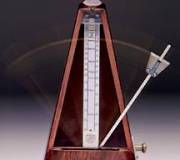
metronomeComposers use terms to guide us in our interpretation of their music. With the invention of the metronome terms relating to tempo (such as presto, allegro, andante, adagio) became more standardised and suggested tempi are given on the body of the metronome in beats per minute, and also at the start of a piece. These speeds are not set in stone, however, and terms should be interpreted according to the character and style of the piece, as well as our own abilities and limitations.



Andante is a term which has always interested me. We know it means “at a walking pace”, but my walking pace may not be the same as yours. And maybe one day my walking pace is hurrying for a train, and another it is strolling in the park……. In the slow movement of Schubert’s Sonata in A, D959, the tempo marking is andantino and the character of the music suggests to me the weary tread of a melancholy traveler. Some will disagree, preferring a brisker walking pace, or the plod of an almost-funereal Adagio.

I love highly descriptive terms – allegro con fuoco (fast and with fire), allegro amabile (which means amiably quick, but which I prefer to translate as “smile as you quickly place”), affettuoso (with affection and tenderness), accarezzevole (caressing), bruscamente (brusquely), perdendosi (dying away). Once could write a passionate love story from these terms.

Tea

When I asked for suggestions for this entry in the Pianist’s Alphabet, a number of my pianist friends and colleagues suggested Tea. What would we do without it? I must drink six or seven cups a day. It fuels my practising, my teaching and my writing. Tea keeps fingers and brain lubricated. My morning ritual is to make a large mug of smokey Lapsang Souchong which I take to the piano. The ritual is repeated at regularly intervals, and mid-morning my husband will silently bring me a cup of tea and place it on my desk behind the piano. Coffee makes me jittery and nauseous – not an ideal combination when one is trying to refine Schubert’s heavenly length.

Others T’s (suggested by friends and colleagues)…..

Toccata

Takemitsu

Talent

Trills

Terrifying Thalberg

Tickle (as in “tickle the ivories”)

Tuning

Technique

Touch

Temperament

Thumbs