This week I am wrestling with one of my personal pianistic bête noirs: the dread cross-rhythm (or ‘poly-rhythm’). I am ashamed to confess that at my time of life (mid-40s) and pianistic ability (advanced), I have never truly mastered playing a cross-rhythm (for example, triplets in right hand over duplet quavers in left hand). I suspect I was never taught how to do it properly by the teacher I had in my teens, though I do recall that one of my Grade 8 pieces, a Chopin Nocturne in D minor, had a few cross-rhythms, which were just skimmed over: I seemed to play them all right, and I passed my Grade 8 with a creditable mark. Unfortunately, for me, being able to play a cross-rhythm convincingly, and, more importantly, correctly, is a basic requirement for a pianist of my level of (so-called) expertise. It is also essential for the Debussy I am learning for my Diploma (the ‘Prelude’ from Pour le Piano), which contains a small section of triplets over semiquavers. For the uninitiated, playing a cross-rhythm is the pianistic equivalent of rubbing your stomach with one hand whilst patting your head with the other (or vice versa).
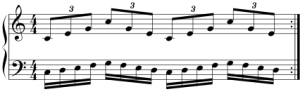
Over the years, my silly difficulty with the cross-rhythm has forced me to exclude a great deal of music from my repertoire: a good deal of Chopin, Schubert, Brahms, Rachmaninov, Tchaikovsky, Prokofiev has, until recently, remained a mystery to me, because I only have to see a group of triplets against quavers, and I go cold with fear.
A few years ago, I taught myself the opening movement of Schubert’s great last sonata, the D960 in B-flat Major. (I also taught myself the rest of sonata, but the glorious first movement was my main preoccupation). In the development section, there are six, yes six, bars of triplets in the right hand over duplets (pairs of quavers) in the left hand. This section marks the climax of the movement, and, when played correctly, is extraordinarily dramatic, as the two strands of music come together. Whenever I encountered this section, I just “fudged” it, playing a rough approximation of what it should sound like and feeling relieved when I reached the end of the section. A brief encounter with a piano teacher (one who I quickly dropped like the proverbial hot potato when I discovered some rather unsavoury truths about him – but that’s another story) gave me a little ditty to help cope with the cross-rhythms in the Schubert. A quick trawl of the internet earlier today, while trying to find a proper exercise to help me with the Debussy, threw up a number of rhymes and suchlike for this purpose, the most popular being “Nice Cup of Tea” or the variant “Cold Cup of Tea” to cope with triplets against duplets. Rhythmically, it works like this:
Nice (both notes together) Cup (2nd triplet) of (2nd duplet) Tea (3rd triplet).
It helps to tap the rhythm out on alternate knees while saying the words a few times before attempting it at the keyboard. This ‘system’ works for very short passages of three against two, or better still, one triplet group against two quavers. But try saying Nice Cup of Tea over and over again for six bars – as for the Schubert – and it quickly becomes apparent that one needs a more rigorous approach.
When I played the Schubert for my current teacher, at my first lesson with her, she immediately picked up my difficulty with the cross-rhythms in the development section, and gave me a neat exercise, which forces one to keep a regular pulse going (essential to ensure the notes of the cross-rhythm fall in the right place). Take the simplest one-octave C major arpeggio in the right hand, in triplets, descending from the C above middle C (C-G-E, C-E-G etc), while the left hand plays crotchet C’s and G’s on the beat (say, in 2/4 time). Get a good sense of the pulse before dividing the left hand rhythm into quaver duplets, and allowing the second duplet to fall just after the second triplet of the group. Be careful not to allow the triplets to turn into a dotted rhythm. I found this exercise really helpful as it prevents one from playing too mechanically and does not interrupt the flow of the music.
Other people advocate a more mathematical approach, involving diagrams and numbers. This is for 3 against 4, pulled from an ABRSM forum on the subject:
1 2 3 4 5 6 7 8 9 0 1 2
x x x x (x falls on every third beat)
o o o (o falls on every fourth beat)
Now, count aloud while patting alternate knees: 1(Both) 2 3 4(left) 5(right) 6 7(left) 8 9(right) 10(left) 11 12
Do this very slowly at first and build up speed, until you can ‘feel’ the rhythm and you won’t have to count it in your head.
Sounds simple? I will be trying this method tomorrow with the Debussy….. I suspect there will be a degree of “fudging” involved: the tempo of the piece means that one could wing it, but I am sure my teacher would notice it – and I want to play it correctly! Very slow practice, playing the notes from left to right in the order they are written and making sure to stress the strong beat where both hands fall together may help my poor brain (and fingers) from getting in a tangle! Knowing each hand’s part intimately (from memory, ideally) should help too. Expect a follow up post on this subject in a few weeks’ time!
Meanwhile, here are some resources which I found helpful.
The first of Brahms’s 51 Exercises is an exercise in cross-rhythm, rather than a fingering exercise. Download a PDF file Brahms 51 Exercises No. 1
PDF Worksheet on Cross-Rhythms







 The Cross-Eyed Pianist