When I was learning the piano as a child, it wasn’t obvious to me why my teacher insisted that I learnt certain repertoire, for example, by Bach, Beethoven or Chopin (my Grade 8 programme featured works by all three). Unfortunately, I wasn’t taught technique as a specific area of piano study, and my teacher never really explained why certain composers and works were useful for both technical and artistic development. Meanwhile, my grounding in music history, styles and genres came from O- and A-level music, going to concerts and opera with my family, and listening to music at home.
Now, as I survey the vast repertoire available to the pianist (far bigger than for any other instrumentalist), I realise that there is much to be gained from studying works by specific composers, for they can each teach us something special which informs the way we approach, interpret and play music.
So, what exactly can the great composers teach us? I have tried to highlight one or two key areas for each composer (these are my own suggestions, based on my experience of their repertoire):
Bach – “counterpoint”
how to approach separate voices and textures within a work. Useful not just for playing Baroque repertoire, but for any music where one is required to highlight different voices and layers of sound.
Mozart – “clarity”, “elegance”
to play Mozart well, one needs precise articulation, finger independence, control, and lightness
an ability to utilise the full range of dynamics and phrasing, with minimal/sensitive use of pedal
Beethoven – “strength”, “structure”
an understanding of the building blocks and architecture of music, and the ability to highlight this
strength, projection, scrupulous attention to rhythm
Schubert – “melody”, “emotion”
Beautifully shaped melodies, rapid shifts in emotion, musical chiaroscuro
the ability to move seamlessly between many emotions, from joy to despair, sometimes within the space of a handful of bars, or even a single bar
Play Liszt and you learn how to be a real performer, with the confidence, communication skills and strength to tackle the big warhorses of the repertoire (Russian concertos, Etudes etc) with true bravura
Fantastic technical grounding: double-octaves, chunky chords, projection, physical stamina, legatissimo and leggiero playing
Debussy – “colour”, “control”, “detail”
Debussy often asks the pianist to forget how the piano works and instead demands touch-sensitive control, subtle shadings, fine articulation, absolute rhythmic accuracy and superb attention to detail. Observe each and every marking in Debussy’s score – they are there for a reason!
Bartok offers even the most junior pianist the chance to learn about percussion and rhythmic vitality, while Prokofiev combines these elements with references back to classical antecedents
Messiaen for rhythm, brilliance, emotion, meditation
Maurice Sand, ‘Chopin giving a piano lesson to Pauline Viardot’, drawing (1844)
Who or what inspired you to take up composing and make it your career?
It was my first instrument, the trombone, that led me to composition. I was unhappy with the exercises I’d been set to practice after my first few lessons, so I decided to write some alternatives. I found this much more interesting than practicing, and so that’s how I started composing!
After that I couldn’t get enough of it. I would write alternative harmonisations of hymns while not singing in the choir at church, and I went through one phase of about a year of writing a new little piece every day (for the exercise rather than for performance).
Although things like this account for about my first 7 or 8 years of composing, I only became “seriously” interested when the composer Steve Martland visited my school for a BBC education project and decided to take me under his wing and encourage me. So I’d say he was one of my first inspirations to make a serious go of it.
Who or what are the most important influences on your composing?
The most direct influences are other composers, in particular the German late romantic / early modern tradition, from Wagner through Mahler to Schoenberg, and in particular Berg. Not a huge amount of newer music, but certainly that of Messiaen, Xenakis, Andriessen among relatively recent composers. But I am also influenced by music that I play (I do a lot of playing, at an amateur and occasionally professional level), which can be anything from wind/brass band music to jazz standards to a wide variety of orchestral and chamber music. Music that I play has a habit of finding its way, heavily filtered, into music that I write. At the moment for example Schubert’s “Death and the Maiden” is spending a lot of time in my head as we’re learning it in the quartet in which I play viola!
What have been the greatest challenges of your career so far?
I hesitate to describe my composing as “a career” as that implies there is a) some structure to it and b) some financial reward, whereas in reality there is neither. The greatest challenge is probably the same for any composer – to simply keep writing, and find a reason to keep writing, in the face of public indifference! And of course, to persuade people to perform your music.
What are the particular challenges/excitements of working with an orchestra/ensemble?
Without question, the first moment of hearing your piece come alive. While it’s the first time the players might have seen it, you the composer have come to know the piece intimately from its first sketches, so you have to be patient and wait for it to emerge. Sometimes the reality can turn out to be quite different to what you imagined, but over time you try to get better at accurately imagining during the composing process.
I really like the process of working with performers. It’s the unexpected touches they put in that really bring a piece to life – their “interpretation”, notes that are fractionally late, rhythms slightly slower than written, their frustrations with it, or whatever; it’s the unplanned bits that make music come to life and make it infinitely more exciting than hearing a computer play it!
Which recordings are you most proud of?
I haven’t got many recordings of my pieces, but I usually get at least one for each piece that’s performed. The one I’m most proud of would be the London Sinfonietta playing my piece Antagony, which won the 1993/94 BBC Young Musician of the Year award for composers – I was 17 at the time and writing a 20 minute piece for two wind bands, amplified strings, and 6 percussionists seemed quite practical. Fortunately, for the BBC and the Sinfonietta, and conductor Martyn Brabbins, this posed no problem! And today I have a great recording and a great memory of a special occasion.
Do you have a favourite concert venue?
The Purcell Room at the Southbank Centre – I first played there in a brass ensemble at 15 and have played there (and heard my music played there) many times since. There’s something timeless about the backstage area and things like the odd signs for performers in Russian that they used to have that’s really special, and the staff are really friendly and professional. I also think that the leather seats in the auditorium are the most comfortable in any concert hall in the UK. I’d much rather my listeners were comfortable when being confronted with my music!
Who are your favourite musicians?
They are the ones I play with most regularly – my quartet, local brass band, etc. They are definitely not well-known international concert artists but some of them are really outstanding musicians and great fun to play with!
What is your most memorable concert experience?
Hearing Louis Andriessen’s De Snelheid and Stravinsky’s Oedipus Rex played by (I think) the BBC Symphony Orchestra at the Royal Festival Hall when I was a teenager. I was brought there by Steve Martland (see above) and it was the moment when I vividly remember thinking “THIS is what I want to do with my life”.
What is your favourite music to play? To listen to?
To play – perhaps boringly, I really enjoy playing the music of the old masters: Bach, Beethoven, Mozart, Schubert, etc. There’s a reason why they are considered great composers and it’s so clear every time you play their music. There’s also so much that can be learnt by playing music like that!
To listen to – I have very broad tastes but I actually don’t listen to a huge amount of music. At the moment I enjoy listening to random avant-garde electronic music by people on Soundcloud or to odd online classical music radio stations and just seeing what’s on. I’m a great believer in serendipity!
What do you consider to be the most important ideas and concepts to impart to aspiring musicians/students?
To follow what you want to do; don’t get put off by public indifference and by chasing easy fame by playing (or writing) crowd-pleasers. If you aren’t moved by what you do then no-one else will be.
What are you working on at the moment?
An opera about the Suffragette Emily Wilding Davison, for premiere in July 2013, 100 years after her famous / notorious death under a racehorse while protesting at the Derby. Please have a look at: http://www.emilyopera.co.uk!
Where would you like to be in 10 years’ time?
Taking a curtain call to a rapturous audience at Bayreuth after the successful premiere of my latest opera. Failing that I’ll settle for being happy, healthy and not too poor in some part of the world with nice landscape!
What is your idea of perfect happiness?
Being outdoors somewhere spectacular without any worries about anything or anyone.
What is your most treasured possession?
My brain.
What do you enjoy doing most?
Other than carefree time with my wife and daughter, I’d say playing great music with other people – music that everyone finds challenging but just within their technical ability…
Tim Benjamin is also the co-founder of Clements Theory, the leading e-learning resource for ABRSM and Trinity Guildhall Grade 5 Theory. Tim has written a comprehensive set of Grade 5 Theory study guides which are used on the website, and he also designed and edited many of the questions. Further information here
Early music and Baroque crossover ensemble l’Arpeggiata, under the direction of theorbo player Christina Pluhar, gave a five-star performance of toe-tapping Tarantellas, jazzy improvisations, and soulful songs in their Proms debut at Cadogan Hall. Read my full review here
Who or what inspired you to take up your chosen instrument and make music your career?
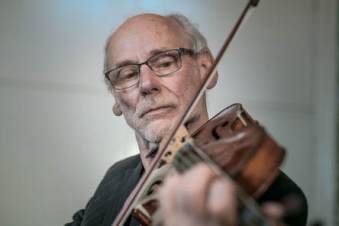
My mum and dad: Dad was a devoted brass band player, there was always music in the house (he had a gorgeous walnut radiogram, with piles of records – mostly 78s!). They fixed up violin lessons for me, made me practise, came to almost every concert I did, helped get me in the NYO, and thence to Cambridge.
Who or what are the most important influences on your playing?
My colleagues in the Fitzwilliam Quartet! But before that, our mentor, Sidney Griller and his quartet; the Smetana Quartet; the Beethoven and Borodin Quartets (for Shostakovich); violinist Alfredo Campoli (the ideal violin sound); conductors Otto Klemperer and Roger Norrington (two totally opposite approaches to Beethoven); clarinettists Alan Hacker and Lesley Schatzberger (opening my eyes to historical performance practice); Dmitri Shostakovich himself – the greatest man I have ever met, whose very presence and humility imparted a belief in what we were doing, and a confidence to press on into the future; the greatest performer I have ever heard (not in the flesh, sadly): Dietrich Fischer-Dieskau;
What have been the greatest challenges of your career so far?
Starting off and making headway in the real world as a professional string quartet; playing to Shostakovich; our New York debut – then the complete Shostakovich cycle there; re-building the quartet post- Chris Rowland (it took over twelve years!), and maintaining its profile and pre-eminence in these times of age discrimination in the music world; getting John Eliot Gardiner to observe the spirit and letter of Beethoven’s metronome marks (without seeming too cocky for my position!); getting my own playing onto a higher level, in order not to let the other three down (whilst spending a disproportionate amount of time on admin….).
What are the pleasures and pitfalls of ensemble work?
As a “team player” (which is the most satisfying role for a violist) one can achieve collective heights one could never achieve on one’s own – especially since the FSQ plays to a higher standard than I could ever reach myself! Those concerts (which happen rarely) when everyone is pulling together for the common benefit of quartet and composer, when you feel anyone can do anything, and everyone else will respond and be with each other. The pitfalls are when that doesn’t happen…. Or when individuals prioritise themselves before the group.
Which performances/recordings are you most proud of?
The Shostakovich cycle, of course – although many of them we play better now! The Franck quartet. The Brahms clarinet quintet (with Lesley Schatzberger). Wolf’s Italian Serenade – as virtuosic as we could get in the old days! Then, latterly, our first ever public performance of Schubert’s Death & the Maiden (after 42 years! – as good as I’ve ever heard it from anyone…..).
Who are your favourite musicians?
The ones I play with: my colleagues in the quartet, plus Anna Tilbrook (piano), Moray Welsh (cello), Lesley Schatzberger (clarinet), Carolyn Sparey (viola); also those influential musicians mentioned above.
The Fitzwilliam Quartet
What is your most memorable concert experience?
16th November 1972, Lyons Concert Hall, York: packed to the rafters to witness us play Shostakovich No.13 with the composer in the audience. I have never in my life experienced such electricity in the air, or intensity of applause.
What advice would you give to aspiring musicians/students?
Don’t get in the way of the music or the composer! Be faithful to both the spirit and the letter of the score – i.e. inform yourself as to the exact meaning of the notation, the performing conventions and sound according to the period of music in question. Aim to perfect every aspect of your “craft”, in the service of both the music and your own self-expression – but never impose the latter: this would imply that your own personality is not strong enough to stand on its own. Ego is no substitute for the humility and character required to communicate with your audience.
What is your idea of perfect happiness?
Manchester United overturning the rich pretenders from Man City next year!
What is your most treasured possession?
My family, my friends, my health, my viola, a lock of my late daughter’s hair
What do you enjoy doing most?
Drinking good beer or wine, eating Italian food (or Indian), playing (now watching…) cricket, walking, cycling.
The Fitzwilliam Quartet with pianist Anna Tilbrook perform music by Hugo Wolf, Rebecca Clarke, Franz Schubert and Johannes Brahms on Sunday 8th May as part of the London Chamber Music Society’s Sunday Concerts series. More information/tickets
The Cross-Eyed Pianist is free to access and ad-free, and takes many hours every month to research, write, and maintain.
If you find joy and value in what I do, please consider making a donation to support the continuance of the site


 Who or what inspired you to take up your chosen instrument and make music your career?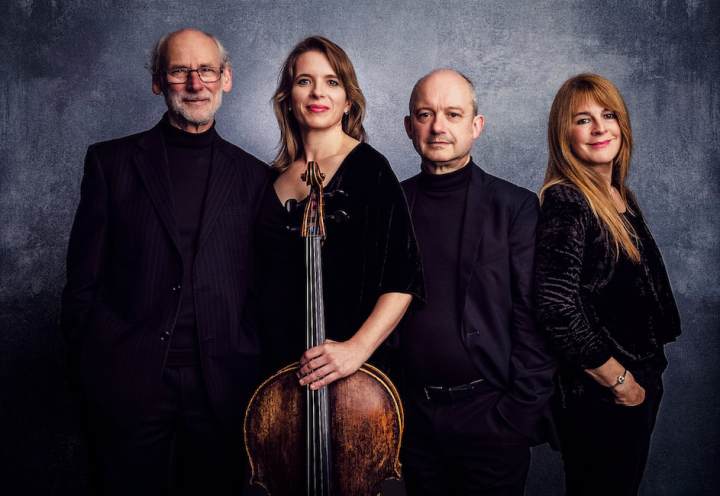




 The Cross-Eyed Pianist