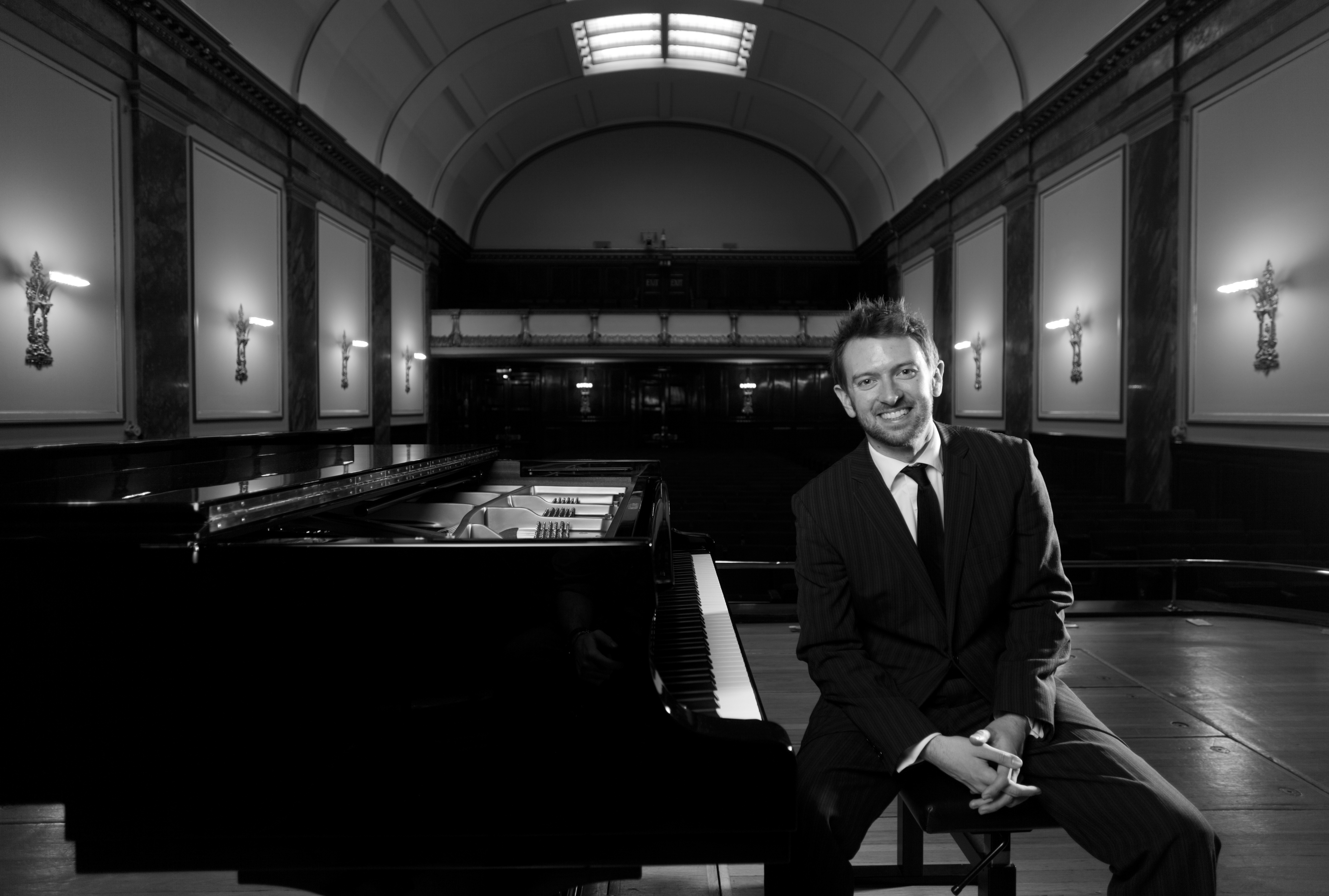
Pianist Clara Rodriguez

London-based Venezuelan pianist, and champion of Venezuelan composers for the piano, Clara Rodriguez returns to the Southbank Centre on 10th December for a concert of music by South-American composers, including Villas-Lobos, Piazzolla and Ruiz, and Debussy. This promises to be a really wonderful evening of music, not just for piano, but for ensemble too, as Clara will be joined by Wilmer Sifontes on percussion, cellist Jordan Gregoris and violinist Ilya Movchan. The concert also features two London premieres of works by Colombian composer Germán Darío Pérez.

I reviewed Clara Rodriguez and friends at Purcell Room last autumn, and Clara also features in my Meet the Artist interview series. Read her interview with me here. And here is Clara in her own words about her forthcoming concert:

All concerts at the Southbank are special events, the magic of one evening only, the energy, imagination and love that goes into putting the programme together is part of our artistic proposal to the world. My concert on Monday December 10th at the Purcell Room is going to be another exciting yet very different experience to the other nine or ten ones I have played there in the past.

The high inspiration, poetry and skill behind all the pieces I am playing makes my heart jump with emotion. Just reading Verlaine’s Clair de lune poem makes me realize even more deeply about the beauty of Debussy’s Suite Bergamasque, which I could play for ever!

Votre âme est un paysage choisi
Que vont charmant masques et bergamasques
Jouant du luth et dansant et quasi
Tristes sous leurs déguisements fantasques.

Tout en chantant sur le mode mineur
L’amour vainqueur et la vie opportune
Ils n’ont pas l’air de croire à leur bonheur
Et leur chanson se mêle au clair de lune,

Au calme clair de lune triste et beau,
Qui fait rêver les oiseaux dans les arbres
Et sangloter d’extase les jets d’eau,
Les grands jets d’eau sveltes parmi les marbres.

Your soul is a chosen landscape
Charmed by masquers and bergamaskers
Playing the lute and dancing and almost
Sad beneath their fanciful disguises.

Even while singing, in a minor key,
Of victorious love and fortunate living
They do not seem to believe in their happiness,
And their song mingles with the moonlight,

The still moonlight, sad and beautiful,
Which sets the birds in the trees dreaming,
And makes the fountains sob with ecstasy,
The tall slender fountains among the marble statues!

I have always been interested by the output of contemporary composers, their loneliness and their bravery in expressing their truths out on paper, apart from appreciating their talent, of course. On this occasion I will première three preludes by the young Venezuelan composer Mirtru Escalona Mijares who lives in Paris and has kindly dedicated the last of the Three Short Preludes to me. It is based on a tanka by the buddhist monk RYOKAN (1758-1831), it is called “…contempler longuement…” in it I have to use special concentration skills to play pianissimo and very slowly as opposed to our usual kind of preoccupation which is to play fast and lots of notes. Mirtru has been working very hard in purifying or cleansing musical phrases and thoughts. It is a challenge! Here is the poem the third Prelude is inspired by:

“Je n’ai rien de spécial à vous offrir juste une fleur de lotus dans un petit vase à contempler longuement “.

I have nothing special to offer to you/Just a lotus flower In a small vase/To be contemplated for a long time

“Hommage à Chopin”, a tour de force written by Villa-Lobos will follow. It is a strange piece, not exactly romantic, I think it has the force of the Amazonian jungle and depicts Chopin’s passionate torments and obsessions. It has a greater number of melodic layers than most piano pieces thus making it quite virtuosic.

It was while studying with Nadia Boulanger in Paris that Piazzolla was urged to develop his love for tango thus creating the “new tango” in which he transformed this old Argentinean dance into music capable of a variety of expression, fusing sharply-contrasted moods: his tangos are by turn fiery, melancholic, passionate, tense, violent, lyric and always driven by an endless supply of rhythmic energy. I am thrilled to be able to play Le Grand Tango, one of his most Classical pieces, and then in the same evening The Four Seasons of Buenos Aires with leading young performers from France, Jordan Gregoris on the cello and from Russia, Ksenia Berenzina on the violin. You’ll see what exquisite pair of musicians they are. We are having the fun of our lives playing this music. It is luxury!

Not forgetting my Caribbean roots, I have added three composers from that part of the world, for two reasons, my dear London public expects it and simply because I have so much joy playing them. So, from Cuba a nostalgic Danzón by José María Vitier, who composed the music for the film “Strawberry and Chocolate”, then two London premières will follow by a composer from Bogotá, Colombia, Germán Darío Pérez, in which my friend percussionist Wilmer Sifontes will play the kind of percussion that should accompany a bambuco and then we’ll play together the very lively Zumba que zumba (joropo) written for me by the Venezuelan composer Federico Ruiz, in which Wilmer will play the Venezuelan maracas. I doubt it if this programme could be more exciting or varied!

A cadenza is “an improvised or written-out ornamental passage……usually in a “free” rhythmic style and often allow for virtuosic display” (source: Wikipedia).

The piano music of Romantic composers Fryderyk Chopin and Franz Liszt is littered with cadenzas and fiorituras (flowery or florid embellishments and ornaments), and understanding the purpose of these ornaments, and how to play them effectively is crucial to a proper study of their music.

The Liszt Sonetto 104 del Petrarca, which forms the biggest showpiece of my LTCL programme, has a fair sprinkling of cadenzas and fiorituras. On first sight, some of them look horrendous: for example, a long bar of thick black demi-semiquavers, a trill in thirds, marked crescendo e rinforzando. In fact, this is probably the easiest of all the ornaments in the work. To play it well, one simply requires a light hand and forearm, and a flexible wrist. Given the subject matter of the sonnet by Petrarch which inspired this music (the lover who complains of the contrasting emotions his lady has wrought in him), I think this trill suggests the agitated flutterings of the lover’s heart. Allow the trill to build in intensity (rinforzando) and don’t hammer the crescendo before allowing the dynamic level to die back into a ritenuto, which leads into the next bar.

trill

The first cadenza comes on page 3 (Dover Edition of complete Années de pèlerinage), at the first real climax of the main melody. As well as offering decoration, its main purpose is as a bridging section between the ff climax and a rinforz. cadence. Marked accelerando, with a crescendo, it needs to sound dramatic and light/fleet-fingered. Don’t be tempted (as I have been in the past) to begin the crescendo too soon.

Cadenza1

In terms of learning this cadenza, and the others in the work, the best approach is to first analyse it to see how it is constructed. This one is based on an arpeggiated diminished seventh chord pattern which repeats up the register. As for playing it, it is better to break it down into smaller more manageable groupings. I suggest groups of 8s. Learn the groupings and memorise them, and practice them at a faster tempo than you intend to play them within the music, so that when you play the cadenza within the context of the music, you can allow it to relax slightly, which will give greater dramatic impact.

The cadenza at the start of page 4 is based on a c-sharp minor arpeggio in its ascent. I did an exercise with my teacher in which the hand closes up and becomes very soft to allow the thumb to pass underneath more quickly, again resulting in a more fleet-fingered and light sound. Meanwhile, the descending chromatic scale in thirds on the third line simply needs to be memorised. I have yet to find a “quick fix” for this – repetitive practice is the only way to crack this one, in my experience!

cadenza2

On page 5, after a huge and passionate climax, the music retreats into a dolce-dolente (“sweet and doleful”) section. Although no dynamic marking is given, the direction una corda suggests pianissimo and I aim for a “far away”, almost whispered sound through here. The cadenza in this section (for which I keep the left-hand pedal engaged) is a delicate, ethereal descent into a smorzando cadence, which leads to four bars of great calmness. It is not an easy cadence to play – the chords necessitate a “patting” movement with the fingers (while keeping the wrist still), to sound both notes of each chord equally and, more importantly, to ensure both notes of come down together. As for the cadenza on page 3, practice this in small sections (and like the earlier cadenza, it is built on a repeating pattern), ramp up the tempo out of your comfort zone, and then drop it into the music and let it unwind as it descends.

cadenza4

The final cadence on page 5 is straightforward enough if you follow the division of notes between the hands as given in the score, and the fingering scheme. Again, it’s based on a repeating pattern. Liszt doesn’t give a pedal marking here, and I think it is a matter of personal taste whether one adds a tiny amount of pedal, just to blur the edges fractionally, or leaves it dry. Personally, I don’t pedal it, and I lift the pedal off gradually through the preceding, ascending diminished seventh arpeggio.

cadenza5

In my humble opinion, both as a pianist and listener, fiorituras and cadenzas should never sound forced. In Chopin, especially in his most intimate miniatures such as the Nocturnes, the ornamentation should float, almost weightless, above the melodic line, and should sound almost improvisatory, and not strictly metrical. I do not believe Chopin, or even Liszt, intended such decorations to be purely for the purpose of virtuosic display. Indeed, they are integral to the music: they act as bridging passages, to increase emotional impact in the music, to create drama and climaxes, and to embellish the main melodic line.

Resources

On fioriture in Chopin by Frank Merrick

A general post I wrote on the Sonetto 104

Pierre-Arnaud Dablemont

Who or what inspired you to take up the piano, and make it your career?

What an embarrassing question for me! I could say that I immediately fell in love with the instrument, that it was inside me and so on, but that would be a big lie. The truth is I can’t remember how I came up with the idea to learn how to play the piano. I remember I wanted to take a ballet class, but it didn’t work out and I never had my ballet lessons. Next thing I know: I’m playing the piano. But one thing is absolutely sure: my parents didn’t force me. They had no musical background and were pretty scared by my aspirations to be a professional musician. Concerning my career choice, I can’t remember whether someone or something specifically influenced me; I think it grew in me and finally became obvious in my teens. I started studying mathematics alongside my studies at the conservatory; finally I stood up for myself and came out of the closet as a full-time music student!

Who or what were the most important influences on your playing?

My teachers Véronique Menuet-Stibbe and František Maxián. They are very different pianists and both brought me what I needed at the time I met them. I only recently discovered how much I owe them for the pianist I am now and how deeply they influenced me. Of course, some world-class famous pianists played an important role in my development as well, like Schnabel, Michelangeli, Gould, Pollini or Pogorelich, among others.

What have been the greatest challenges of your career so far?

Being happy with what I do and finding out who I really am as a pianist. It takes time to find your repertoire, to understand who are the composers you’re able to understand and play well, and who are those you like but shouldn’t play. It takes time to get what’s important for you in music, which direction you want to give to your work. And I have the feeling that giving yourself space to think is a real challenge in today’s music business.

Which performances/recordings are you most proud of?

Well, my first album was released 3 months ago and I’m very proud of this achievement. It was a difficult project and I’m happy I managed it from the beginning to the end. It was very important for me to understand the whole process and I gained a immensely valuable insight. I’m also very proud I can offer it for free.

Do you have a favourite concert venue to perform in?

Not really. As long as there is a good piano, the basics of a concert hall and an attentive audience, I’m happy with the venue.

Favourite pieces to perform? Listen to?

Of course I love performing Ravel’s Gaspard de la Nuit and Janáček’s On an Overgrown Path as well as In the Mists, and that’s why they are part of my debut album. I have also a special thing for performing Beethoven and contemporary music: both feature in my next recording projects. I don’t listen to a lot of piano music (I used to) but in my current playlist, you’ll find Brahms’ Violin Concerto (C. Ferras/ H. von Karajan), Brad Mehldau’s Elegiac Circle, Dvořák’s ‘cello and piano concerti (Dupré/Barenboim – Richter/Kleiber), Beethoven’s Symphonies (Fürtwangler) or Bach’s Goldberg Variations (Gould – 1981).

Who are your favourite musicians?

Those who make me think, those who make me want to play the piano.

What is your most memorable concert experience?

Performing in the dark, with just one little reading lamp for me to see the keyboard. This was a difficult Messiaen/Berio/Takemitsu program: the experience was amazing both for the audience and me. I’d like to do it more often, maybe with a more standard repertoire. I think it really enhanced the performance and was really interesting, musically speaking.

What do you consider to be the most important ideas and concepts to impart to aspiring musicians?

Never take anything for granted. Find your own truth and stand up for it. And remember that piano playing can’t only be based on goodwill, feelings, intuitions or piano practice. It is much more than that.

What are you working on at the moment?

I’m working on my next recording dedicated to Beethoven’s Sonatas op. 27, 28, 109, 110 and 111, so I’m diving into his piano works, especially the Sonatas and Concerti, and it’s a real pleasure to go back to this music I haven’t played for a long time. And alongside this work on Beethoven, I’m learning Bach’s Partitas, quite new repertoire for me, and planning several multimedia projects for next year.

Where would you like to be in 10 years’ time?

I hope I’ll keep the same attitude towards life and music, the same amount of insane musical ideas, the same passion for my instrument, with a little more free time and easiness to realize my projects.

What is your most treasured possession?

I don’t own much things, I don’t really connect with objects. My piano is certainly the best answer I can provide here.


Pierre-Arnaud Dablemont has built a reputation as a unique recitalist with an unusually broad repertoire. His multifaceted musical personality and insatiable curiosity have led him to exciting new directions, going beyond the beaten paths of the usual conformist thinking and giving him a particular view on the works he interprets.

His album Introducing Pierre-Arnaud Dablemont, released in July 2012 is Dablemont’s first solo recording and includes works by Janácek and Ravel, two composers who have a particular resonance with Pierre-Arnaud Dablemont and reflect his path in the music world.

In 2013, Dablemont will release two new albums featuring six piano sonatas by Beethoven op. 27 n°1 & 2 “Moonlight”, op. 28 “Pastorale”, op. 109, op. 110, op. 111. Alongside these two recordings, the pianist will issue an essay on piano and interpretation. In the course of 2013, he will also appear in a documentary film about his work and point of views and release video recordings of several recitals.

Actively involved in the expansion and promotion of contemporary piano repertoire, Dablemont has premiered new works by composers Pavel Trojan, Petr Pokorný, Edith Canat de Chizy. In 2013, he will perform and record two new short pieces by British composer Steven Berryman: …brightly illuminated, vividly seen and Can it be such raptures meet decay?.

Born near Paris, he grew up in a non-musical family. Dablemont received his first piano lessons at age 8. Showing a talent for music, he quickly became more serious about piano and began his education under Véronique Menuet-Stibbe. He later studied with the eminent pedagogue and pianist František Maxián at the Prague Conservatory, who particularly influenced his playing.

Pierre-Arnaud Dablemont keeps a widely-read blog. There he writes about his concerts, practicing as well as he publishes detailled essays on music or analysis of works.

www.pierre-arnaud-dablemont.com

This delightful interactive art/music project was created by Newcastle artist Anton Hecht. A small grand piano was set up in the busy Haymarket bus station in Newcastle, and commuters and passers by were invited to join the pianist at the piano to play a few notes of Beethoven’s iconic Piano Sonata Op 27, no. 2 , the ‘Moonlight’.

Filmed over the course of an entire day, Anton edited each contribution together to create an almost seamless performance in a film which is as much about the daily life of the bus station and the people who pass through it as it is about the music. The end result is a rather special communal playing experience. Anton has worked on a companion project, ‘Come Play Satie With Me’, in which the public engage in the process of collectively playing one of Eric Satie’s Gnossienne on a Steinway in the main auditorium at St. David’s Hall, Cardiff. Pianist Andy Jackson accompanies and guides, and like the Bus Station Beethoven, the resulting film is rather wonderful. Look at the concentrated expressions on the faces of the people who join Andy at the piano.
Watch both video clips here:

‘Bus Station Sonata’

;

Come Play Satie With Me