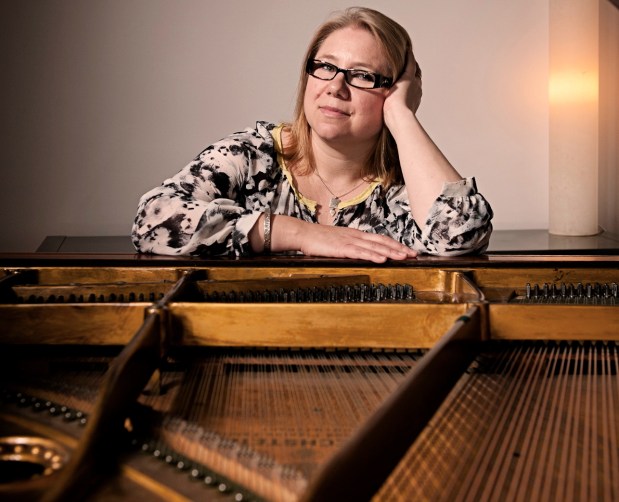
Judith Bingham (photo credit: Patrick Douglas Hamilton)

Who or what inspired you to take up composing, and make it your career? 

I started when I was very small – my mother said I was 4, but I don’t think she really knew. The attraction was its secrecy I think – I was already playing the piano, and liked the fact I could have a secret world that no-one else could influence. I think the person who influenced me to make it my career was Berlioz, my teacher and friend during my teen years when no-one else took me seriously.

Who or what were the most significant influences on your musical life and career as a composer? 

Apart from Berlioz, two people really encouraged me when I was young, Colin Davis and Hans Keller: both were very selfless with their time though, of course, I didn’t appreciate that until I was much older. I was very lucky to have Hans as a teacher, – his Viennese background with its rigors and psycho-analytical slant suited me very well. He had a hugely improving effect on my writing and was also very kind. Musical influences were The Fires of London, French Baroque music, and probably singing in big choirs.

What have been the greatest challenges of your career so far? 

Being a composer for a living is continuously challenging! But I think the biggest challenge is being truthful in a world that worships fashion. Inner voices make you doubt what you are doing but there is no Art without Truth. I think as I get older there is a challenge of being brave and fresh and not just doing what you know you’re good at.

What are the special challenges/pleasures of working on a commissioned piece? 

I like the fact that every commission inhabits a separate world, it’s a totally different project from the last. As I was a performer myself for so many years I love working with musicians – I know that sounds obvious, but it is such a magical experience, the transformation from the page to the open air. Trying to get it right – the act of fulfilling the brief – while remaining uncompromised is the great challenge, especially in church music where there are so many restrictions.

What are the special challenges/pleasures of working with particular musicians, singers, ensembles and orchestras? 

Whether they can do what you’ve written! That’s the heaven and hell of life for composers. All composers get a lot of bad or inadequate performances either through their own fault, – having written something that’s miles too hard for the commissioners – or short rehearsal time – or lack of empathy, or all three. A piece has to be very banal for people to get it straightaway, but often there isn’t enough rehearsal time for people to get beyond the stage of getting the notes right. This is the English disease. Often it isn’t to do with money but with a British distaste for too much emotional involvement. There is an idea that repeated performances take the place of rehearsal. But it’s tragic when people commission a big piece, only do it once, and spend most of the rehearsal time doing the Beethoven. The pleasure is when people really engage and go the extra mile – of course, they get more out of it this way, and the experience for everyone becomes extremely uplifting. The real magic happens when people feel free from worry about the notes and start to bring themselves to the performance, then the piece can really travel.

Which works are you most proud of?  

That would be a variable thing, and pride isn’t quite the right word, more a transient sort of satisfaction. But I would choose ‘The Ivory Tree’, a kind of dance drama I did for the Cathedral at Bury St. Edmunds. It was a project that went on for years and had some extremely fraught moments, but ended it fantastic performances.  I like mixing dance and singing, and would love to write an opera-ballet.

Who are your favourite musicians/composers? 

I am really eclectic with composers, though I have stopped listening to any sort of pop music. This might sound snobby, but it is more that there is only so much time. At the moment I’m listening to a lot of Prokofiev. He is a composer with enormous range, and I love the ambiguity of his music. I am trying listen more to women composers, as more and more music is being recorded now, alas, generally by women. I like the discovery of Italian baroque music by nuns, which is gorgeous. Favourite musicians: Roger Norrington, Philippe Herreweghe, Marc-André Hamelin, and people I’ve worked with – Stephen Farr, Tom Winpenny, Peter Skaerved Sheppard, Chamber Domaine, Andrew Carwood – too many to mention.

What is your most memorable concert experience? 

There are some terrible ones! But I can’t really do a league table of the good ones. When I was a student, performing in the Proms was overwhelming, especially Berlioz and Mahler. My first experience of the great roar of a full Albert Hall was extraordinary. Sometimes it is the small unrecorded events that stay with you, or a particular feeling of telepathy with other performers. You might expect big events, big names to be memorable. But it is often something more intimate where a transcendental kind of communication happens.

What do you consider to be the most important ideas and concepts to impart to aspiring musicians? 

I like what Peter Maxwell Davies said to students: ‘my first piece of advice is – don’t listen to anything I say!’ or words to that effect. I think I would say that integrity matters: this is even more true in today’s world, where things are remembered for ever on the web. The more you dilute your ideas and your identity the less anyone will value what you do. In the (very) long run what people want from a composer is individuality, and truth. It doesn’t mean an easy life though. Develop your ideas – the music doesn’t think for you. Read and think, and develop ideas on the big mysteries of life. There’s a lot of junk out there: the world doesn’t need any more.

Where would you like to be in 10 years’ time?

Still alive, please, and compos mentis.

What is your idea of perfect happiness?

No such thing.

What do you enjoy doing most?

Thinking, starting a new project, researching pet subjects.

What is your present state of mind?

Stressed as usual.

Born in Nottingham in 1952, and raised in Mansfield and Sheffield, Judith Bingham began composing as a small child, and then studied composing and singing at the Royal Academy of Music in London. She was awarded the Principal’s prize in 1971, and 6 years later the BBC Young Composer award. Recent composition prizes include: the Barlow Prize for a cappella music in 2004, two British Composer Awards in 2004 (choral and liturgical) one in 2006 (choral) and the instrumental award in 2008.

Read Judith’s full biography here
Interview date: October 2013

Schubert_Beethoven_sonatas_SMLMP35Mozart – Fantasy in C minor, K475
Beethoven – Sonata in C minor, op 13 ‘Pathétique’
Schubert Sonata in B flat major, D960

Semaphore: SMLMP35, 1 CD
Sarah Beth Briggs, piano


Sarah Beth Briggs’s latest release is dedicated to her teacher, the renowned pianist and musicologist Dennis Matthews, who died 25 years ago this December. Sarah pays tribute to his memory with a selection of much-loved works by Mozart, Beethoven and Schubert, pieces which were at the core of Matthews’ performing repertoire, and to which he introduced Sarah when she was still very young. The liner notes contain a touching tribute to Dennis Matthews by Sarah, recalling a concert when she heard him perform Schubert’s last sonata.

Mozart composed the C minor Fantasy in May 1785, shortly after the C minor Piano Sonata K457. Often a set piece for young piano students (I learnt the Fantasy, together with the C minor Sonata, when I was about 12 or 13, with little conception of how profound these works really are), the work is imbued with a gravity, drama and pathos more akin to Beethoven, and programming it before the great C minor ‘Pathètique’ Sonata allows the listener to make connections, both musical and emotional, between these two works. Sarah brings a sense of mystery to the opening motif,  with a spacious and suspenseful reading. This atmosphere of darkness and disquiet pervades the work, though there are sunnier episodes too.

Throughout Sarah plays with great clarity, sensitive to Mozart’s precise and dramatic articulation, dynamic ‘chiaroscuro’, and contrasting changes of mood, character, key and tempi. The major key interludes are warm and lyrical, while the Allegro sections are furious and agitated, the tremolando figure in the treble a brief but impassioned outburst. This is dramatic and highly satisfying reading shines a new light on this well-known work, and had me reaching for my (rather dog-eared) score from my teens, with a view to revisiting this Fantasy.

From the drama of Mozart’s C minor to Beethoven’s in the ‘Pathètique’ Sonata, Op 13. Like the Fantasy, the Sonata opens with a darkly dramatic and richly orchestral ascending broken chord figure. But this is more than an introduction, returning several times during the course of the movement. The succeeding Allegro is tight and energetic, played with a tempo which suggests the music bordering on unbridled frenzy, but never allowed to fully break free. This, coupled with the same careful articulation as in the Mozart, serves to further highlight the tension and dynamic contrasts of this movement. In the liner notes, Sarah gives her reasons for omitting the exposition repeat.

The slow movement is surely one of Beethoven’s best loved and most beautiful, a warm ‘cello-like cantabile over a gently moving bass line, suggesting a song without words. Unfussy pedalling, and sensitivity to the melody in the treble, and string articulation in the bass line, make this movement most satisfying, a delightful breathing space between the drama of the first and final movements.

The final movement has an elusive quality, and, despite its minor key, is wistful rather than dark. Sarah’s choice of tempo allows the passage work and cadenzas to shine. Like the Mozart, the movement ends defiantly.

Composed only a few months before his death in 1828, Schubert’s B-flat Sonata D960 was the result of a period of fervent compositional activity, and is considered to be his finest piano sonata. Compared to the Beethoven, it is expansive (indeed, the “heavenly length” of its opening movement is as long as an entire Beethoven Piano Sonata), and Sarah’s account offers a persuasive narrative, from the songful opening measures of the first subject, through the entire exposition (thankfully with repeat intact, to allow one to fully comprehend the drama of the trill before the reprise, and the extraordinary bridge into the development), to the gentle, prayer-like closing cadence. This is enhanced by the choice of tempo, a moderato that moves forward with a pleasing suppleness and fluency, and scrupulous attention to articulation.

Richly resonant bass notes underpin the meditative Andante sostenuto slow movement, while a sunny wamth pervades the central A major section, recalling the opening sentence of the first movement. The third movement sparkles, fresh and delicate, its playful Scherzo theme emerging gradually, as if from the mist of the previous movement. The essential sunniness is hardly obscured by the darker Trio; rather the shift of mood seems witty here, rather than gloomy.

The finale brings together many of the elements heard in the previous works on this disc: contrasting moods, tempi, dynamics, textures and colours, but always reinforced by Schubert’s melodic grace and poetry. Sarah is responsive to the shifting landscape of this movement, and the overall atmosphere is witty and positive, ending with a triumphant Presto.

Sarah Beth Briggs (image credit: © Clive Barda/ArenaPAL)

This is an extremely satisfying, characterful and thoughtful reading of three great works for the piano, underpinned by intelligent programme notes, and attractive design (the cover image is a painting of Sarah by Paul Martinez-Frias). The recording was made on a Steinway at Potton Hall, Suffolk, a venue famed for its clear acoustic. Combined with Sarah’s ever-responsive articulation, musical sensitivity, quality of sound and clarity of delivery, this is a splendid programme, and excellent value too.

Meet the Artist……Sarah Beth Briggs

I can think of few better ways to spend a Monday lunchtime than enjoying piano music in a beautiful setting such as the Wren church of St James’s, Piccadilly. It was doubly pleasing to escape the cold October rain on this particular Monday.

St James’s Piccadilly hosts regular lunchtime recitals, mostly featuring up-and-coming and emerging artists. There is no entrance charge, though audience members are invited to make a donation afterwards to enable the church to continue to host these concerts.

A multi-award winning graduate of the Royal College of Music, pianist Amit Yahav is now pursuing a career as a performing artist as well as undertaking doctoral studies into the music of Chopin, at the RCM. He has received particular praise for his performances of Mozart, Chopin, Schumann and Liszt.

Amit opened his recital with Bach’s Partita No. 2 in C minor BWV 826. The Partitas were the last set of keyboard works Bach composed, and are the most technically demanding of all his keyboard suites. They were originally published separately, and later collected into a single volume, known as the Clavier-Übung I (Keyboard Practice), the title suggesting that Bach regarded these as technical works for rather than music for performance. In fact, like the French and English Suites, the Partitas are extremely satisfying, enjoyable and varied works, for both performer and listener.

The C minor Partita opens with grand orchestral statements before moving into more fluid territory, to which Amit brought great clarity of articulation, despite the rather echoey acoustic in the church, and the large voice of the Fazioli grand piano. The subsequent movements were shapely, Amit always sensitive to the melodic lines and “voices” so crucial to Bach’s music. The Courante, Rondeaux and Capriccio were sprightly, imbued with wit, despite the minor key.

The Schumann Humoresque Opus 20 might seem a strange pairing with Bach’s mannered arabesques, but in fact both pieces worked well together as a programme. The Humoresque shares a number of features with the Partita, most notably its changes of mood and tempo through the individual movements. The work consists of seven movements, to be played attaca one after another. Amit was adept at neatly capturing the mercurial wit and humour of Schumann’s writing, highlighting Schumann’s dual musical personalities: episodes of warm lyricism and emotional depth were contrasted with masterly double-octave passages, nimble tempos, and full-toned fortissimos. This was an extremely enjoyable concert, the music performed with finesse, sensitivity, and obvious commitment by this young artist.

Details of future performances by Amit Yahav can be found on his website

Meet the Artist….,.Amit Yahav

“Everything we experience is a gift, a present we should cherish and pass on to those we love”

The inspiring and moving story of the oldest living Holocaust survivor and concert pianist Alice Herz-Sommer.

Now 109 and living in a tiny flat in London, Alice still plays the piano for several hours every day, practicing her beloved Bach and Beethoven. Once a renowned and celebrated concert pianist who performed to enthusiastic audiences around central Europe, Alice was deported to the Theresienstadt concentration camp, where, like thousands of others, she endured unspeakable hardships. Yet it was music that enabled her to look beyond the horrors of day-to-day life in the camp. She played more than 100 concerts inside the camp, and still talks with great passion about the experience.

Allice’s extraordinary story has now been made into a full-length documentary by Oscar®-winning filmmaker Malcolm Clarke

Full details about Alice and the film about her life here