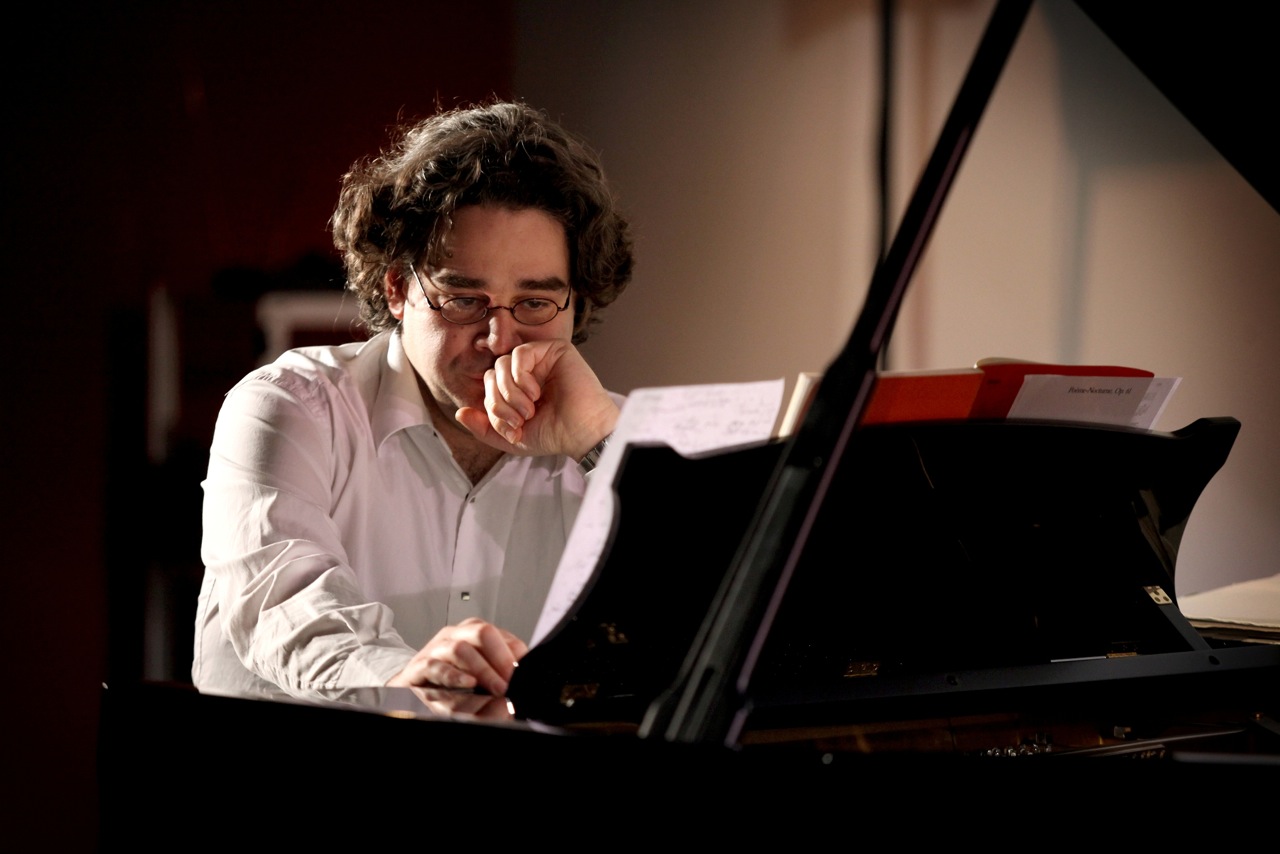
(Picture © Guy Vivien)

Who or what inspired you to take up the piano and make it your career?

I heard my father playing Chopin, Grieg and Schumann at home almost every evening on our small upright piano. Then I tried to imitate him! As I was gifted, he decided to do everything necessary to help me in my development: courses with great teachers, day to day work. He believed in my musical career from the very beginning and that was probably the most important.

Who or what are the most important influences on your playing?

Arthur and Karl-Ulrich Schnabel (with whom I really learned my Beethoven), then Leon Fleisher, who was for me a kind of Mentor, and Christian Ivaldi, who opened my brain to the world of Wagner and Strauss, which radically influenced radically repertoire and the texture of my personal sound.

What have been the greatest challenges of your career so far?

Playing the 32 Beethoven sonatas in 10 days.

What are the particular challenges/excitements of working with an orchestra/ensemble?

Playing a concerto with orchestra is the utmost gift a pianist can receive! The piano concerto repertoire is just fabulous and I always feel like it’s an achievement in a solo career. The main problem is to build a relationship with a conductor in a very short rehearsal time. You can feel a kind of frustration sometimes. It is why my relationship with Philippe Jordan is very special, as we have recorded and played so many concertos since 2007! The complete Beethovens on CD and in concert as well as Mozart, Brahms and Saint-Saens. The musical result is amazing because we feel like chamber music partners.

Which recordings are you most proud of?

My Brahms 2nd concerto with LPO and Paavo Berglund, the Beethoven Fifth Concerto with O.P. Radio-France and Philippe Jordan, and my last live recording of Beethoven’s ‘Hammerklavier’ Sonata recently released.

Do you have a favourite concert venue?

This is a tough question. For recital, I would say Wigmore hall and Queen Elizabeth Hall, Köln Philharmonie and Metz Arsenal.

With orchestra, Suntory Hall in Tokyo, Salle Pleyel in Paris and Royal Festival Hall in London. Next season I will make my debut in two great European hall: Tonhalle in  Zürich and the Concertgebouw in Amsterdam!

Who are your favourite musicians?

Among others – Furtwangler, Celibidache, Barenboim, Boulez, Brendel, Pollini and Sokolov. I rediscovered Arrau recently: a genius.

Regarding the conductors I’ve played with I would mention Esa-Pekka Salonen, Daniel Harding, and of course Philippe Jordan. Recently I played with the young conductor Edward Gardner: he was astonishing.

What is your most memorable concert experience?

Philippe Jordan conducting Parsifal in Bayreuth.

What is your favourite music to play? To listen to?

Beethoven always to play and listen, I listen more than ever Wagner’s Ring..and all the others.. Then Bruckner 4/5/7/8/9, the complete Mahler

What do you consider to be the most important ideas and concepts to impart to aspiring musicians/students?

Do not only work solely at your instrument, although it is crucial to spend hours on practising. The main thing is to have an exhaustive knowledge of orchestral and operatic repertoire in order to make the piano like a real orchestra

What are you working on at the moment?

The 5 Beethoven Concertos and the 32 Sonatas, as well as some Wagner paraphrases to celebrate this genius!

I also have some modern music as usual, new studies from Georges Benjamin and a Piano Concerto by Tristan Murail.

Where would you like to be in 10 years’ time

Any place where I could perform Beethoven’s music.

What is your idea of perfect happiness?

My wife’s love forever and music everywhere.

What is your most treasured possession?

Patou, my dear cat!!!!!

What is your present state of mind?

Promethean!

Interview date: November 2013

François-Frédéric Guy is regarded as one of the most fascinating pianists of his generation since his career was launched by his debut with Orchestre de Paris and Wolfgang Sawallisch in 2000.

Guy is an artist of immense interpretative authority and superlative technique. He has spent much of his career performing the works of Beethoven, recently completing recordings of the five concertos with Philippe Jordan, and the 32 Sonatas.  Guy has performed worldwide with orchestras such as the Berlin Symphony, Hallé, Philharmonia, London Philharmonic, Munich Philharmonic, Orchestre de Paris and San Francisco Symphony and conductors including Esa-Pekka Salonen, Bernard Haitink, Daniel Harding, Neeme Järvi and Michael Tilson Thomas.

www.ffguy.net

This week I took the difficult and reluctant decision to ask some of my students to leave my studio at the end of this term. This decision was not taken lightly, and is not something I have had to do before (a couple of students left of their own volition, for various reasons, and I have never had any trouble replacing them).

In recent months, in particular since completing my Licentiate Diploma, I have wanted to focus more on my own playing and performing, something I came late to, but now really enjoy, be it for my local musical society, at events organised by the London Piano Meetup Group, or simply for friends at home. In addition to this, my other activities – concert reviewing, co-hosting the London Piano Meetup Group (LPMG) and managing the South London Concert Series (SLCS) – take up quite a lot of my time each week, and I am also toying with the idea of taking the Fellowship Diploma (FTCL) in the next few years. All of these things take time – learning and preparing repertoire for performance takes the most time. And recently I have decided I want to be “a musician who teaches”, rather than the reverse.

People say to me “I don’t know how you find the time!”, and lately I’ve been wondering this myself, as I rush from one activity to another, constantly watching the clock and frantically trying to fit everything into each day. I began to resent the time spent teaching, not just the actual one-to-one tuition, but all the preparation and admin that is required when running an active and popular teaching studio, and I found I wasn’t enjoying my busy life all that much any more. When I actually fell asleep during a recent concert at the Wigmore Hall, I decided it was definitely time for a change.

Some musicians who are regular performers who also teach regard teaching as a necessity to pay the bills, and many are able to “switch off” while listening to a student playing a song by Adele or a simple Grade 1 piece. My naturally conscientious nature won’t allow me to do this, and I want to give each student individual and personal attention, no matter what they are playing.

Learning to play the piano is hard. It takes commitment and time, and students (and their parents) need to understand that consistent, regular practise equals noticeable progress. There are, unfortunately, no two ways about it, and even top professional pianists put in many hours of practice, day in day out. One cannot simply to pitch up for lessons week after week having done nothing between lessons and expect to make progress: it just doesn’t work like that! Unfortunately, where I live in an very affluent area of south-west London, there is a strata of parents who feel that music lessons are a crucial part of their son or daughter’s c.v., along with tennis, Tai Chi, and Kumon maths. Thus, many children are pushed into music lessons which they may not enjoy nor benefit from, and it can be depressing for a teacher to sit at the piano with a child who clearly doesn’t really want to be there.

So, I took a deep breath and drafted notice letters. I decided I wanted to focus only on my more advanced students, in particular those who are studying for exams. When I wrote to the parents concerned, I placed the responsibility for my decision entirely upon myself: I cited a need for more time for my other activities, a wish to reduce my teaching hours, my desire to focus on my own repertoire, and family commitments. Fortunately, I had the support of a couple of teaching colleagues who were willing to be mentioned in my letters, and I was thus able to offer the parents alternative teachers, should they wish to seek lessons elsewhere.

There was a time, until quite recently in fact, when I would consider any student, provided I liked the student and parent, and vice versa. On reflection, it seems this attitude was based on a need for a steady income, rather than proper consideration of how my teaching talents are best served and personal job satisfaction. I admit I am in a fortunate position, being married to someone who is in a well-paid job, and I can now afford to be more selfish about my time.

My teaching philosophy has changed considerably in the seven years since I established my practice: I used to think that simply being at the piano was enough, to gain enjoyment from it, but in the last few years my interest has shifted and I am now most interested in encouraging my students to become rounded musicians, who play with fluency, expression and confidence. I want to introduce my students to the fantastic canon of classical music by offering them a broad selection of repertoire: playing pop songs is all very well, but it does not give one a proper grounding in the history of classical music. This may appear a narrow view, but I fully believe that the study of even the most simple pieces by Bach and Mozart, for example, offers students crucial insights into how music is created and important technical training.

I don’t think any teacher should feel guilty or bad about asking students to leave their studio. Sometimes it is necessary – for reasons of behaviour, personality clash, lack of practice etc – and sometimes one just has to accept that not every child can be turned into a budding musician. Above all, I think it is crucial that one gains a strong sense of job satisfaction and enjoyment, otherwise one will begin to resent certain students, an attitude which can colour one’s whole approach to teaching.

Come the new year, I hope I will be better able to balance my own piano study with my teaching, my writing and my other musical activities, without feeling put upon or stressed. And to the students who are leaving my studio, I wish them luck and hope they will continue their piano studies with another supportive and inspiring teacher.

Resources:

  • If you feel you have a problem student, try discussing the issues with the student and/or parent initially. If there is no improvement, it is then time to consider asking the student to leave.
  • Try and offer students whom you have asked to leave details of other teachers, should they wish to seek lessons elsewhere
  • Be honest: explain the reasons why you are asking a student to leave.
  • If you have written contracts with your students, be sure to observe the terms set out therein, if applicable
  • Don’t feel guilty: it is your work and your life and it is important to feel in control. This enables us to do our job better, with greater satisfaction and enjoyment.
  • Organisations such as EPTA and the ISM can offer support

Who or what inspired you to take up the violin and make it your career?

My dad originally. He’s a violinist and I heard him practicing as soon as I was born. It seemed like fun – which is a huge tribute to my dad for making it look that way. I don’t think I have successfully communicated a joy of practice to my children, who hear nothing but shouting and swearing from my practice room.

Who or what were the most important influences on your playing/composing?

My teachers were, and continue to be, huge influences. Starting with Sheila Nelson as a child, then Jean-Jaques Kantorow and Ruggiero Ricci as a teenager, with Victor Danchenko at Curtis as my last teacher.

Each one had a massive impact on my playing and my whole approach to music. I can’t imagine not having studied with any of those four teachers.

What have been the greatest challenges of your career so far?

Keeping the discipline of every day practice, the neurosis involved in ever taking time off, and balancing the whole thing with a desire to be at home with my kids instead of travelling.
That last part is a real challenge, and not one I particularly relish, as I prefer being at home with my kids to anything else.

Which performances/compositions/recordings are you most proud of?

Without a doubt my new album, Fairy Tales, which is an album for children that took years to put together. I’ve never been so proud of anything, at least professionally. It’s the only thing I’ve recorded which I can actually listen to for fun.

Do you have a favourite concert venue to perform in?

The UK has some wonderful halls – Bridgewater Hall, Symphony Hall, the Wigmore.
But for a musician a venue is about more than just the hall itself. I just played in Antalya, Turkey, and the hall was basically next to the beach. You can’t ask for much more than that.

Favourite pieces to perform? Listen to?

Britten concerto, which I have also just recorded, is possibly my favourite piece to play at the moment. Very hard indeed but I would play it every night if someone would let me.

Who are your favourite musicians?

I hate all musicians! Particularly Meghan Cassidy from the Solstice Quartet, who is currently sitting next to me and being distracting.

What is your most memorable concert experience?

I’m hoping it will be tonight, but I might not have practiced enough.

What do you consider to be the most important ideas and concepts to impart to aspiring musicians?

I think the simple most important piece of advice I have is that you’d better really want to do it. Otherwise, the sacrifices you need to make will not feel comfortable…

What are you working on at the moment?

Loads of things!  Paganini Concerto is currently providing most stress as I haven’t played it since I was a lad and it has apparently got much more difficult.

What is your most treasured possession?

I guess my kids don’t count as “possessions”?!
Probably my violin then…..wouldn’t be able to do much without that.
Matthew Trusler has developed a reputation as one of Britain’s leading violinists, performing with many of the world’s great orchestras, and receiving huge critical acclaim for his diverse recordings. He has also founded the record label Orchid Classics on which some of the most important artists of today are recording, and the Lenny Trusler Children’s Foundation, which raises money for desperately ill babies. Trusler was instrumental in forming the Malmo International String Festival of which he became Artistic Director in 2011, and was in 2012 appointed a director of Delange Artists Management, based in Amsterdam.

Matthew Trusler’s full biography

Marc-André Hamelin, (image credit: Fran Kaufman)

Canadian pianist Marc-André Hamelin has an unerring ability to tackle anything the piano repertoire can throw at him: the craggy, disparate edifice of Charles Ives’ Concord Sonata, Stockhausen’s Klavierstück IX, Villa-Lobos’ savage Rudepoema, the mannered classicism of Haydn, and the sweeping romanticism of Liszt. His latest concert, part of his residency at Wigmore Hall in 2013/14, combined peerless technical mastery, cool perfection, pristine beauty and profound musical understanding in a quartet of works by Medtner, Janáček, Ravel and Hamelin himself, with the London première of his own composition. The programme traced a darkly lit narrative from the brooding opening bars of Hamelin’s atmospheric Barcarolle, through the sprawling musical landscapes of Medtner’s Night Wind piano sonata in E minor, inspired by a poem by Fyodor Tyutchev, to the poignant intimacy of Janacek’s On an Overgrown Path and the strange night-time fantasies of Ravel’s Gaspard de la nuit.

Read my full review here