Who or what inspired you to take up the piano, and make it your career?
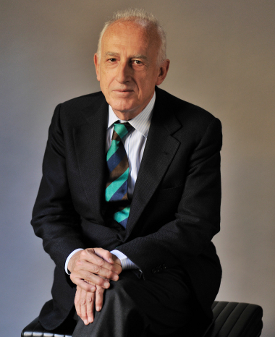
My mother chose the piano for me. I was a small child. I was inspired by Furtwängler conducting Beethoven’s 9th symphony. The slow movement made me cry. I chose music so I could be moved throughout my life.


Who or what were the most important influences on your musical life and career?

Denyse Rivière, Marcel Ciampi and Paul Badura-Skoda.

What have been the greatest challenges of your career so far?

Every concert, every meeting with a great artist, is the greatest challenge for me.

Which performance/recordings are you most proud of?

None, except the one I had in my dream last night.

Which particular works do you think you play best?

None. Because at the end of one performance, I know exactly what not to do the next time.

How do you make your repertoire choices from season to season?

I never plan. It’s a difficult question to answer. It’s just like a love story; you don’t know who you are going to fall in love with. Each season it’s a new surprise, a new love story.

Do you have a favourite concert venue to perform in and why?

Usually the most important concert is just the next one. There is no difference between a small village and Carnegie Hall.

Favourite pieces to perform? Listen to?

I listen like crazy to the music from the film The Umbrellas of Cherbourg by Michel Legrand.

Who are your favourite musicians?

Usually, the greatest dead ones because they are the most inspiring and they are no longer dangerous.

What is your most memorable concert experience?

In Kuala Lumpur. When I arrived on stage, there were no pedals on the piano.

What do you consider to be the most important ideas and concepts to impart to aspiring musicians?

To always be curious and inspired by the past. And I can say for myself that I love the past. It’s more relaxed than the present and much more secure than the future.

Where would you like to be in 10 years’ time?

How can I answer this question, when I don’t know where I’ll be in the next ten hours?

What is your idea of perfect happiness?

To fly in love (not fall).

What do you enjoy doing most?

I watch movies all the time, for example, Umbrellas of Cherbourg by Jacques Temy, Le Charme discret de la Bourgeoisie by Louis Bunuel, and all Frederic Fellini’s movies. And occasionally I like to practice.

What is your present state of mind?

I feel totally out of my mind. Fauré and Schubert are depressing me. The music is so very sad.

Jean-Marc Luisada gives a recital of works by Fauré, Schubert and Chopin at the Institut français, South Kensington on Saturday 5 April, 4pm as part of It’s all About Piano!

www.jeanmarcluisada.com

David Bismuth, pianist (photo credit: ©JP Raibaud)

Who or what inspired you to take up the piano and make it your career? 

I chose to play the piano after I heard a friend playing a few notes. It seemed only natural that I should try the instrument and start playing. After a couple of years of private teaching, I entered the Conservatory of Nice, on the French Riviera, where I was born.  When I turned 14, I entered the Paris National Conservatory. It was at this time that I considered becoming a professional someday…


Who or what were the most important influences on your musical life and career? 

The person who has influenced me most these past ten years is the great pianist Maria Joao Pires. I had the chance to work with her when she lived in Portugal giving workshops there. Our musical collaboration evolved over the years and we even played together sometimes, 4 hands or 2 pianos. Both as a musician and as a person she remains a great source of inspiration.

What have been the greatest challenges of your career so far? 

To work without a manager and do everything by myself!

Which performance/recordings are you most proud of?  

I’m very pleased with the reactions I have received so far for my last recording, dedicated to “BACH and his sons”. It was particularly interesting to discover the music of Wilhelm Friedemann Bach, Carl Philipp Emanuel or Johann Christian Bach and make this family reunion happen, together with their father’s music.

Which particular works do you think you play best? 

I play a lot of French music… Maybe being a French pianist and living in Paris makes me feel closer to this repertoire and to the emotions and sensitivity it requires…

How do you make your repertoire choices from season to season? 

The recording projects I have help me toc hoose what I’m going to play next season. Sometimes I get special requests from festivals or orchestras asking me to perform pieces that I have dreamt about but never performed before which is particularly exciting.

Do you have a favourite concert venue to perform in and why? 

I played once in Polynesia, on an Island named Moorea. The concert took place in a beautiful resort in the countryside above the sea. The stage looked out onto the Pacific and from the piano I had an incredible view. When the concert started, the sun was setting…. I think this place instantly became my favourite venue in the world!

Favourite pieces to perform? Listen to? 

To perform: Bach/Busoni ‘Chaconne’ and Debussy ‘Clair de Lune’

To listen to: Rachmaninov 3rd Concerto and Schubert Sonata No. 21 D.960

Who are your favourite musicians? 

Radu Lupu, Jacqueline Du Pré, Samson François

What is your most memorable concert experience? 

Sharing the stage with Maria Joao Pires performing Mozart Concerto for 2 pianos in Paris, Salle Pleyel, in November 2010.

What do you consider to be the most important ideas and concepts to impart to aspiring musicians? 

I think one of the most important things in music is to keep true tothe score, in order to discover what is not written on the score!

I would also encourage younger musicians to let the music come from their entire body, not only from their fingers and their head…

What are you working on at the moment? 

Mozart Concerto for 3 pianos, with the Orchestre de Paris.

Where would you like to be in 10 years’ time? 

I have absolutely no idea… And I like it !

What is your most treasured possession? 

My son Matteo! But he’s not really my possession, is he ??

What do you enjoy doing most, when not playing the piano? 

Watching tennis matches on tv… And also playing myself!

David Bismuth gives a recital of works by Fauré, Franck, Alkan, Chaminade and Saint-Saëns at the Institut français, South Kensington on Sunday 6 April, 12 noon as part of the It’s all About Piano! festival

www.davidbismuth.com


This weekend sees a celebration of all things piano at London’s Institut Français, with workshops, lectures, film screenings and performances. In the run up to this surfeit of piano goodness, I am delighted to be publishing Meet the Artist Interviews with some of the performers, including acclaimed French pianist Pascal Rogé (who also performs at Wigmore Hall in June) and harpsichordist Kenneth Weiss. The first interview is with French pianist David Bismuth.

Full details about the festival here:

www.institut-francais.org.uk/itsallaboutpiano

Behind_The_Lines1-724x1024Music of Our Time (MOOT) is an innovative musical community founded by Norman Jacobs, which seeks to promote and appreciate contemporary music through communal listening, creative discussion, talks, films and other events, with a special focus on disability groups. MOOT enjoys a lively and busy season of concerts each year, always with a special theme: last year it was music and disability, and this year it is music of the First War in a series of concerts entitled ‘Sounds of War – Instruments of Peace 1914-2014′. The series launches on Wednesday 7 May with a concert of works for piano duet, performed by Helen Burford and Norman Jacobs.

The concerts, which form part of Brighton’s Fringe Festival, feature composers and music from the era of the First War (Bridge, Ravel, Elgar, Holst, Debussy, Butterworth, Finzi, Ireland), or focus on an aspect related to it, such as ‘Empty Sleeve – music for the left hand’, performed by left-handed pianist Nicholas McCarthy, which reminds us of the pianists who lost an arm during the conflict (most notably, Paul Wittgenstein) and who were able to continue a performing career, playing repertoire for the left hand. Alongside the concerts are film screenings (Oh! What a Lovely War!), a performance of Jessica Duchen’s play A Walk Through the End of Time, lectures and talks, a composing workshop and a trip to Frank Bridge’s house.

MOOT’s events will not only commemorate the centenary of the start of the First War and serve as a poignant remembrance for those whose lives were irretrievably altered by the conflict, but will also celebrate the music and poetry of that “lost generation”. Some, like George Butterworth, lost their lives in the war; others were profoundly and irrevocably affected by it (for example, Frank Bridge, a committed pacifist).

For more information about MOOTs events, please visit the Music of Out Time website


