Syzygy Saxophone Quartet formed in 2009 after playing together at the World Saxophone Congress in Bangkok. The quartet aims to promote and perform established contemporary classical works for saxophone, alongside new music written especially for the ensemble. 

At the beginning of 2013 Syzygy Saxophone Quartet were the only ensemble in Europe to be awarded the performance and recording rights to the new 45 minute work by the American composer David Maslanka. Entitled ‘Songs for the Coming Day’, the work  considers ethical and moral issues facing the world today such as the environment and war. Despite such problems, the piece is imbued with hope, reflecting the composer’s belief that “that under the chaotic surface of our world there is a rising creative energy through which is growing a new idea of living in harmony with ourselves and the Earth” (David Maslanka) and that there is still optimism regarding the future of the planet.
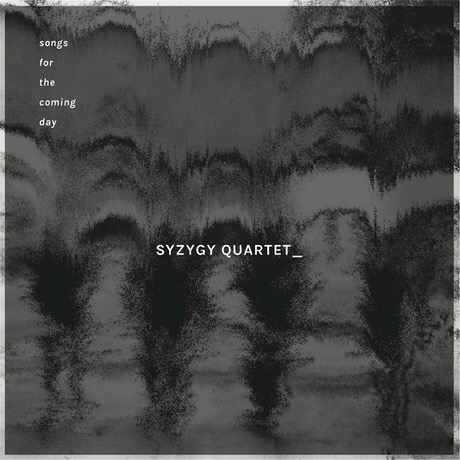
  
Lasting around 45 minutes, the work comprises nine movements, relatively brief “songs without words”, with titles such as Breathing, Awakening, Letting Go of the Past, and The Soul is Here for its Own Joy. The movements have hymlike qualities both in the SATB harmonies and ensemble playing, but also because some are actually based on hymns or songs,  adapted and reset for saxophone. Eight of the nine movements have varying degrees of slow tempi and a generally quiet or restrained dynamic palette.

The opening movement, ‘At This Time’, utilises a three-note motif redolent of ‘Nimrod’ from Elgar’s Enigma Variations, and just as in the Elgar, this rising figure sounds a note of hope. All the movements, except for the penultimate one, are reflective and meditative, and Syzygy’s precise and concentrated ensemble playing and exceptionally well-blended, warm tones enhance the sense of contemplataion and stasis. The music itself is melodic and accessible. At times it has a choral quality reminiscent of Renaissance sacred music in it harmonies and simple lines underpinned by ostinato figures or pedal points.

In contrast to the other movements, the eighth, ‘The Soul is Here for its Own Joy’, bursts forth with exuberance and rhythmic excitement, while the closing movement, the poignant and introspective ‘Song for the Coming Day’ returns to the pensive mood of the earlier movements.

The saxophone is often the poor-relation instrument in classical repertoire, rarely utilised in the orchestra and not generally taken up by “famous” composers. In ‘Songs for the Coming Day’, the combination of elegance, restraint and melody and Syzygy’s technical assuredness and musical understanding, we are given the opportunity to appreciate the saxophone as a classical instrument.

Highly recommended

‘Songs for the Coming Day’ is available now 

Syzgy Quartet will feature in a forthcoming Meet the Artist interview

syzygyquartet.co.uk

11 Dec flyer.png

Enter the National Physical Laboratory campus via the Queen’s Road, Teddington entrance. Take the second exit at the roundabout left onto Bushy Road (signed NPL Sports Club). At the T-junction, turn right into Glazebrook Road. Bushy House is the large 18th-century redbrick building. Enter via the main door (white columns) or smaller door to the left. Turn left – the Scientific Museum is at the end of the corridor.

More about the NPL Musical Society

(photo: Martin Tompkins)
Who or what inspired you to take up the clarinet and pursue a career in music?

Hearing the sound of a clarinet in a live orchestral concert – I had been advised to take up a second instrument to complement my piano studies and the sound won me over!

Who or what were the most important influences on your musical life and career?

My two most important teachers – firstly, my initial piano teacher, Bridget Christian, who above all encouraged me to love the music that I played. Secondly, my major clarinet teacher during my school years, Dr. Kevin Murphy. He was not just a teacher, but a friend and mentor in every respect, demanding excellence and dedication, fostering (and sometimes reining in) my enthusiasm, and giving me advice and principles which I use every day in developing my career.

What have been the greatest challenges of your career so far?

Leaving full-time study and transitioning into the profession – occasionally staring at a worryingly bare diary, and having the confidence to continue.

Which performance/recordings are you most proud of?

Walking onto the stage at Snape Maltings aged 14, and summoning the courage to perform my first concerto (Weber’s 2nd, op. 74). I don’t remember much about the experience except overwhelming nerves before it, and overwhelming excitement and relief after it.

Which particular works do you think you play best?

I don’t know if I play them best, but the works that I enjoy performing the most are those which I truly can put my own interpretative stamp on, or collaborate with other musicians to create our own unique, musically considered approach. I am also – for better or worse – a bit of a showman, and I love to engage with that element in concertos, or lighten the tone of a recital with a fun and frothy showpiece.

How do you make your repertoire choices from season to season?

At the moment, my main priorities are variety (to keep both myself and audiences engaged), stylistic balance, and originality through new works.

Do you have a favourite concert venue to perform in and why?

I’m sure that I haven’t performed in nearly enough venues to make a choice, but for sentimental reasons (certainly not for acoustics) it would have to be Wells Cathedral, Somerset, a place I associate wholly with my formative musical years.

Favourite pieces to perform? Listen to?

To perform: undoubtably the Mozart Quintet K581 and the Copland Concerto.

To listen to: Jessye Norman’s 1982 recording of Strauss’ Four Last Songs with Kurt Masur and the Leipzig Gewandhaus, Claudio Abbado’s Daphnis et Chloé with the London Symphony Orchestra, or Earth, Wind and Fire’s Greatest Hits.

Who are your favourite musicians?

Far too many to list – but three that spring immediately to mind are: Joyce Didonato, for her advocacy of an utterly healthy, positive and enthusiastic approach to the world of music; Mitsuko Uchida, for her unwavering musical integrity; and Edith Piaf, for the sheer authenticity of her expression.

What is your most memorable concert experience?

During my final course as principal of the National Youth Orchestra of Great Britain – the principal’s ensemble played John Adam’s Chamber Symphony and Copland’s Appalachian Spring under Pablo Heras-Casado, and the full orchestra performed Copland’s monumental 3rd Symphony with Antonio Pappano live on BBC2 at the BBC Proms. It was an unforgettable and idyllic three weeks, with so many cherished memories. Rehearsing and performing the Weber Quintet op. 34 during my final year at university with the Endellion String Quartet was equally terrifying, thrilling, and enlightening.

What do you consider to be the most important ideas and concepts to impart to aspiring musicians?

Enthusiasm, enjoyment and dedication.

Where would you like to be in 10 years’ time?

Settled, happy, and making a living out of what I love doing, while continuing to love doing it!

What is your present state of mind?

Incredibly excited, if a little apprehensive about what my career will bring.

Joseph Shiner’s biography

josephshiner.co.uk

Is writing about music really like

“dancing about architecture”?

Tuesday 2nd February 2016, Senate House
University of London

I am delighted to be involved in this special event exploring the wide variety of writing about classical music today, including concert and opera reviews, academic writing, music journalism, programme notes, blogging and musicians who write about music

Guest speakers:

  • Dr Mark Berry – (Royal Holloway, University of London and blogger at Boulezian)
  • Jessica Duchen – author, classical music journalist and blogger
  • Mary Grace Nguyen – freelance opera and theatre critic and blogger at Trend FEM
  • Simon Brackenborough – blogger at Corymbus

Q&A and discussion session
Networking opportunity

Do join us for what promises to be an interesting and lively event, plus an opportunity to connect with like-minded people

Tuesday 2nd February 2016
7-9pm

Court Room, Senate House
University of London, Malet Street, London, WC1E 7HU

Tickets £5, students free (with proof of status)
https://billetto.co.uk/en/events/music-into-words

Presented in association with the Institute of Musical Research and the School of Advanced Study


