anna-tcybuleva

Who or what inspired you to take up the piano and pursue a career in music? 

I spent my childhood in a small scientific town in the south of Russia. I grew up in a creative family. My father is a radio physicist, my mother was a musician. She opened this fantastic world of music and art for me. She graduated from the College of Music as a pianist and also studied in Imperial Academy of Arts in St. Petersburg as an art historian. We had a lot of books about music and art at home. While I was a child my mother often played for me, or showed gramophone records of great musicians. When I was 6, my mother became my first piano teacher. Aside from that, I studied violin, but after two years I made the decision to play only the piano.

I remember one important moment in my life. I was 10 and I prepared for my first serious competition for young pianist in Moscow. At that time I already lived without parents, studied with another teacher in a town of Volgodonsk (approx. 700 km from my home). My mother also came to Moscow to support me. But everything was so difficult… I missed home, my parents missed me. My new teacher was very strict with me, forced me to practise more and more. When my mom saw how difficult the life of her 10-years-old daughter already was, she told me: “Let’s give up music and go back home?” To which I answered: “No, mommy, it is too late to go back”.

From that moment I never doubted that I was on the right way, and my mom always supported me.

Who or what were the most important influences on your musical life and career? 

For me there is no difference between musical and real life. Everything that happens to me affects my outlook. In other words, I learn from everything. My parents taught me to be always honest and analyze what is happening. I learn from my dear teachers, who are also teaching me to be honest and to listen to the sounds. They are the same important people for me as parents. By the way, my mountain skiing and swimming instructors taught me to be strong and always keep working, no matter what.

When I take the music scores, read them and play, I learn from composers. Some of them have greatly influenced me and my views. When I listen to great musicians, I get inspiration from their way of expression, but never try to copy them.

Life influences me every day and gives the most important lessons. And the music helps me to understand and express them.

What have been the greatest challenges of your career so far? 

There are a lot of creative challenges in the life of a musician: for example, to play something, what you wanted to play before, but weren’t ready for; how to analyze and understand, how to unite the form of the piece in your mind. Sometimes this kind of problem interrupt my sleep. But for me, the more harder the challenge is, the more interesting it is. I will never stop searching for new musical challenges.

Which performance/recordings are you most proud of?

It is very difficult for me to be satisfied with my playing. Every time after my performance I know how to make the piece better.

It is too early for me to be proud of something, which I played. The big and interesting endless searching is ahead. I hope I will be able to reach something genuine in the future. But I will start thinking about it no earlier than in 60 years.

Which particular works do you think you perform best? 

The works which I love with all my heart I play well. If I open the score and don’t like the piece, it means that I didn’t looked at the score attentively. Then I try to find more interesting details (there are always a lot). I discover something new for me in the piece and attempt to better understand the intent of the composer. Step by step, I fall in love with the work and then I play the piece, which I love!

How do you make your repertoire choices from season to season? 

The choice of repertoire is a very serious thing. Sometimes I spend weeks choosing the programme for a concert. I often seek advice from my teachers who have more experience than me. We discuss each programme and decide together.

Do you have a favourite concert venue to perform in and why? 

When I go to the stage, I get into a special private space, where I can imagine around me whatever  I want (big or small hall, empty or full audience and etc). There is no favourite concert venue for me. My feelings don’t depend on the external situation. I try not think about it while I’m on the stage.

Favourite pieces to perform? Listen to? 

I happy to play any kind of solo, chamber and orchestral music.

And I love to listen any musical genre in general.

What do you consider to be the most important ideas and concepts to impart to aspiring musicians?

The main thing in music for me is to listen and hear.

Where would you like to be in 10 years’ time? 

At home with my family, in front of a keyboard with scores and a pencil.

What is your idea of perfect happiness? 

Fortunately, I don’t know yet. When the time comes and if I have a chance, I ask one man, who definitely knows about that.

What is your most treasured possession? 

Health and happiness of my family.

Anna Tsybuleva was born in 1990 and started piano studies at the age of six. Anna is currently a post-graduate student at the Moscow Conservatory, while also studying at the Basel Music Academy with professor Claudio Martinez Mehner.

In 2012, Anna took part in the International Gilels Piano competition in Odessa (Ukraine), where she has won the 1st prize. The same year Anna was one of the winners of the prestigious Hamamatsu Piano competition (Hamamatsu, Japan).

Anna has performed at a number of international music festivals in Russia, the United States, Europe and Japan.

In June 2015, Anna Tsybuleva won 1st Prize at the prestigious Leeds International Piano Competition in the United-Kingdom, leading to many important invitations to perform in the UK and internationally.



Sometimes – often! – learning a new piece of music can feel like ascending a steep mountain.

The first few weeks, when the piece is still very new, can be an uphill slog as you cope with note-reading and learning, understanding the structure and harmony, and trying to get a handle on the character and expressive elements of the piece. Then one day you go to practise it and suddenly it seems a whole lot easier: you’ve scaled that initial steep ascent and have arrived on a pleasant plateau where playing becomes enjoyable again. At this point your progress may suddenly become quite rapid as you feel more at ease with the music.

But then – and I’m sure you know the feeling – you reach a certain point where you feel stuck on a ledge, the summit in sight, but seemingly unattainable. You need a push, a burst of energy to get you up there.

When I am reach this point in my learning, it is usually a sign that I need to see my teacher to assess my progress and to give me a shot of inspiration and encouragement to push me to the next level.

Sometimes reaching a seemingly inescapable plateau indicates that we are over-thinking our practising, or fretting over small or imaginary issues which we have turned into bigger problems. In this instance, try shifting the focus of your practising: if you have been practising the same piece in the same way for the past few weeks, try a different approach.

Maybe it’s a sign that it’s the time to put the music away for a few weeks and look at something else. “Oh but I might forget everything I’ve learnt!” I hear you cry. Not true – if you’ve done the careful learning in the first place, revisiting the music after a break should be fairly straightforward and it will take a matter of days to reacquaint yourself with the score. Taking a break also revives our interest in our music and gives us pause for reflection. Returning to the music after a break often throws up interesting new insights and ideas about the music, enabling us to work with renewed energy and excitement.

Conversations with friends, colleagues, teachers can often shine a light on a seemingly intractable issues with a piece. Asking a trusted friend or colleague to hear you play and give feedback can be helpful too. Meanwhile listening to recordings or going to concerts can lead to moments of revelation and inspiration.

Playing the piano is hard – as my teacher regularly says, “If it was easy, everyone would do it!” – and some pieces remain difficult, despite the many hours of work and thought we put into them. Thus, it is important to celebrate the Eureka! moments, while also allowing ourselves time to evaluate and reflect on what we are doing.

If you’ve reached a plateau in your learning, don’t despair. See your teacher, if you have one, or learn something new, something easier, or return to a piece you know you play well (this can be a tremendous confidence booster). Go to a concert with friends and enjoy talking about the music afterwards, join a piano group where you can meet other pianists and discover that we all share the same afflictions, hopes and fears. We don’t have to be chained to the piano every day to gain useful support for our practising and musical thinking.

Above all – don’t give up! And enjoy your music.

Further reading

The Bulletproof Musician

Practising the Piano


Olivier Messiaen’s monumental work Vingt Regards sur l’enfant Jésus (Twenty Contemplations on the Infant Jesus) surely ranks amongst the “greats” of the piano repertoire, standing shoulder-to-shoulder with Bach’s Well-Tempered Clavier and Beethoven’s 32 Piano Sonatas in terms of its scale, variety and pianistic challenges. It is one of the most ground-breaking works in 20th-century piano music, a work which has accrued iconic status and deep respect. It combines richly-hued romanticism and the spare modernism that influenced Messiaen’s pupil, Pierre Boulez, and reveals many of Messiaen’s preoccupations and interests – birdsong, eastern rhythms and instruments, cosmology, religious iconography and his own deeply-held Catholic faith.

French pianist Pierre-Laurent Aimard enjoys the special distinction of having known Messiaen personally, and he studied with Yvonne Loriod (who premiered the work in March 1945 and who became the composer’s second wife in 1961). Aimard has a long-standing and highly-respected relationship with Messiaen’s piano music and it remains a core part of his repertoire. He is also a champion of modern and contemporary piano repertoire, and as a result he brings to this music a special understanding of Messiaen’s unique approach to pitch, rhythm, sonority and attack.

Read my full review here

qsmolzomdsqg96-gyfbfopjs_w7_lgtb2l2kftvgoy57udwjhdrjmda-asj4rjglizp2gouoe-8w599-h795-no

Who or what inspired you to take up the violin and pursue a career in music? 

To be honest there was no great epiphany or moment of inspiration, it just always felt like I was meant to be making music – exactly how and in what form is still wonderfully open … tomorrow is a new day and will bring with it new inspiration.

Who or what were the most important influences on your musical life and career? 

Everything and everyone we encounter seeps into our being and becomes a part of our fabric, not least musical. When we give a name to the ‘most important’ influences there is always the danger that we forget the ‘very minor influences’, whose accumulation pave the indispensable road. Having said this, there are two remarkably special people who have shaped my playing and my life, and to whom I am eternally grateful: my mentor and teacher Nina Balabina and – on a more ethereal plane – Mahatma Gandhi.

What have been the greatest challenges of your career so far? 

Not to pursue one.

Which performance/recordings are you most proud of?  

Life has taught me not to look back but rather, in the spirit of forgetfulness, learn to live in the present, so I hope you do not mind if I pass on this question.

Which particular works do you think you perform best? 

More than anything I feel at home performing contemporary music or music from the last century, often in unusual and improvisatory combinations with older music.

How do you make your repertoire choices from season to season? 

I love having a large variety of works during a season both in style and genre. I try and create a balance between works I have played many times and into which I can delve deeper; new repertoire pieces; newly commissioned works; and finally works that will challenge different aspects of my playing and musical personality and which will hopefully open me up to new musical spaces.

Do you have a favourite concert venue to perform in and why?

For me it is more than anything the energy of the audience that makes a concert special. Therefore I love performing in any space that encourages a bubbling sharing of energies. Then, there are of course the ‘great’ halls that have their unique aura, filled with the sounds of past legends – it is a great privilege to be able to stand and add ones own little sounds to such spaces.

Favourite pieces to perform? Listen to? 

My tastes are rather eclectic and vary from day to day, from season to season. Some days I love the melancholic strains of Byrd and Josquin, on other days the romantic drama of Strauss, while Bach is always close at hand to cleanse the soul. I may also get immersed in the epic melodrama of Muse or the contemplative strains of Indian music.

Who are your favourite musicians?

Oh dear, this could be a very long list! Two personalities that immediately come to mind our David Oistrakh and Ravi Shankar.

What is your most memorable concert experience? 

Playing to monks in the Himalayas.

What do you consider to be the most important ideas and concepts to impart to aspiring musicians? 

Always LOVE every minute of what you are doing and learn to totally immerse yourself in the process, not worrying too much about where it will lead and what the resulting outcome will be.

What is your idea of perfect happiness? 

I experience perfect happiness when I get so lost in what I am doing, which happens most often when I am performing, that all time – past and future – seems to converge on the singularity of the present moment, bringing with it a surreal combination of overwhelming peace and the feeling of ecstasy.

Hugo Ticciati performs with Dame Evelyn Glennie at Kings Place on 27th April, and directs the Festival O/MODERNT in Stockholm from 10th to 16th June, centred on Handel and the Art of Borrowing. 

Festival O/MODERNT

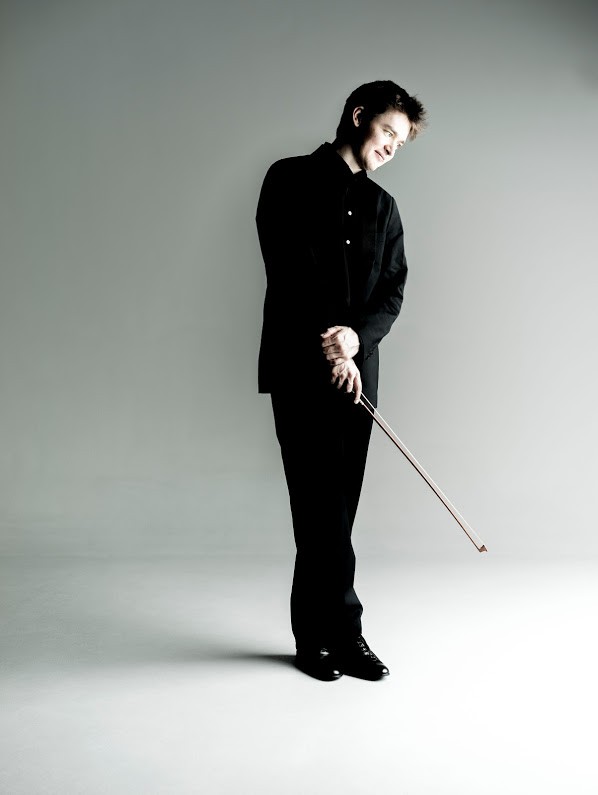
Hugo Ticciati is a violinist with a uniquely intellectual approach to his work, incorporating aspects of literature, philosophy, spirituality and meditation. He embraces the world of contemporary music, collaborating with composers such as Sven-David Sandström, Albert Schnelzer, Anders Hillborg, Djuro Zivkovic, Leonardo Coral, Andrea Tarrodi, Tobias Broström, Thomas Jennefelt, Sergey N. Evtushenko, Esaias Järnegard, Wijnand van Klaveren. In the coming seasons he will be performing world premières of concertos dedicated to him in Europe, Asia, and North and South America. Hugo also loves devising concerts and events that combine music with dance, literature and more obscure arts such as kinetic painting and rock balancing.

Last season’s highlights included concertos by Bach, Mozart, Prokofiev, Schnittke, Hartmann, Shchedrin, Piazzolla, Auerbach, Glass, Lutosławski, Takemitsu and world premieres of concertos by Tobias Broström, Sergey N. Evtushenko and Albert Schnelzer in venues including Carnegie Hall, Mariinsky Theatre Concert Hall, Chicago Symphony Hall and King’s Place. He also curated a series of concerts at the Wigmore Hall and the Muziekgebouw aan ‘t IJ, Amsterdam.

Read more about Hugo Ticciati

(Photo credit: Marco Borggreve)

