A Vast Obscuritycelebrates a number of notable anniversaries in the creative arts, including the bicentenary of Lord Byron’s death, the 460th anniversary of Shakespeare’s birth, as well as the centenary of the death of Song Easel’s featured composer, Gabriel Fauré. The work of poets plays a central role in this year’s series, with ‘obscurity’ a collective noun for a group of poets.
Audiences can look forward to some of the genre’s most incredible music, including Gerald Finzi’s Let us Garlands Bring (Francesca Chiejina, 16 June), and various depictions of the classic Wanderer figure (Mark Padmore CBE, 21 June). A vibrant new take on Don Juan (Ella Taylor, 31 May) features a new commission for the bicentenary of Byron’s death from Dr Joe Spence and Emily Hazrati, as well as a veritable feast of Gabriel Fauré across his centenary weekend (11-12 May), with highlights of Fauré’s Requiem Op.48, starring Elin Manahan Thomas, followed by a complete performance of his mélodies the following day – not to be missed!
Song Easel is thrilled to share an unforgettable collection of recitals in a variety of venues in South East London where performances promise to transport audiences to new dimensions. To quote the vision of Song Easel’s esteemed launch artist Roderick Williams OBE, “words are no longer just words, and music is no longer just music.”
SongEasel is an Arts and Education charity operating in South East London.
Our annual song series features some of the world’s leading exponents of song, whilst our vibrant community engagement and education programmes bring live music of an international standard to new listeners, building audiences for the genre in innovative and creative ways.
The pursuit of musical excellence is a journey that many musicians embark upon with a fervent desire to achieve perfection. We strive for flawless performances, impeccable technique, and unwavering precision. As an advanced amateur pianist, these are goals to which I too aspire.
But the constant pursuit for perfection and an ongoing desire for perfectionism in one’s music making can be a double-edged sword for musicians. The relentless pursuit of flawlessness can lead to a never-ending, often negative cycle of self-criticism and anxiety. Musicians who set impossibly high standards for themselves may find it difficult to ever feel satisfied with their performances, leading to a constant state of stress and self-doubt. Some may ask themselves, “will I ever begood enough?”
The pursuit of musical mastery is admirable, and indeed the striving for mastery is a major driver of motivation and commitment. However, it is also essential to recognise the significance of know when and accepting that you are “good enough” as a musician. Perfection can be an unattainable goal; acknowledging you are “good enough” is not only perfectly acceptable but can also be liberating and personally fulfilling. It can help musicians to break free from the paralysing grip of perfectionism, allowing them to enjoy the process of making music and to develop as artists and individuals.
My own personal acceptance that I am “good enough” came after I had spent nearly ten years studying for professional performance diplomas, having returned to the piano seriously after a gap of nearly 25 years. Having secured two diplomas with distinction in relatively quick succession, my ego led me to believe that the final, Fellowship diploma was well within my grasp. Unfortuntely, I failed this diploma; the deep disappointment I felt on receiving the news gave me an opportunity to reflect on what I really wanted from my music. I knew I would never be a professional musician, despite playing at an advanced level and receiving external validation from teachers, mentors, peers and audiences, and I knew I was a good pianist. But taking lessons, and attending courses and piano meetup events, where there was a tendency to constantly compare oneself to others of a similar ability, made me question my own abilities in a way which made practicing and music making feel like a chore rather than a pleasure. (And ultimately, as a amateur musician, pleasure should be at the foundation of one’s musical pursuits.)
“You don’t need to go on courses to know you’re good” my ultra-sensible, pragmatic and honest husband told me one day. And he was right. So I learnt to trust my own musical instincts, to recognise the value of what I had to say and to measure it against the music rather than other people – to, as Schumann said, “…converse more with scores than with virtuosi” – to recognise my own autonomy as a musician, and accept that I am “good enough”.
The result has been liberating. I no longer care what other people are playing, at what level they play at, or what repertoire they are working on. I play the music I want to play, and I’ve stopped beating myself up if I don’t practice every day (another joy of being an amateur is not feeling beholden to one’s instrument and muse every single day).
So why should you, as a musician, accept that you are “good enough?”. Here are some thoughts on the subject:
Embracing Individuality
Every musician possesses a unique set of skills, experiences, and perspectives. Embracing the idea that you are “good enough” means recognising and celebrating your individuality as an artist. It allows you to focus on your strengths, develop your style, and create a distinctive musical identity. While aspiring to reach new heights and improve is essential, acknowledging your current level of skill and artistry is a valuable step toward authentic self-expression.
Redefining Success
Success in music should not solely be measured by technical perfection or the approval of critics, peers, teachers or audiences. By accepting that you are “good enough,” you redefine what success means to you personally. It can encompass the joy of playing, collaboration with colleagues, the connection with your audience, and the sense of accomplishment from personal growth. This shift in perspective encourages a more holistic and fulfilling musical journey.
Reducing Performance Anxiety
The fear of making mistakes and the pressure to be flawless on stage are very common triggers for performance anxiety in musicians. Accepting that you are “good enough” can significantly alleviate this anxiety. When you recognize that making mistakes is a natural part of the learning process and that it does not diminish your worth as a musician, you can perform with greater confidence, freedom and enjoyment.
Sustainable Motivation
Constantly striving for perfection can lead to burnout. On the other hand, acknowledging that you are “good enough” can provide you with a sustainable source of motivation. The satisfaction derived from setting achievable goals, making incremental but noticeable progress, and celebrating small victories can keep you inspired and committed to your musical journey over the long term.
In conclusion, accepting that you are “good enough” is not a sign of complacency nor mediocrity. It is a testament to self-compassion, personal growth, and a healthier perspective on the art of making music. Embracing your current level of skill and artistry while still aspiring to improve can lead to a more fulfilling, enjoyable, and sustainable musical journey.
This site is free to access and ad-free, and takes many hours to research, write, and maintain. If you find joy and value in what I do, why not
Award-winning British composer Thomas Hewitt Jones has written a brand new hymn especially for the Royal School of Church Music’s Big Hymn Sing for Music Sunday. With words by Dr Gordon Giles, Canon Chancellor of Rochester Cathedral, Sing to the Lord, a new song of creation is a wonderfully rousing hymn in five verses, with a soaring descant in the final verse.
Thomas Hewitt Jones says, “Gordon Giles and I have had enormous fun writing this new hymn for the RSCM’s Music Sunday. It celebrates in words and music the joy of singing together in a spiritual context – one of the most uplifting things that any of us can do. I’ve written tune in E-flat major, which is a very warm key, and there are one or two harmonic surprises which I hope reward both singer and listener alongside Gordon’s beautiful text. Here’s to us all lifting our voices together for the fantastic cause of encouraging and protecting the value of singing together – and thinking beyond ourselves – both now and in the future.”
Gordon Giles says, “With this hymn specially written for music Sunday, inspired by Thomas’ magnificent tune, I wanted to write a set of words which ebbed and flowed, rose and fell with the arc of the tune, and which not only drew on scripture but enabled us to sing about singing and its purpose in worship – to praise God. Drawing on the theology of Dietrich Bonhoeffer (who was an accomplished pianist) and Paul Tillich, I wanted to reference the idea of God not just as ground of our being, but ground bass – the metaphorically musical foundation of all the spiritual counterpoint that our lives weave above and around the fundamental concept of God as creator, saviour and inspirer of everything, including faith, hope and love.
There is also something essentially trinitarian about the harmony of earth and heaven, expressed in the triad – the three-in-one chord, which is both the basic structure and harmonic variation of music with endless and eternal possibilities. The harmonies we make and sing with our God-given voices are expressions of both divine and musical trinities of melody, harmony and counterpoint all working together yet sounding as one.”
Music Sunday, which this year takes place on Sunday 9th June, is an annual event presented by the Royal School of Church Music (RSCM) to celebrate and give thanks for the music and musicians that enhance worship in such a meaningful and powerful way. Participating churches in 2023 included Winchester Cathedral, Llandaff Cathedral, Peterborough Cathedral, Dulwich College Chapel Choir, and St Michael and All Angels in Colombo, Sri Lanka.
This year the RSCM is encouraging churches to put on a Big Hymn Sing For Music Sunday and it has created resource pack which can be downloaded from the RSCM’s website. Churches are encouraged to do something special – it might be their own Big Hymn Sing for Music Sunday, holding a special service, using special prayers, putting on a concert or having a social event. Above all, Music Sunday is about celebrating church music and the work of all church musicians.
The other hymns in the RSCM’s Music Sunday Big Hymn Sing resource pack were selected following a public vote and include well-known, much-loved hymns such as Dear Lord and Father of Mankind, Guide Me, O Thou Great Redeemer and Love Divine, All Loves Excelling.
Full details of the Big Hymn Sing for Music Sunday, including the downloadable hymn pack and a toolkit to help plan and advertise events, can be found here: https://www.rscm.org.uk/whats-on/music-sunday/
In a transformed landscape in the aftermath of Covid, the RSCM is reaching out with a vision to involve churches and communities nationwide, as well as overseas, to celebrate the role of church music in worship and the dedication of all church musicians. The RSCM, as an educational charity, supports the church and church musicians to make the best of music in worship, and RSCM Music Sunday is a powerful way to provide a positive solution for everyone to come together to celebrate. From extended services to afternoon teas; from recitals to cake sales; from sponsored hymns to small churches joining together, there are so many ways to join in.
The Royal School of Church Music
The Royal School of Church Music (RSCM) is the Salisbury-based, national, independent charity enabling the flourishing of church music. As the central ‘home’ of church music, RSCM provides relevant education, training and resources to its membership, the wider church, and beyond. It is committed to encouraging the best of music in worship, and to advocating music as a tool for growth of the church.
The RSCM supports thousands of member churches across the UK and worldwide through its international partners. In addition, it also supports many schools and Individual members, and its work is sustained by thousands of Friends, Regular Givers and other donors.
The RSCM is an open, life-long learning organisation, offering face-to-face and distance education and training through its programmes, published resources, courses and activities.
Founded by Sir Sydney Nicholson in 1927, the RSCM’s original emphases were English and choral. Now, in a diverse international context, the RSCM’s work is far broader and more diverse, and aims to make all its work ecumenical in purpose, nature and content.
Her Majesty Queen Elizabeth was RSCM’S Royal Patron from 1952 until her death in 2022, and its president is The Most Revd and Rt Hon The Lord Archbishop of Canterbury. The organisation celebrates its centenary in 2027.
Never, in the history of publishing, has so much human misery been created by one book. pic.twitter.com/4dEGv0gSZh
— Ron Manager Remembers Nottingham and Stuff (@ronmanagernottm) April 7, 2024
I retweeted it because it amused me. But looking at that red cover with the simple outline of a recorder also brought a Proustian rush of memories – of about 20 children sitting in a sun-filled classroom at Maney Hill Primary School in Sutton Coldfield in the early 1970s, with the book open flat on the table in front of us, each clutching a brown plastic recorder from which we attempted to draw sweet – and often not-so-sweet – sounds!
I confess I loved the recorder. It was easy to play and portable so you could take it round to your best friend’s house and play London’s Burning or Three Blind Mice in a round together. I loved the green Dolmetsch box that the recorder arrived in, and the special fluffy cleaning device.
My interest in, and enthusiasm for the recorder was encouraged less by school recorder playing and more by my father, himself a very competent amateur clarinettist and recorder player. Our joint enthusiasm was undoubtedly helped by David Munrow, whose radio and TV programmes about early music inspired us to improve our recorder playing, explore new repertoire and different instruments too (I had a very pretty blonde wood alto recorder in addition to the treble). At the same time, I was beginning my piano studies, and I have very happy memories of making music at home, with my dad and with other recorder-playing school friends. Later, at secondary school, I was sufficiently proficient in the recorder (though I never took any grade exams) to join the Recorder Group which performed mostly Renaissance and Baroque repertoire. It was one of many fantastic musical opportunities I enjoyed at a state comprehensive school in the early 1980s: how lucky we were then!
That image of The School Recorder Book brought a flood of memories for me so I posted it on Twitter and asked people to share their own reminiscences of playing the recorder at school. The response has been incredible – I never imagined that I would “go viral” online with a post about learning the recorder (to date, the post has received over 116K views)! So many wonderful memories shared (some not so positive!) – there isn’t room to include them all here, so I will include a selection and you can read the rest via my original post.
The first person to reply was concert pianist Sir Stephen Hough with a less than positive memory:
I do remember it. And the ghastly shrieking sound it helped produce at Thelwall County Primary … it would be interesting to know if anyone actually got into music by learning the recorder in this way.
Started learning at 8. At 12, went to Saturday morning local music college to play. Took Trinity College grades up to 8, then Diploma; A level music, and entered first ever BBC Young Musician (1978). And met my husband!
HEATHER
Many, many other people responded with comments about how the recorder had encouraged their interest in music, got them reading music, and led them to move on to other instruments. For some it was an important gateway into music which eventually led to a professional career in music:
Recorders are cheap for schools and parents to buy and are a great way to give children their very own musical instrument. They’re also a gateway to other instruments and a way to make notation come to life! And they can sound really good!
OLIVIA
This book laid the foundation of a joyous musical journey for many of us whose life would be so much poorer for not learning an instrument! If it was still compulsory in schools we wouldn’t be in half the mess we are!
PHIL
I learned with this at school in the early 80s, and remember my delight when the notes on the page finally matched up to my fingers and the sound I made! Went on to the next book in private lessons, took up treble, exams up to grade 8, learned tenor and bass, am still playing.
SERENA
Still have my original recorder and case from the 1970s! This instrument was responsible for starting my musical and teaching career. The book really helped me understand notation, pitch and rhythm before taking up the piano and violin. pic.twitter.com/Efqs7jtbQQ
Learning recorder in primary school was such an integral part of my musical education. We were so lucky to have a really enthusiastic head teacher who encouraged us to learn. She played classical music as we entered assembly and wrote the name of the piece on the blackboard.
MARK SIMPSON, composer & clarinettist
Flipping LOVED it – played for hours. Mum introduced me (a primary teacher who taught recorder in class w/ this book) and then I learnt with my class when I was 9/10. I’m convinced it made me a better singer (breath, phrasing etc) and nowadays a better broadcaster!
KATIE BREATHWICK Classic FM presenter
I received over 500 replies to my original tweet, and a few reminiscences by email too. I’m so grateful to everyone who shared their recorder memories, even the less savoury ones, such as recalling the taste and smell of the disinfectant in the bucket where the school recorders lived between lessons! The overriding message from all of this is that playing the recorder at school laid the foundations for a love of music, the ability to read music, the inspiration to go to learn other instruments, to teach music or to pursue a career as a performing musician (“I wanted to be Michala Petri!” declared one enthusiastic respondent to my original tweet).
Of course there is a serious side to all this ‘recorder love’. Today children learn instruments like the ukelele or ocarina at primary school and the recorder has rather fallen out of favour. Yet it’s one of the most logical, simple instruments to play and makes a pleasant sound from the get go. The reasons given for learning the ukelele are identical to those for the recorder: indeed, learning any musical instrument helps with concentration, cognition, memory, self-confidence, and a host of other valuable life skills.
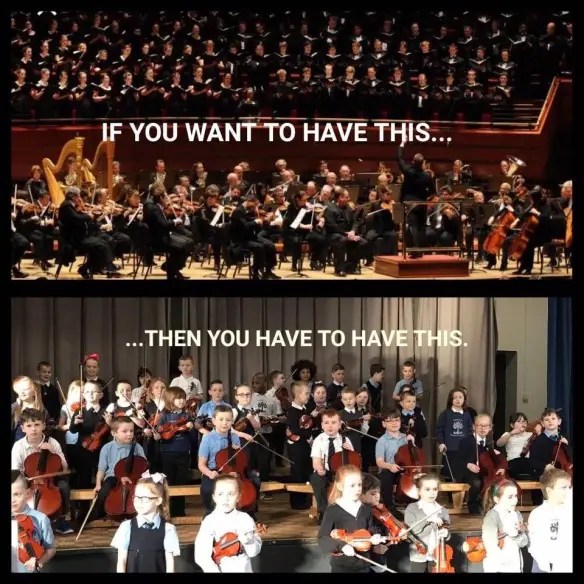
Today music teaching in schools is declining at an alarming rate and recent statistics on music education make for depressing reading. Only 5,000 students in England took A level music in 2023, down 45 percent since 2010 [1]. If this downward trend continues, in less than 10 years no students in the state sector will be taking music A level, and learning music will become the preserve of the privately-educated, specialist music schools, and those who can afford private tuition. Not only does this decrease the pool of potential professional musicians and music educators, it also confirms the tired cliché that music, in particular classical music, is an elite activity. The impetus has to be from bottom up – from early years education where enthusiastic, creative teaching fosters an interest in and love of music from a young age.
Reversing the decline in music education will take sustained, collaborative efforts from a range of different organisations, partners, and funding bodies across the music sector. A diverse and thriving music sector, with a representative workforce and equal opportunities for children and young people to consider meaningful careers in music, was not built overnight. It is the work of decades of trust building with children and families and careful, considered, and consistent offering of opportunities for young people to develop their skills over many years. The best time to reverse the decline in music education and address representation issues in the music sector is not when young people reach adulthood, but during childhood.
The Day the Music Dies? Why time is running out to tackle the decline in UK music education
You can read all the responses by clicking my original tweet and scrolling down.
If you remember this book, please share your memories about learning the recorder at school, playing at home, playing in ensembles etc. Also how it encouraged your interest in music, if applicable (I'm researching an article). pic.twitter.com/L2Q5EOplrg
The Cross-Eyed Pianist is free to access and ad-free, and takes many hours every month to research, write, and maintain.
If you find joy and value in what I do, please consider making a donation to support the continuance of the site









 The Cross-Eyed Pianist