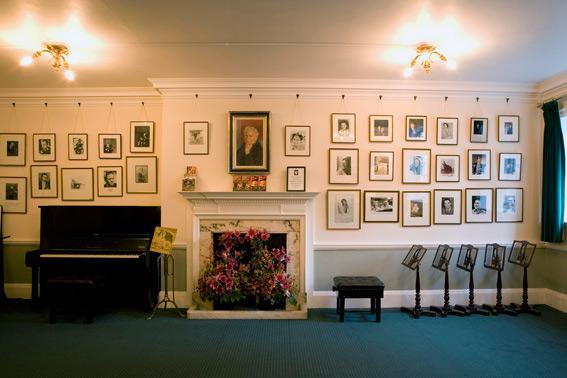
A weekend course for advanced adult pianists run by Cuban pianist Eralys Fernandez and Professor Nigel Clayton from the Royal College of Music. The course takes place at the Purcell School in Hertfordshire and runs from 6th to 8th April 2018 The course comprises individual lessons, workshops and student and teacher concerts.  Accommodation and meals are all part of this exciting weekend which aims to create a great social and educational atmosphere.  Reduced rate for observers.  Ability level: Grade 8 to post-diploma.

  • High-level piano lessons focusing on technique, sound, interpretation, style.
  • Analysis of pieces and their structure.
  • Advice on performance and controlling nerves

The course will run from Friday evening until early Sunday evening.   There will be 2 workshops,  a Q & A session, at least two individual lessons taught by Nigel and Eralys and potentially a third lesson with another teacher.  There will be a student and teacher concert to complete the course.  There is also the option of having a harpsichord lesson with Eralys. The Purcell school has extensive practice facilities and a concert hall.

During the weekend 6 meals are provided with prosecco, wine, tea, coffee, ice cream, cake and biscuits to help proceedings.  There is accommodation at the Purcell school on the Friday and Saturday night.  Please note it is basic student accommodation and is not ensuite, although some rooms will have a piano.

Course fee: £420 (including accommodation and meals), observers £180

For further information and booking please visit:

http://eralys-piano-masterclasses.co.uk/

The life of the pianist is, by necessity, solitary (and I have written before about The Pianist’s Loneliness). For many of us, the solitude is not an issue: we crave a sense of apartness to enable us to do our work and to create special connections with audiences when we perform, and we need quietude to allow time for self-reflection and evaluation.

The sequestered nature of the pianist’s life also calls for great self-reliance: we must  be self-starting, motivated, driven and focused to ensure our work (practising and preparation) is done each day. Most of us draw pleasure and satisfaction from knowing our work is done and done well, but without other colleagues and musical companions to interact with, it is easy for self-doubt to creep in, for us to question our role or our value, to ask “am I good enough?”.

Such negativism can stem from a performance which didn’t go to plan, the disappointment (and anger) from failing an exam or audition, a less-than-favourable review or some ill-advised comments from a teacher or mentor. Alone with our thoughts, such things can fester and grow into bigger problems than they need to be, and while most of us know that these things should simply be put down to “experience”, reflected upon and then put to one side, it can sometimes be difficult to shrug off feelings of inadequacy.

In his book ‘The Mindful Pianist’, teacher and pianist Mark Tanner notes the importance for the pianist of exercising “self-compassion” as a protection from the feelings of failure that can develop from setbacks, in addition to negative self-talk, lack of self-esteem, or dismotivation which can plague us when we spend so much time alone.

large

Self-compassion is really no different from having compassion for others: the ability to recognise or understand difficulties, pain or suffering, and to respond in a kind, humane and sympathetic way. Having compassion enables us to offer understanding and support when someone makes a mistake, and demonstrates that we appreciate that we are all human and that suffering, failure, and imperfection are all part of the shared human experience.

By exercising self-compassion, we simply turn these kind and sympathetic responses back on ourselves. It involves acting in the same way as we would towards others when we are having a difficult time, fail or notice something in ourselves which we don’t like.

Self-compassion can be defined in three elements – self-kindness, mindfulness and common humanity – and can be applied to the pianist’s life and work as follows:

Self-kindness helps us cease the self-evaluation and critical assessment, the negative self-talk, asking “am I good enough”, comparing ourselves to others and the subsequent feelings inadequacy.

By exercising self-kindness we can recognize that perfection is an unattainable artificial construct, that when we fail, we need not beat ourselves up nor judge ourselves too harshly, but instead accept that we are human, that we “had a bad day at the office”, Self-kindness allows us be curious, open, and loving when it comes to how we regard ourselves.

Self-compassionate people appreciate that being imperfect, failing, and experiencing life’s difficulties are inevitable. By being self-compassionate we can be more gentle with ourselves when confronted with painful experiences rather than getting angry when life falls short of our expectations or set ideals. This can lead us to greater emotional equanimity.

From the musician’s point of view, such an attitude enables us to work with curiosity and open-mindedness, to be more self-inquiring, to regard mistakes as tools for learning and self-improvement, and to be kind to ourselves when lack of time or motivation means we may not get as much practising in on a given day as we’d hoped.

Mindfulness helps us to be non-judgmental and to take a balanced approach to our emotions. Being mindful allows us to observe our thoughts and feelings from a distance, and for the musician it encourages a positive attitude towards mistakes (learning tools) and setbacks.

Mindfulness also means “living in the moment” and being awake to experience: for the musician mindfulness encourages us to practise thoughtfully, with concentration, commitment, improved focus and care.

In a performance situation, it encourages us to focus on creating the sound we hear on the spot, and to immerse ourselves in the vibrancy and “now-ness” of the music, rather than over-thinking what we are doing or getting caught up in comparing the performance to the ideal one we have in our head. It also enables us to banish the destructive “inner critic”, to be less “over-identified” with our thoughts and feelings, and to be accepting of our own strengths and weaknesses.

Common humanity is about recognising that personal inadequacy, vulnerability and failure are part of the shared human experience – something we all go through rather than being something that happens to “me” alone. By recognising this, we accept that we don’t need to be singled out as the “most” or “least”, “best” or “worst” of anything, and we can become more objective about who we are in the world and how we choose to be. For the musician specifically, this includes not constantly comparing oneself to others but rather being accepting of who we are, and freeing oneself from the tyranny of perfectionism.

Self-compassion can protect us from the negative thoughts, self-doubt or feelings of inadequacy that the life of the musician may provoke, but it can also encourage us to open ourselves up to the full spectrum of our experience which is the starting point for truly compelling and mature musicianship.

[Opera is] more than entertainment. Opera offers an insight into the complexities of the human psyche – it is a metaphor for, or an exposition, even, of our own personal dreams and nightmares…

– Kevin Volans, composer

9713815625_f3f9b6e30b
Lise Lindstrom as Turandot at the Royal Opera House

Last week my best friend went to the opera for the very first time. And not just any old opera, she went to see the final dress rehearsal of Puccini’s ‘Turandot’ at the Royal Opera House (“the one with that aria they sing at the World Cup” as she put it). She texted during the interval to tell me about it – “It’s so beautiful!” and “OMG it’s incredible!“, and the next day, over lunch, she described the experience in detail to me – the venue, the music, the narrative. For someone who claims to “know nothing about classical music“, her descriptions of the music and the story-line were articulate, intelligent and heartfelt. She spoke of how the music swelled in passion, only to pull back from the brink, holding her in suspense; how the singers interacted on stage, the impressive tone of their voices, the incredible sound of the chorus; the magnificent setting, and many other details large and small which, for her (and many like her, myself included) make opera one of the most exciting and engaging art forms. She even expressed frustration at the intervals, which, for her, disrupted the flow of the performance. She admitted she had gone to the ROH with many preconceptions – that she would feel out of place in the audience (she didn’t), that the audience would be very highbrow (they weren’t), that she wouldn’t be able to understand the narrative (she did) and that she might find the experience boring (she didn’t). Instead, she found the experience immersive, emotional and exciting, echoing the quote at the beginning of this article, that “all human life is right there, in the opera!“.

9717048020_da1196e286_z


It is that magical combination of music, words, song, acting, setting, emotions that make opera so absorbing and exciting. Having returned to opera fairly recently myself, I fully identify with my friend’s comments: even the most far-fetched story-lines take on a sense of heightened realism and credibility in the special atmosphere of the opera house. In fact, far from being inaccessible, opera is full of memorable, hummable tunes. I bet most people could hum Bizet’s Toreador’s Song (from Carmen), or the magical duet from The Pearl Fishers, and of course my friend recognised ‘Nessun Dorma’ (from Turandot), because it has been elevated to the rank of a sporting anthem. We hear excerpts from opera in film and tv soundtracks, and in adverts, so embedded is this art form in our Western cultural landscape. And as my friend discovered, to her surprise, opera is rather more relaxed than the “sitting in the dark in hushed reverence” atmosphere of, say, the Wigmore Hall, and  the etiquette of opera-going is looser. For example, you can applaud after a particularly fine aria or chorus set-piece and no one glares at you as if you have committed some major musical faux pas, and there is a very tangible sense of shared experience.

Please can we go to an opera together?” my friend asked and I assured her that as soon as the ENO new season opens, we will go. It will be fun to go with opera’s newest fan!

English National Opera

Royal Opera House

First published in 2007 ‘The Rest Is Noise’ by Alex Ross, music critic of the ‘New Yorker’, charts twentieth century Western classical music from the dying embers of “fin de siecle” Europe and the years prior to the devastation of the First World War to the present day. In many ways, the book is less a history of classical music than a history of the twentieth century as told through its remarkable, often shocking and epoch-making music.

Playlist curated by Frances Wilson.

Listen to the playlist

(This playlist is not available in the US and Canada)