‘Wings of Freedom’ is a large-scale work for symphonic wind band, written by Thomas Hewitt Jones and commissioned by the Central Band of the Royal Air Force. Inspired by the RAF’s four core values – Respect, Integrity, Service and Excellence (RISE) – the piece received its London premiere at Holy Trinity church, Sloane Square, last September, under the direction of Squadron Leader Chris I’Anson.
The band subsequently performed the work in Cambridge and also at Regent Hall in London, where the entire piece was filmed. You can now enjoy it via the RAF Music Service’s YouTube feed:
2024 Harold Smart Memorial Composition Competition for Young Composers
The Royal School of Church Music (RSCM) has just launched the 2024 Harold Smart Memorial Composition Competition. This invites individuals 25 and under (as of 1 July 2024) to compose an original anthem – a fresh, innovative work that inspires and uplifts, suitable for performance in a church setting.
For experienced and new composers alike, this is an excellent opportunity to showcase talent and make a significant contribution to sacred music. The text to be used has been written by Dr Canon Gordon Giles.
The winner will receive a cash prize of £300, as well as £200 of composition tuition (with an agreed tutor), with the possibility of publication by the RSCM.
Closing date for submissions: 31st October 2024
Full information, including submission guidelines and how to enter here
ABOUT THE ROYAL SCHOOL OF CHURCH MUSIC
The RSCM is the Salisbury-based, national, independent charity enabling the flourishing of church music. As the central ‘home’ of church music, RSCM provides relevant education, training and resources to its membership, the wider church, and beyond. It is committed to encouraging the best of music in worship, and to advocating music as a tool for growth of the church.
The RSCM supports thousands of Affiliated churches across the UK and worldwide through its international partners. In addition, it also supports many schools and Individual members, and its work is sustained by thousands of Friends, Regular Givers and other donors.
The RSCM is an open, life-long learning organisation, offering face-to-face and distance education and training through its programmes, published resources, courses and activities.
Founded by Sir Sydney Nicholson in 1927, the RSCM’s original emphases were English and choral. Now, in a diverse international context, the RSCM’s work is far broader and more diverse, and aims to make all its work ecumenical in purpose, nature and content.
HM The King is the RSCM’S Royal Patron, and its president is The Most Revd and Rt Hon The Lord Archbishop of Canterbury. The organisation celebrates its centenary in 2027.
The second in Dakota Gales series of guest articles, Notes from the Keyboard, aimed at adult amateur pianists
When my wife gifted me a smooth and shiny Yamaha keyboard for my birthday in 2020, I couldn’t play Chopsticks or even find middle C on it. As an adult learner, I also had limited time, so focused practice was of the essence.
After flailing about, I developed the most effective practice mindset and routine that I could. I’ll share it below.
Over the next four years, I dug into playing piano, but also into how to learn to play piano. Four years later, I’m playing pieces I thought were a decade out. Chopin. Beethoven. Debussy. I sometimes can’t believe my fingers can fly the way they do.
A portrait of Debussy I did while learning to draw people.
None of this magically arrived in a brain chip from Amazon. I didn’t buy Pianist Hands on Ebay and splice them onto my arms.
Nope. This progress was achieved through good old-fashioned dedication. *yawn* I know, I know…show me the TikTok video that has you playing 650 pieces in a week using JUST FOUR CHORDS!
Riiight. The faster success is gained, the shakier it is. Get Rich Quick with this money-making scheme! Learn a language in a week! Get a six pack sitting on the couch! Earn a college degree between episodes of your favorite Netflix series!
Hogwash. Easy come, easy go. There’s so much satisfaction to be found in the effort, the daily scales, the consistency. I’d wager that every pianist who continues to play must embrace the daily grind.
After years of doing this, I’ve realized something important: the toughest part of learning piano is… BEING PATIENT.
It takes as long as it takes. Want to learn a Beethoven sonata or Chopin etude in your first year? That’s nice. It’ll be built on a shaky foundation. Even pros like Andras Schiff didn’t even feel capable of tackling Beethoven’s sonatas until he was in his 40s!
However, if you create a smart practice routine and stick to it, you will improve. Not a matter of maybe: you will.
Ten minutes of practice per day is 60 hours per year. Thirty minutes is 180 hours! I’d wager that you can find 10-30 minutes each day to learn a new skill. Trade some social media or Netflix time for piano. Your future self will thank you.
That said, I’ve wasted plenty of time in the four years since a piano dropped in my lap. Since we’re adults and lack the time to futz about, we’ve gotta maximize our time at the piano!
Here are four key things that benefited me the most:
When I started playing piano, I’d do some scales, arpeggios, whatever to warm up. Then straight into repertoire, which consisted of just trying to play something, over and over. I had no plan, just “start at the beginning and wear this down via submission.”
Picture me with a catapult outside a Piano Piece Castle. If I lobbed enough rocks at the walls, eventually I could break it down! The problem: I wasn’t being thoughtful about where or when to throw the rocks. Sometimes I attacked Castles that were WAY too big for my artillery.
Since then, I’ve learned to use deliberate practice to simplify things and hammer concepts into my brain in smaller chunks.
I break pieces down into their smaller parts (e.g. only working on 2 bars at a time, or breaking an arpeggio into block chords, or an octave into only the root note). I slow pieces to 50% and only increase the tempo once I can lights-out play it. I might play the same bar 25 times in a row, firehosing it into my brain, coating that brain circuit in myelin so that it’s a superhighway, not a goat trail.
It feels slow in the moment, but I learn pieces not just better, but faster, one bar at a time. Deliberate practice builds a stronger structure, brick by brick, versus throwing up a stick built house that blows over in the wind of live performance.
Book recommendations: The Musician’s Wayby Gerald Klickstein,Effortless Masteryby Kenny Werner, andThe Art of Practicing by Deline Bruser. These have helped me dial in my practice routine and develop a different mindset around performing (and mistakes—they’re just feedback!).
Scoring a couple hours of piano in a friend’s studio on a sweet grand piano.
Learning music theory
BLERGH. Music theory, the Brussels sprouts of learning piano. Give me the repertoire, the chocolate cake!
Well, I quickly realized that trying to learn pieces without knowing the basics of theory meant it took forever to figure out a piece. If we compare it to reading, I was basically sounding out letters vs. reading sentences. Th…e. THE. C…aaaa CAT.
Painful. By learning key signatures and basics like major and minor triads (and then their inversions), I made much faster progress. I also developed the ability to memorize pieces quite well because I was thinking in chords and chord progressions instead of individual notes. Now I play all my pieces from memory.
In my experience, spending some time on music theory will drastically speed up your learning progress. I’ve grown to enjoy the analysis that I do with pieces before even putting my hands on the keys. Brussels sprouts as the appetizer, thank you very much.
Resource: This Skillshare course by professor Jason Allen is fantastic.
Hiring a teacher
There are SO many resources for online self-paced piano lessons. They’re affordable and easy to use. They help. I still occasionally do.
Let me encourage you to also hire a teacher, local or online. I cast about for nine months before starting lessons and am so so so glad I didn’t wait longer.
Mine, a Brazilian named Antonio, offers me feedback and insight on my playing a video course could never provide. “Hey, what if you shifted your wrist 10 degrees? In most renditions, pros play that piece like ____. Perhaps this fingering for that passage works better for your hand?”
I’ll write more about my experience with online lessons, but real quick… Not only are online lessons more affordable, they offer the benefit of being portable. When I travel, I can bring my keyboard and still take lessons.
My progress accelerated dramatically when I hired Antonio for a weekly lesson. He corrected things I’d never even considered (like pivoting on my 3rd finger for big left hand arpeggios, not the 2nd finger). If almost every pro had a teacher when they were learning, it’s probably worth it for us amateurs!
Resource: Just search “online piano teacher.” Many popular YouTube pianists also teach lessons.
Piano with a view in my camper van.
Don’t get too big for your britches
Many intro piano pieces felt too simple or boring for me. Right out of the gate, I wanted to play the beautiful pieces.
When the Saint’s Come Marching In? HAH. March on OUTTA here: give me Chopin’s Nocturne in Eb, baby!
The problem: I had zero piano skills. I couldn’t even read music or play a scale!
I was learning how to bungee jump by wingsuit jumping. Less risky on a piano (no bridges to smash into), but certainly a waste of time.
I spent HOURS learning the melody line to the Chopin nocturne…with zeroooo chance I’d be able to actually play it with the left hand added in. I didn’t even know what the key of Eb meant.
My teacher helped me understand which pieces would push me vs. shut me down. Instead of expending hours on a piece I had no chance of playing, I started grabbing achievable pieces. They still took work (I’m looking at you, Consolation No. 3 and your mind-bending triplets), but I could do it!
But I still dream, keeping a list of “goal” pieces. These are pieces that I really want to be able to play that are too difficult for me to learn efficiently at this time. This gives me a long-term set of goal trajectories, which helps me focus on what to work on now. (I’ll also work hard sections of pieces slowly, over months, such as the fast cadenzas in Liszt’s Liebestraum #3 or Chopin’s Db nocturne.)
To keep track of pieces, I created a spreadsheet that I update regularly. I also have an ongoing Spotify playlist to which I add pieces that catch my fancy. (After four years, it’s a tour of my listening.) I listen broadly to different eras of piano music as well as different continents. Albeniz from Spain, Villa Lobos from Argentina, Copland from America, and of course the core canon from Western Europe.
Keep dreaming, but stay reasonable! No wingsuiting just yet…
Your future self will thank you
In college, on a whim I test drove a Lexus I had zero chance of affording. The sound system was top-notch, crystal silky magic.
Later, I chatted with a friend about how I couldn’t wait to own a car like that and listen to classical music while I drove.
“Don’t turn into an old man TOO fast,” she cautioned.
Now I’m an almost-old man at the ripe age of 42. I get to listen to classical music while I drive…but I can also PLAY a bunch of it!
Sure, it took focused work and required shifting time from other activities.
It was worth it. I’ve launched a ship I can sail on for the rest of my life, a journey into a whole new language—nah, world— I hadn’t visited before.
A gift my younger self forwarded to future me that I gratefully accept.
When he isn’t playing piano, Dakota Gale enjoys learning languages (especially Italian) and drawing. He also writes about reclaiming creativity as an adult and ditching tired personal paradigms in his newsletter, Traipsing About. He can often be spotted camping and exploring mountain bike trails around the Pacific Northwest.
This site is free to access and ad-free, and takes many hours to research and maintain. If you find joy and value in what I do, why not
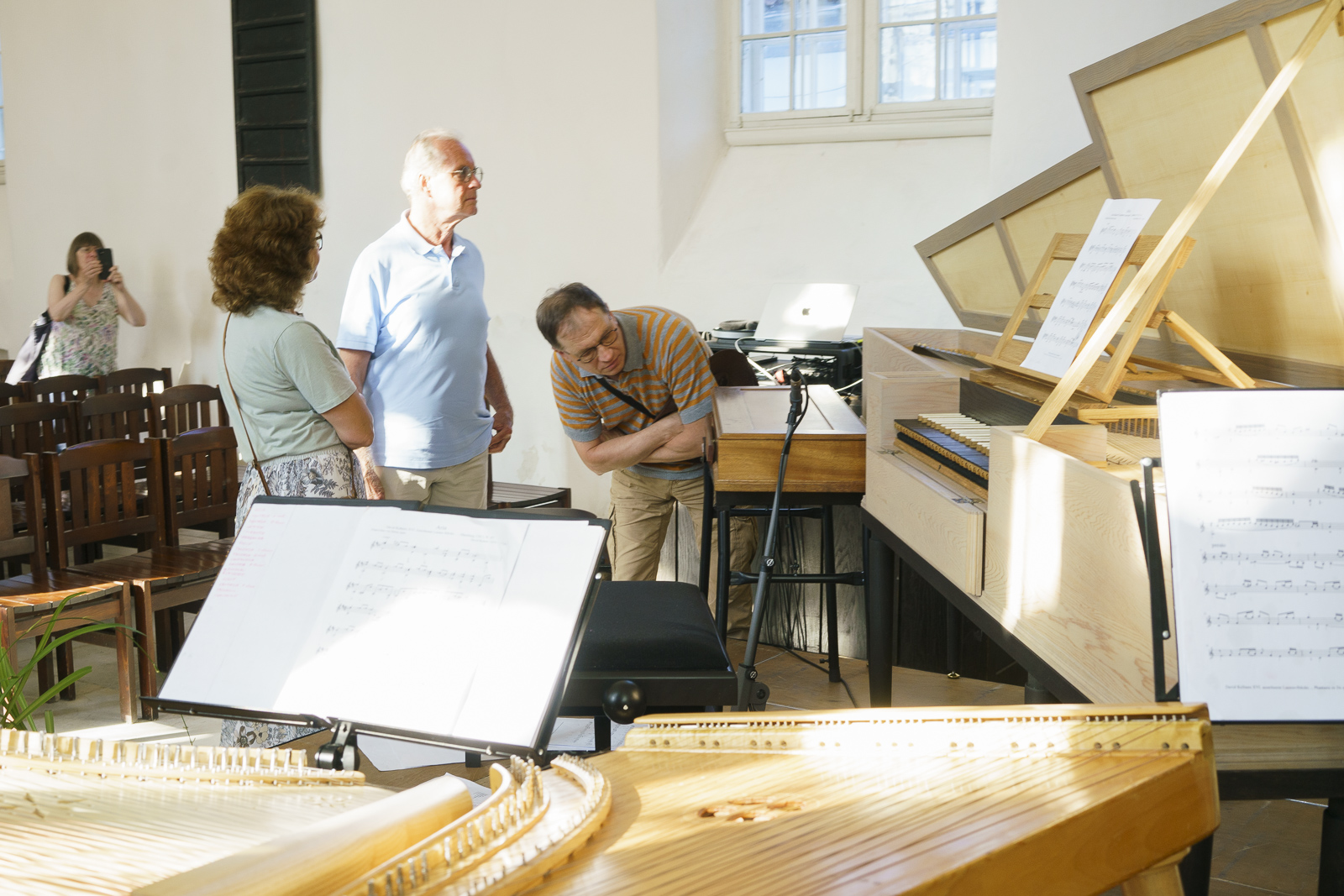
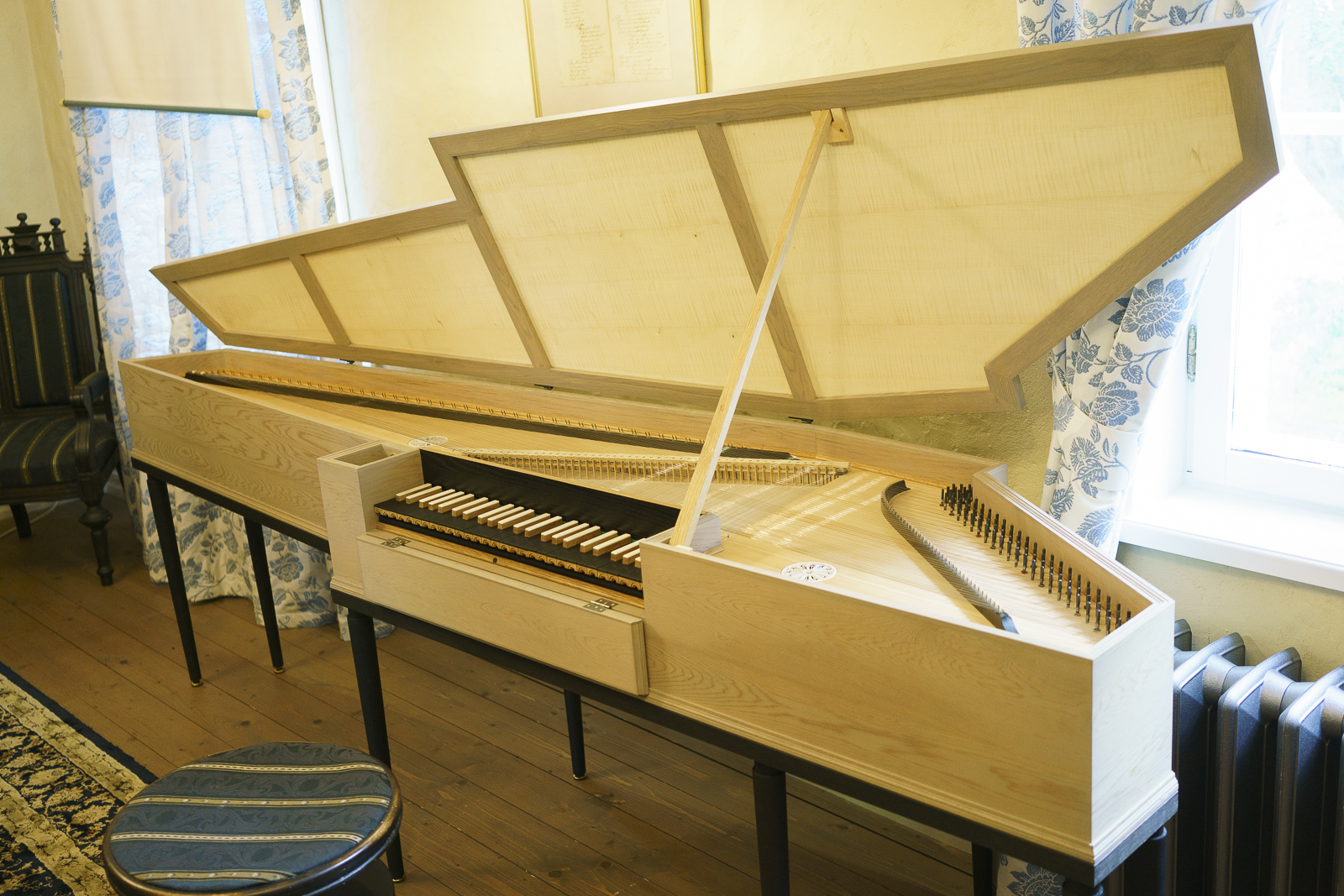
Have you ever heard a cembal d’amour? Have you even heard of it? I certainly hadn’t before attending this year’s Early Music Festival in Haapsalu, Estonia. One of the weekend’s concerts was a duo recital by keyboard players Taavi Kerikmäe and Anna-Liisa Eller. While Eller switched from the psaltery to its larger sibling the arpanetta – double-sided and chromatic, like a harpsichord standing vertically upright – to the Estonian kannel – a chromatic zither – and folk kannel, Kerikmäe played the cembal d’amour, a brand new instrument completed earlier this year by Latvian harpsichord maker Kaspars Putrinš.
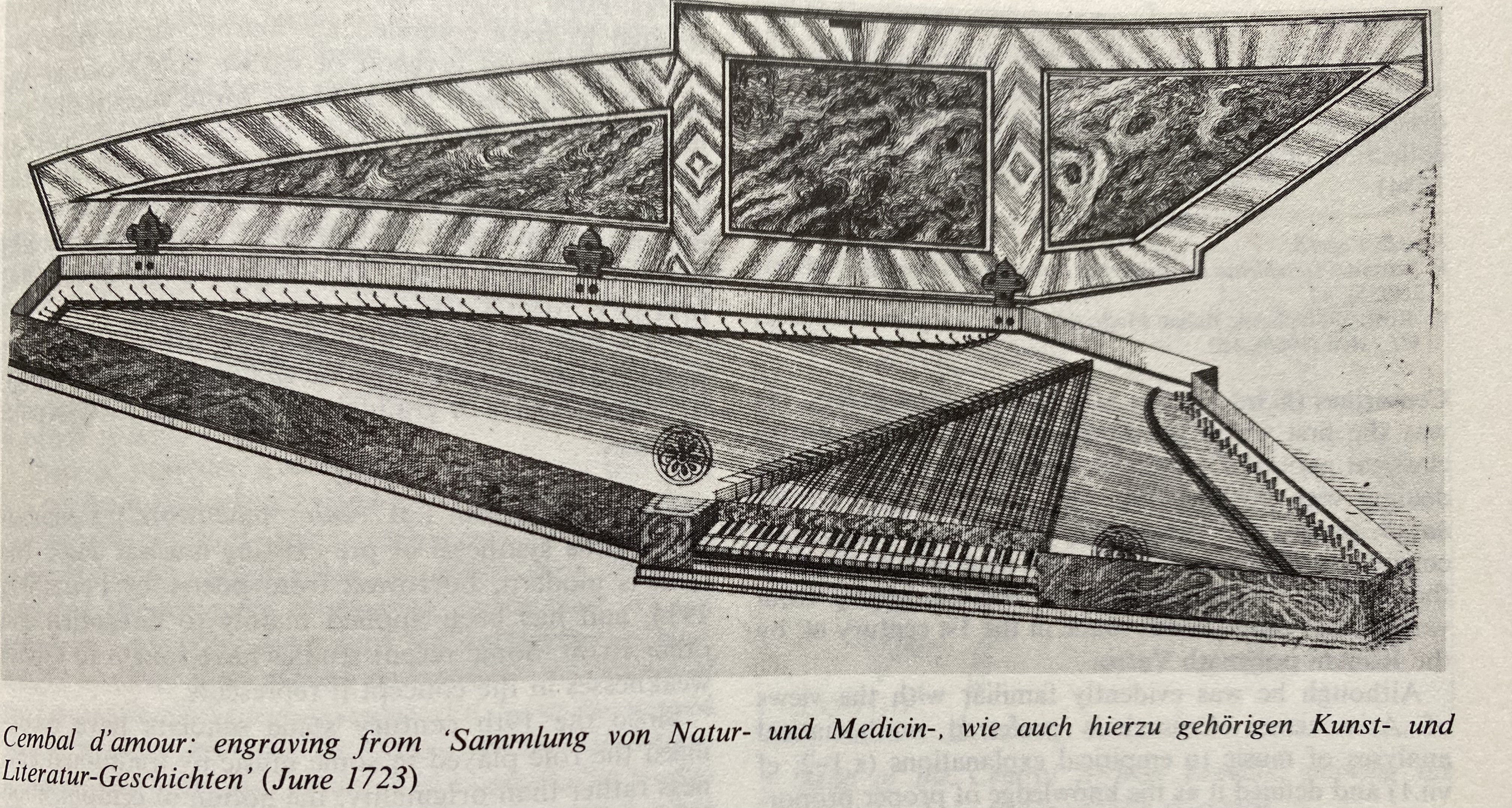
As far as is possible it is a reproduction of a keyboard instrument invented by Gottfried Silbermann (1683–1753) of Freiburg. Silbermann’s work as an organ builder was highly regarded by J S Bach, and he was also well known for his clavichords, one of which was prized by C P E Bach. He created the cembal d’amour in 1721, to a commission from the Estonian composer, performer and poet Regina Gertrud König (née Schwartz), wife of Dresden’s court poet Ulrich König. It was a clavichord with strings of approximately twice the normal length, which were struck by their tangents at precisely their midpoint – it seems that what König was after was a louder sound than the traditionally very quiet clavichord.
Cembalo d’amore
(photos by SabineBurger)
Silbermann’s original instrument has not survived, but its invention was announced in the Leipzig-produced Sammlung von Natur-und Medicin-, wie auch Hierzu gehörigen Kunst-und Literatur- Geschisten (Catalogue of natural and medical, as well as related art and literary histories) for July 1721. It was pictured in the June 1723 edition of the same publication and in a coloured drawing among the papers of the composer and musicologist Johann Matheson, a contemporary of Silbermann. Another description and diagram can be found in J F Agricola’s annotations to Jacob Adlung’s Musica mechanica organoedi (1768).
Taavi Kerikmäe is best known as a composer and performer of contemporary and experimental music, both film scores and art music; he is Head of the Estonian Contemporary Music Centre, and has collaborated with composers such as Pierre Boulez, Kaaija Saariaho, Tristan Murail and Louis Andriessen. But he has recently been exploring early music, especially clavichords, in performance with his duo partner Anna-Liisa Eller (who is also his wife).
Their Haapsalu recital consisted entirely of music by David Kellner (?1670 –1748), a composer, organist, poet and musicologist who was also the stepfather of Regina Gertrud König, commissioner of the first cembal d’amour. Born in Germany, Kellner studied at Estonia’s University of Tartu from 1694 and married König’s mother Dorothea Schwartz, daughter of the city’s mayor. He is known to have applied for the position of organist in the Swedish church in Tartu, later worked for a short time as organist of St Nicholas Church in Tallinn, and in 1732 published a treatise on continuo-playing which was printed in Swedish, German, Dutch and Russian, and survives in numerous reprints. Unfortunately the only music by Kellner to have survived is a collection of sixteen lute pieces in tablature, published
in 1747. Eller and Kerikmäe have arranged these for the assortment of instruments that we heard in Haapsalu, adding a basso continuo to bring out the beauty of Kellner’s music, which they feel is a hidden treasure of Estonian baroque music, and deserves an audience beyond lute and guitar players. Taking place in the gorgeous sixteenth-century Lutheran Church of St John, the concert was one of the quietest I’ve ever attended – despite the cembalo d-amour’s additional power compared to a normal clavichord – but the beauty of the different instrumental timbres repaid the intensity of the listening experience as these skilled musicians presented a sequence of elegant dance movements, taken mainly from Kellner’s Fantasias in different keys.
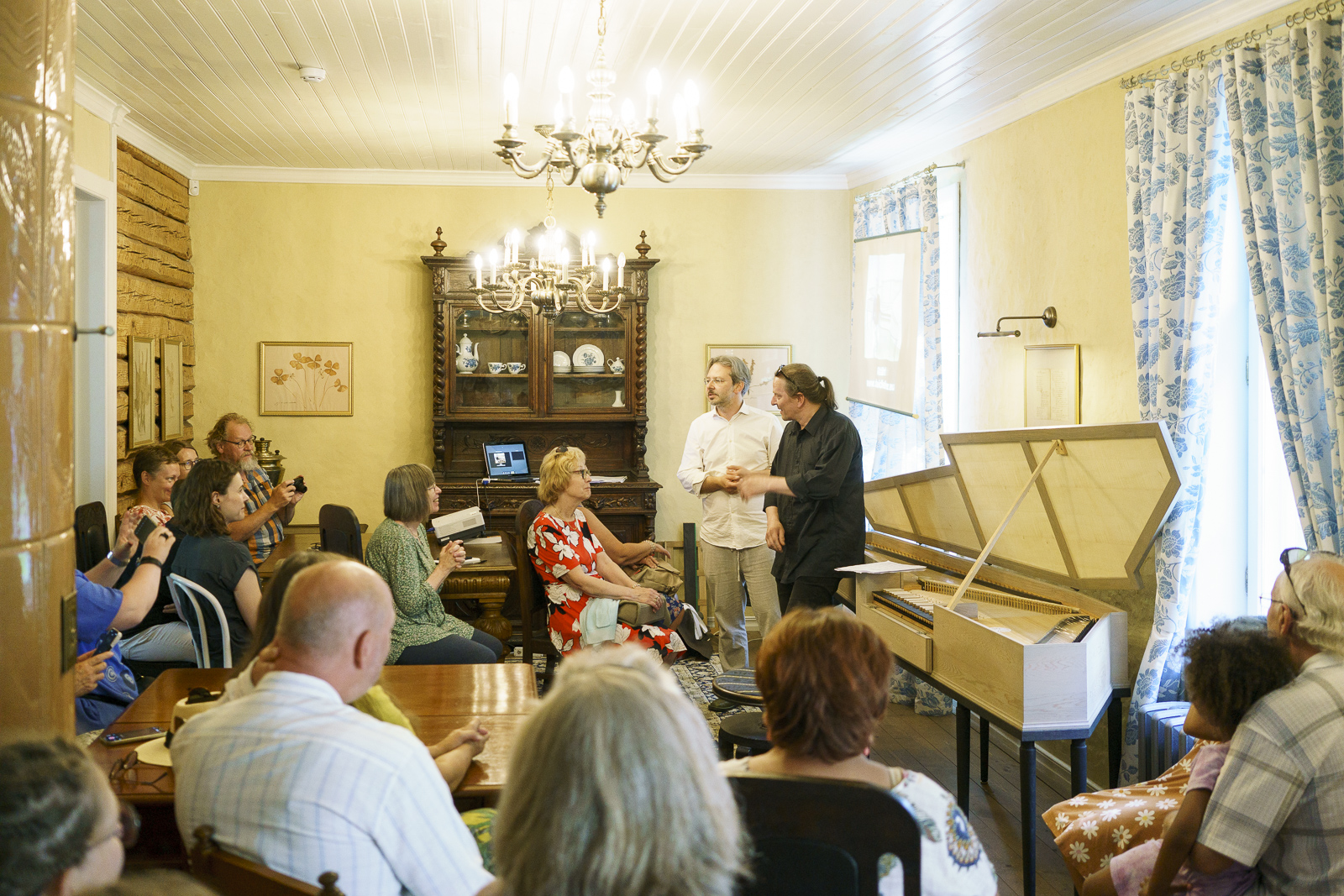
The day after the showcase concert Kerikmäe and Kaspars Putrinš set up the cembal d’amour in the salon of the Lahe Guest House for an afternoon lecture-demonstration that allowed audience members to experience the sound in a more intimate acoustic and find out more about the reconstruction project. Kerikmäe began by explaining for the non-specialists among us the crucial difference between a harpsichord, which has plucked strings, and a clavichord, where they are hit, and how this means that the harpsichord is louder, but the clavichord allows for more dynamic variation according to the pressure exerted by the player, so it is more subtle.
Silbermann’s concept for the cembal d’amore was not just to do with its extra long strings, but the fact that they vibrated independently from two bridges, one in the normal position to the right of the keyboard, and one behind and to the left of the keyboard, resonating from two soundboards on two sides of the irregularly-shaped instrument. We don’t know whether König wanted it to accompany herself singing or to use as part of a chamber ensemble, but the name is believed to derive from its suitability for performances alongside the viola d’amore.
Other contemporary makers did try to copy Silbermann’s idea, but he was very protective of his concept and sued them. Only one antique instrument survives, in a Helsinki museum, but it is much damaged. There were several twentieth-century versions, but most are now lost and they do not seem to have been designed to the same proportions as Silbermann’s. Putrinš explained that his new instrument is not a copy but a prototype, based primarily on the Matheson drawings. Building it was a challenge, but has provided a starting point for further exploration.
Kerikmäe and Eller are also keen to draw attention to the legacy of Regina Gertrud König, who was highly respected in her lifetime and can probably be considered as Estonia’s first female composer, but they are hampered by the fact that none of her music has yet been discovered. For now her influence is primarily represented by the instrument that she commissioned and its latest incarnation.
More information about the music of David Kellner and about the Kerikmäe Eller Duo: www.davidkellner.eu
(Photos by Clare Stevens)
Clare Stevens is a freelance writer, editor and publicist, specialising in classical music, choral music and music education. After 30 years living and working in London, she is now based in the Welsh Marches.
This site is free to access and ad-free, and takes many hours to research and maintain. Why notsupport The Cross-Eyed pianist here:
The Cross-Eyed Pianist is free to access and ad-free, and takes many hours every month to research, write, and maintain.
If you find joy and value in what I do, please consider making a donation to support the continuance of the site











 The Cross-Eyed Pianist