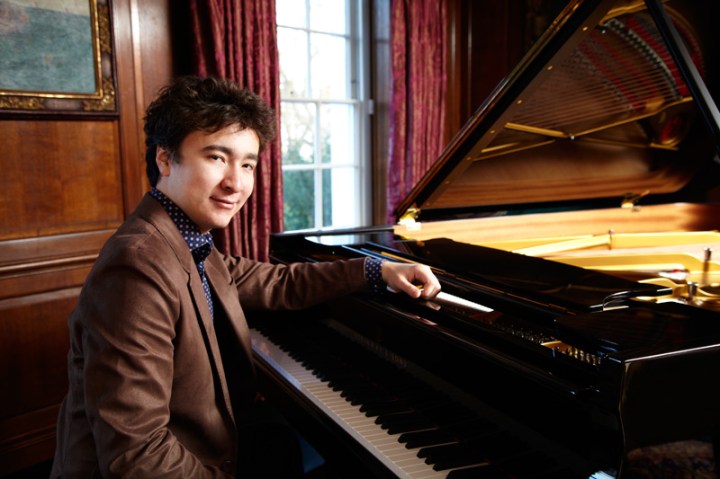
The Jazz Room at The Bull’s Head, a riverside pub in Barnes, SW London, more usually vibrates to the tunes, rhythms and vibe of the genre from which it takes its name, but last night the intimate space was filled with altogether different sounds in a concert given by two highly acclaimed classical musicians – David Le Page (violin) with Viv McLean (piano).

David-le-Page-2-1

In addition to his solo, ensemble and orchestral work, David Le Page is also a composer of beautifully-crafted, imaginative and highly evocative music. His latest album ‘The Book of Ebenezer’ (release date TBC) is inspired by The Book of Ebenezer Le Page by G B Edwards. Set in Guernsey through the late nineteenth century up to the 1960s, the novel takes the form of a fictional autobiography narrated by Ebenezer Le Page, a typical “Guern’ man, deeply engrossed in his life on the island. David Le Page also hails from Guernsey,  no relation to Ebenezer Le Page, though as David said in his introduction to his music, the name Le Page is as common in Guernsey as Smith is elsewhere in the UK. David has taken moments in Ebenezer’s life as recounted in the book as the inspiration for an album of 10 exquisite miniatures for violin and piano.

In the slower, more reflective pieces, the music is redolent of the spare grace and meditative stillness of expression of Arvo Pärt, while the more lively pieces have folksy intonation and foot-tapping rhythms. Several of the pieces use Guern folksongs, and one is based on Sarnia Cherie, the national anthem of Guernsey. All the music is highly evocative, infused with a tender poignancy which speaks not only of the eponymous hero’s reminiscences and reflections but also of David’s connection to the island of his birth, its landscape and its weather. There are haunting bird calls, as if heard from afar, the gentle wash of the sea rippled by the wind, the glint of light in water – elements which give the music a filmic quality and serve as a narrative thread which runs throughout the suite of pieces.

Purists may balk at hearing classical music in a venue normally reserved for jazz, but the small size of the jazz room lends itself to the right kind of concentrated listening and intimacy of expression which this music demands and offers. And David Le Page and Viv McLean create a very special intimacy of their own – these musicians work together regularly and their empathy and mutual understanding is palpable in every note they play.


David Le Page and Viv McLean return to the Jazz Room at the Bull’s Head for a special concert for Valentine’s Day on Wednesday 14 February – details here

Who or what inspired you to take up the piano and pursue a career in music?

I started the piano when I was 3 (apparently!), and to be honest I’ve never for a second thought about the possibility of doing anything else. And I guess I might have to finally come to terms with the fact that – at 36 – Stoke City seemingly aren’t going to be calling me to play up front for them, so I guess I’m stuck with the music.

Who or what have been the most important influences on your musical life and career?

I had the great fortune to go to Chetham’s School of Music for nine years, during which time I had a fantastic education in the nuts and bolts of music, before going to the Royal Academy of Music in London to do the Undergraduate jazz course there. Having such a comprehensive training has certainly been invaluable in helping me adapt to, and survive in, the myriad of musical situations I tend to find myself in!

I’ve also been lucky enough to work with some amazing musicians over the last 20 years, and I’ve always tried to learn from everyone I’ve worked with, and every musical challenged I’ve undertaken. That’s one of the lovely things about being a musician – you never stop learning!

What have been the greatest challenges of your career so far?

Logistics! Replying to emails, booking flights, doing my accounts… The glamorous stuff!

In all seriousness being a freelance musician does come with a unique set of challenges, and surviving professionally, or professional surviving if you like (!) is right up there with the hardest of them.

Alongside that, I’ve always struggled with performance anxiety (a problem rarely discussed but frequently suffered by so many…) so dealing with that is always at the forefront of my mind.

Which performance/recordings are you most proud of?

My last release under my own name, called ‘Instrumation’, features a chamber orchestra and I wrote, arranged, produced and mixed it all – so I’m very proud of that! Every album I’ve ever made I’ve tried to do to as high a standard as possible, and whilst your style, influences and sound inevitably change over time, hopefully the attention to detail and quality of your work can remain a constant feature of what you do.

Which particular works do you think you play best?

Unfortunately I don’t really get too much opportunity to play the more standard repertoire, but this is something I’d like to rectify at some point in the future. So I guess the answer would be – hopefully – my own!

How do you make your repertoire choices from season to season?

I guess this question, again, is a little bit irrelevant for my particular career! That said, I do really enjoy the wide variety of musical situations I end up getting involved in, and I guess there is a certain amount of reacting to what is requested of me that dictates the musical direction I end up taking. In terms of a more general direction, I certainly find myself enjoying the world that lies in between the composed and the improvised more and more, so the pieces from the ‘classical’ side that I get involved with tend to be those that lend themselves to this kind of treatment. I seem to come back time and time again to 20th Century French music, as the harmony and lyricism seems – to me – to be so strongly connected to the world of improvisation and harmonic exploration that I enjoy so much.

Do you have a favourite concert venue to perform in and why?

I was fortunate enough to perform my own music at the Proms back in 2008, and to play in the Royal Albert Hall, and in front of a live BBC television audience, was just the greatest thrill. I guess, with having a classical education, performing in that situation, on that iconic stage, felt like truly fulfilling a dream. Aside from the RAH, I’ve been so fortunate these last few years to play in hundreds of concert halls around the world, all different shapes and sizes and all fantastic in different ways, but I guess on a personal note – playing in the Bridgwater Hall in Manchester has always been a wonderful experience, as I remember seeing it being built from the very beginning when I was at Chetham’s in the 90’s – so finally getting to play concerts there as a professional musician has always been a special experience.

Who are your favourite musicians?

In terms of composers, Ravel, Debussy and Dutilleux are my favourites. Jazz musicians: well piano-wise my heroes have definitely been headed by Keith Jarrett, Chick Corea and the wonderful, much-missed John Taylor. In a wider sense, the music of electric bassist Jaco Pastorius and guitarist Pat Metheny has always really been special for me. And aside from that, I always absolutely love listening to Steely Dan, Earth Wind and Fire, and Stevie Wonder. Hopefully that covers quite a bit for now!

As a musician, what is your definition of success?

To achieve respect and appreciation from my fellow musicians has always been the main aspiration for me. Of course every concert I play, I really want to give the audience a wonderful evening and take them on a musical journey, but in a more general sense I think that question of what my legacy will be has become more and more important to me as the years pass. I try extremely hard to give everything I can to each project I’m involved in, so when things go well after all the hard work, it always makes for a satisfying moment!

What do you consider to be the most important ideas and concepts to impart to aspiring musicians?

This would take quite some time to answer, but suffice to say I’m always encouraging my students to really try to put in the hours at the piano, as nothing can really replace good old-fashioned hard work! I do try to get them to try to stretch themselves creatively as much as possible, as, in the world of improvised and new music especially, developing and honing your own ‘voice’ and sound is of paramount importance. Again, there really isn’t any short cut to this, other than to put the hours in!

Gwilym Simcock performs at the London Piano Festival on 4 October. More information


Gwilym Simcock has carved out a career as one of the most gifted pianists and imaginative composers on the European scene.  He moves effortlessly between jazz and classical music, with a ‘harmonic sophistication and subtle dovetailing of musical traditions’. Gwilym has been hailed as a pianist of ‘exceptional’, ‘brilliant’ and ‘dazzling’ ability, and his music has been widely acclaimed as ‘engaging, exciting, often unexpected, melodically enthralling, complex yet hugely accessible’, and above all ‘wonderfully optimistic’.

Gwilym’s influences are wide ranging, from jazz legends including Keith Jarrett, Chick Corea, Jaco Pastorius and Pat Metheny, to classical composers including Maurice Ravel, Henri Dutilleux, Béla Bartók and Mark-Anthony Turnage. Although principally a jazz artist, Gwilym has composed numerous works for larger Classical ensemble that combine through-composed elements with improvisation, creating a sound that is distinctive and very much his own.

Read more

Is Baroque music about composers or performers?” mused Lindsay Kemp in an article ahead of the launch of his new festival of Baroque music at the splendid venue that is LSO St Luke’s. The inaugural concert was given by Joanna Macgregor in a programme which sought to confirm Kemp’s assertion that Baroque musical festivals don’t have to be about historically informed performances (HIP), or period instruments and people in periwigs.

home-banner-445

Kemp, who was artistic director of the Lufthansa Festival of Baroque Music (LFBM) which morphed into the London Festival of Baroque Music when Lufthansa withdrew funding, is clearly well-versed in presenting ambitious musical ventures (he’s also senior producer at BBC Radio 3 and a writer on music), and in creating Baroque at the Edge he decided he wanted to do something that was not just another early music festival, but rather a festival of music which “anyone can come and enjoy” (surely all music festivals and concerts should be thus?). Hosting the majority of the concerts of the weekend festival at LSO St Luke’s is symbolic for Kemp too – “an 18th-century church on the outside, and a beautiful modern concert hall on the inside“. The programmes in Baroque at the Edge seek to celebrate Baroque music for what it is – wonderful music first and foremost for anyone to play without worrying about HIP and all that it encompasses – combined with music from other eras and genres. In short, a modern “no rules Baroque festival” to attract the kind of audience who wouldn’t normally go to Baroque or early music concerts, and also people from the locale in which St Luke’s is situated – trendy Shoreditch, Hoxton, Islington and the City.

joanna20macgregor

It was good to see the first concert so well-attended. Joanna Macgregor’s programme offered a typically provocative and eclectic selection of music on the theme of birds (in the first half) and ground basses/the Chaconne (second half), grouping works by Couperin, Daquin, Rameau, Poglietti, Byrd, Purcell and Pachelbel with music by Janaček, Messiaen, Birtwistle, Glass, Liszt and Gubaidulina. The programme opened with a triptych of Baroque works recalling birdsong (cuckoos, nightingales), characterful works delicately enunciated, written for the court, yet tender and intimate in expression. Macgregor introduced the sets of pieces: more softly-spoken than the first three works, she would have benefited from some amplification for those of us towards the back of the hall (or even some programme notes, though one of the stated aims of the festival is “no programme notes, no lectures”). The twentieth-century works were more satisfying, in particular the bird pieces by Messiaen from his Petites esquisses d’oiseaux and Birtwistle’s melancholy Oockooing Bird (written when the composer was just 16) with some lovely musical colours and highly evocative filigree chirruppings in the upper register. These were reflected in Poglietti’s Aria bizarre del Rossignolo, an early example of descriptive instrumental music where the nightingale’s song appears throughout the work in various virtuosic passages, replete with trills and short, syncopated attacks. Here was Baroque truly at the edge – the music freed from its courtly cage to take flight in a series of vivid improvisatory episodes.

The second half focused on the ground bass, a repeated pattern in the bass over which a series of variations or improvisations are played, and closed with Sofia Gubaidulina’s monumental Chaconne, preceded by a reflective Chaconne in F minor by Pachelbel, expressively played by Macgregor. Two works by Philip Glass were intended to demonstrate the use of the ground bass device in modern music, but these pieces felt rather flat; in fact, in this half, the Baroque pieces were far more rewarding. Joanna Macgregor offered one final work on a ground bass, Handel’s magnificent dramatic Passacagalia in g minor, HWV 432, as an encore.

This was an interesting and varied selection of pieces, elegantly presented. While I enjoyed most of the music, I was not fully convinced that this programme said anything new or different about Baroque music, nor felt particularly “edgy”. But perhaps the programme did at least serve one of the key aims of the festival: to allow artists like Joanna Macgregor to take Baroque music and see where it leads them, freed from worries of ‘authenticity’ or being ‘correct’, and this programme demonstrated that composers from any era can take a theme or concept and work imaginatively with it, be it birdsong or the ground bass.


Friday 5 January 2018, LSO St Luke’s

Joanna Macgregor, piano

Programme:

Rameau – Le Rappel des oiseaux

Daquin – Le Coucou

Couperin – Le Rossignol-en-amour

Janáček – The Barn Owl has not flown away! (from On an Overgrown Path)

Messiaen – Le Rouge-gorge (Petites esquisses d’oiseaux)

Sir Harrison Birtwistle – Oockooing Bird

Couperin – Les Fauvétes plaintives

Messiaen – Le Merle noir (Petites esquisses d’oiseaux)

Hossein Alizâdeh – Call of the Birds

Couperin – Les Coucous Bénévoles, sous des dominos jaunes

Poglietti – Aria bizarre del Rossignolo: Imitatione del medesimo ucello

Rameau  – La Poule

Byrd – Hughe Ashton’s Ground

Philip Glass – Prophecies (from Koyaanisqatsi)

Philip Glass – Knee Play No. 4 (from Einstein on the Beach)

Purcell – Ground in C minor

Liszt – Prelude on Bach’s ‘Weinen, Klagen, Sorgen, Zagen’

Pachelbel – Chaconne in F minor

Sofia Gubaidulina – Chaconne


Baroque At the Edge

Meet the Artist – Joanna Macgregor

Startling contrasts

The dark arpeggiated sonorities at the close of the Andantino are transformed into the sparkling arpeggiated chords which open the Scherzo, and a sense of levity is portrayed through staccato articulation and a lyrical dance-like figure, which is further developed in the second section. The Scherzo serves several purposes in the overall scheme and narrative of the sonata: it provides a breath of fresh air between the Andantino and the Rondo (to omit a third movement and go straight to the finale would be too ponderous for Schubert), and through its tempo, concision and directness, highlights the breadth of the finale.

The second section of the Scherzo (m 17) begins with a LH figure redolent of the rambunctious opening of the third movement of the ‘Great’ C major Symphony and rich in ‘cello and double bass resonances. The tone here is distinctly bucolic, but the pastoral mood is disturbed by “startling flashes of irritability” (Schiff): a dramatic descending scale which recalls the middle section of the previous movement, with a reference to the desolate main melody of the Andantino in the ensuing passage. For a moment it seems as if the desolation of the previous movement has returned, but the atmosphere is quickly dispersed by a chord (m 47) before the effervescent opening theme returns. In the contrasting Trio, scored in D major, Schubert re-imagines the initial theme of the first movement with a serenity redolent of choral writing or a choir of woodwind, closing with a sequence of ethereal chords.

The opening section is then reprised via the Da Capo marking. The musicologist David Montgomery makes the case for observing all the repeats during the reprise. Like many piano students, I was taught that DC repeats should be dropped, a practice Montgomery suggests developed during the late nineteenth-century and certainly when early recordings began to be made, for reasons of limited disc or piano roll space. In the case of Scherzos or Minuets, there is almost complete agreement amongst performers that the DC repeats should be omitted (I have only heard one performance of the D959 in concert where the DC repeats were observed), regarding them as “vestigial” and unnecessary in such a diminutive movement as a Scherzo. In the case of the D959’s third movement, there is a good argument for maintaining them because 1) they make the movement longer, roughly equivalent to the Andantino, and thus create a sense of structural balance between the first and final movements and the inner movements (a “golden ratio”); 2) repeating previously heard material reiterates Schubert’s unusual harmonies and musical signposts (the same argument applies to exposition repeat in the first movement).


Select bibliography

Brendel, Alfred, ‘Schubert’s Last Sonatas’, in Music, Sense and Nonsense: Collected     Essays and Lectures (London: The Robson Press, 2015)

Fisk, Charles, Returning Cycles: Contexts for the Interpretation of Schubert’s Impromptus and Last Sonatas (Berkeley, Los Angeles and London: University of California Press, 2015)

Hetenyi, G: The Terminal Illness of Franz Schubert and the Treatment of Syphilis in Vienna in the Eighteen Hundred and Twenties (Bulletin Canadien d’Histoire de Medecine, 1986 Summer;3(1):51-64.)

Montgomery, David, Franz Schubert’s Music in Performance. Compositional Ideals, Notational Intent, Historical Realities, Pedagogical Foundations (Hillsdale, NY: Pendragon Press, 2003)

Schiff, Andras, ‘Schubert’s Piano Sonatas: thoughts about interpretation and performance’, in Brian Newbould (ed.) Schubert Studies (Aldershot and Burlington: Ashgate, 1998)


A longer version of this article will appear in a future edition of The Schubertian, the journal of the Schubert Institute UK