Who or what inspired you to take up the piano and pursue a career in music?
We always had a piano at home. I come from a musical family. My mum, my grandma, my great-grandma were piano teachers and my first inspiration to take up the piano was just the sheer presence of the piano at home. I was five at the time and it seemed to me very obvious that the piano was there so that I could play it. The irrefutable logic of a five-year-old. I pestered my mum until she gave me lessons; she didn’t want to because she thought we had too many pianists in the family, but I was stubborn as a five-year-old can be and eventually after about 2 weeks she gave in.
The decision to pursue a career in music wasn’t quite a decision. There wasn’t a single moment where I stopped and said “I will be a pianist”. I gave my first concert at the age of seven and then by the age of 9 I was performing regularly. Because there was no break or consideration of pursuing another career, it just very naturally progressed from being something I did as a kid to being something I do with lots of love and passion as an adult.
Who or what have been the most important influences on your musical life and career?
The most important influences are both musical and non-musical. Musically I could name the pianists, Emil Gilels, Arthur Rubenstein, Grigory Sokolov, but also many others, Daniel Barenboim, especially in Beethoven, Martha Argerich in many things and of course not only pianists, conductors such as Furtwangler and Gergiev, John Elliot Gardner. Singers such as Dietrich Fischer Dieskau and of course influences can be non-musical: in a way every experience you have, every book you read, every movie you watch, every place you visit, every encounter you have, every moment you spend with friends or family, they leave a mark on you and direct you indirectly and therefore leave their mark on your playing.
What have been the greatest challenges of your career so far?
There is an ongoing challenge which is to play in a way that does justice to the music and with some composers and with some pieces it is easier and more natural, while with others it requires a lot of very hard work and a lot of thought and time, sometimes months and even years from the point where you start learning a piece to a point where you feel that your interpretation is interesting, engaging and truthful to the spirit of the music. And this is something which is ongoing because even pieces that you thought that you played well in the past, you cannot rely on that past experience as a gauge for the next performance of the piece also being fine. So, basically it’s having the hand on the pulse everyday. I often record myself and listen back, because there’s often a gap between the way you perceive your performance while you’re playing: while you’re very much involved in the detail, hearing it from the outside with maybe a little more objectivity allows you to hear the whole structure and musical line, and judge whether it works or not. And this is something which happens almost everyday.
Which performance/recordings are you most proud of?
I’d say for the recordings the War Sonatas, no 6,7 & 8 by Sergei Prokofiev, which I released on Orchid Classics in 2012. More recently, a CD I released with Naxos and with the Royal Liverpool Philharmonic Orchestra and Vasily Petrenko of the 2 piano concerti by Shostakovich, with an arrangement which I made of his own 8th String Quartet. As for performances I can think of various occasions which I thought at the time were good performances, but I often find that listening to the same recording a few years later, because you have changed in that time, you already feel a little more distanced from your previous work and you feel that if you were to do it today you would do it, not necessarily better, but differently. So I think most of the recordings would be a faithful document of how you felt about the piece at the time. Also, the CD I recorded of Rachmaninov’s Etudes-tableaux Op. 39 and his Musical Moments Op.16, also from Naxos. So I’d say I’m very proud of these three CD’s.
Which particular works do you think you play best?
I have a very close affinity to Russian repertoire – Rachmaninov, Prokofiev, Shostakovich, but also Stravinsky, Tchaikovsky, Mussorgsky. So most of the Russian composers I am deeply in love with and I am also very strongly connected to their world, Russia being my home country and also being my native tongue. Russian literature, Russian poetry are also very close to me. I don’t know if any of these explain the fact that I have such a strong connection to Russian music, but when I play Russian music I feel very much at home and I never grow tired of it. I also have a strong connection to German composers, in particular Brahms, Beethoven, Schumann and the being quite omnivorous, I also wouldn’t want to be without Ravel, Gershwin, Bartok or Liszt. But Russian and German composers in a way form the core of my repertoire and almost every recital programme will contain works from at least one of these groups. I find in general works that have a very strong story-telling element appeal immensely, music that you can almost imagine has a story behind it, even if there is no story handed to us from the composer. But also music that you then as a performer can transform into a narrative on stage. And these kind of works occur throughout the entire musical repertoire, it’s not just confined to Russian, German or French music.
How do you make your repertoire choices from season to season?
When it comes to recital repertoire. I’m mostly free to choose my own works and then it’s a combination of works which I want to explore personally, works that I want to record and am planning to record, maybe in a year’s time, and I want to start playing them in concert a long time before the recording to gain this unique experience which live performance can give you and which you cannot simulate, no matter how much you practice at home. This probably involves some Russian or German repertoire. When it comes to concerto repertoire then the choice is usually in the hands of the orchestra. Normally the orchestra will ask the soloist to come and perform a concerto which is in the programme, and when it comes to chamber music then it is a collaborative choice between all of us who are involved in that concert.
Do you have a favourite concert venue to perform in and why?
I can think of several exceptional halls – the Mozarteum in Salzburg, the Musikverein in Vienna, the Concertgebouw in Amsterdam, probably three of the absolute top venues. The reason for all three is the glorious way the sound soars when you’re in the halls, it’s effortless and it’s an absolute marvel to experience. Another favourite concert venue, for a very different reason, is the Royal Albert Hall, because of the Proms. Playing at the Proms for a 5500 audience with the first row of the prommers being maybe 20cm from you, the electricity in the hall, the silence of a crowd of that size listening and the reaction in the end, it’s a uniquely memorable experience.
Who are your favourite musicians?
My favourite musicians I mentioned earlier, but to recap – Emil Gilels, Arthur Rubenstein, Grigory Sokolov, in all 3 cases because of the deep humanity of their playing. Their touch, their sound – unique to each one of them but all together extremely musical, with every note capable of showing shading or nuance in a really awe-inspiring way. And through the very deep understanding a personal rendition of basically everything they’ve played. To that group I would add David Oistrakh. the Russian violinist. for the very same reasons. and conductors Furtwangler. again for his very deep humanity. and Valery Gergiev for sheer excitement and colour of his interpretations. Sir John Eliot Gardiner, whose recordings of Bach in particular I grew up on and keep listening to almost every day. Dietrich Fischer-Diskau – again someone whose recordings I grew up on and who strongly influenced my approach to lieder, which I accompanied quite a bit, and to phrasing in general and to this connection between text and music in the art song.
What is your most memorable concert experience?
Playing at the Proms – last time I played the first piano concerto by Liszt and that was highly memorable, the silence of the full Royal Albert Hall listening and then the eruption of shouts and applause at the end. You’re thrilled afterwards for days – it’s a rush that stays with you for a very long time.
As a musician, what is your definition of success?
There can be several kinds of success – one kind is on any particular evening to be able to perform well. To be able to play in such a way that hopefully makes the audience forget their troubles for a few hours and be transported to wherever the music would like to take them to. On the other hand, in a way which you feel does justice to the music you’re playing, that catches a little glimpse of this truth behind the notes, that the note is just a gateway and which is in this very subjective realm of interpretation. Of course, long-term the definition of success for a musician I’d say is again on two level. One is a career level which is measured in concerts, recordings, performances, prizes, if applicable, awards. But on another hand, it is maybe the legacy which you leave behind you, whether especially for those artists who were recording artists who have the legacy of recording – whether in 50 or 100 years later your recordings still sound truthful and still relevant and have value for those who listen to them at that time.
What do you consider to be the most important ideas and concepts to impart to aspiring musicians?
Apart from technical advice which is something every musician works on on a daily basis, I’d say the most important thing is (at least in my opinion) truthfulness to the core of the music. That is that every decision of interpretation that you make is not so much a preconception you have or an idea, but something which you feel comes from the music itself. It can come from the text (the notes), it can come from this space behind the notes, just thinking of the notes as a gateway to a pocket universe which composers fixed in place for us in order to gain access to that little – or great – world. This world, if the notes are completely objective, and every performance would have these notes in that order, but this world behind the notes which is the emotional and storytelling content of the performance, it is highly subjective and that is why interpretations differ so much from one another. Exploring those worlds and exploring them with unending respect and love to the composer and to that particular world which you are exploring, these for me are crucial things for every musician and I cannot think of any great musician to whom I would not feel this in their interpretation, this love and utter respect for the music which they are exploring, and this need and drive and desire to delve deeper and deeper into this world behind the notes.
What is your idea of perfect happiness?
I have two ideas of perfect happiness. One, as a musician, my idea of perfect happiness is that moment at a concert where you feel that everything is just flowing through you. It doesn’t happen every time, it’s rare in a way, but when it happens, the feeling when everything comes together and you feel that you’re almost possessed by the flow of music, being almost a conduit to it, while being able at the same time to shape this flow a little bit and direct it, these moments as a musician are utter happiness. My perfect happiness as a human being is to spend any amount of time with my family. It’s probably the most precious time I have in my life and there really can’t be too much or enough of it.
www.intermusica.co.uk/artist/Boris-Giltburg
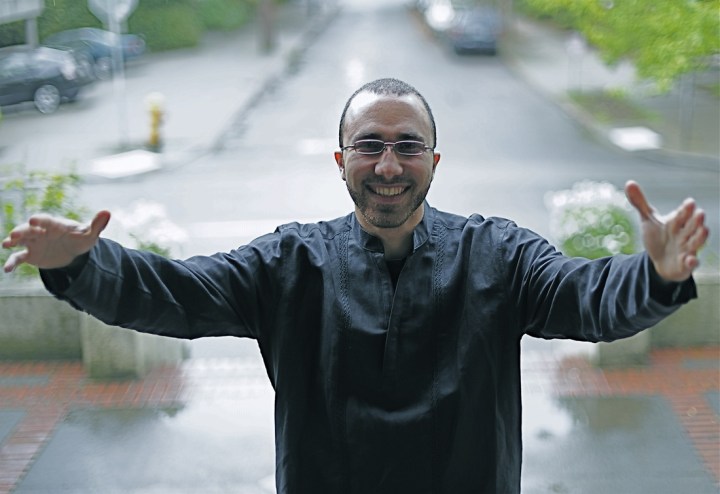
(Artist photo: Sasha Gusov)






 The Cross-Eyed Pianist