krpan

Winner of the 61st Ferruccio Busoni International Piano Competition, Ivan Krpan shares his thoughts on influences, inspirations and performing

Who or what inspired you to take up the piano, and pursue a career in music?

My parents inspired me to start learning about music when I was a child. My father is a violinist and my mother a musicologist so I have been surrounded by music my whole life. When I was six years old I started to go to Blagoje Bersa music school in Zagreb and for some reason I liked the piano more than other instruments so that’s how it started.

Who or what have been the most important influences on your musical life and career?

My parents had a big influence on me especially during the first years of music school. My first teacher, Renata Strojin Richter, taught me all the basics of piano playing and music in general so I am really grateful to her. And of course, my current teacher, Ruben Dalibaltayan, taught me a lot during our piano lessons in the Music Academy in Zagreb.

What have been the greatest challenges of your career so far?

I cannot really say but I think that the greatest challenge in life of any artist is to pursue and develop your ideas every day.

Which performance/recordings are you most proud of?

When I look back I see that every performance has its own place in my musical development and that every performance is a representation of my state of mind at that point. All my performances make a big picture for me so I appreciate them all.

Which particular works do you think you play best?

I like to think that I play best any work I am currently playing.

How do you make your repertoire choices from season to season?

I play works I like or works I am interested in. And when I play works I am interested in, I start to like them. Also, I am still studying so I have to play what is required for exams.

Do you have a favourite concert venue to perform in and why?

No, I don’t have a favourite concert venue. I enjoy playing in lot of different places. Also, I think that people who I play for are more important than the hall itself.

What is your most memorable concert experience?

I don’t know because every concert is different, so I remember them because of all those different things I encounter. For example, I remember some concerts because of the beautiful pianos I played and some because the awful pianos that I played on! Also I remember some when the audience was very noisy during the concert and at some other concerts I had the feeling that people were really interested in what I was trying to give them.

As a musician, what is your definition of success?

I think that you are successful if you are going forward following your ideas. The most important thing in art and in life in general is that nothing ever stays the same. Everything is changing and so we should also change and evolve. It is not easy but if you manage to do it then you are really successful.

What do you consider to be the most important ideas and concepts to impart to aspiring musicians?

The most important thing for anyone is to be yourself without pretending and to do what you love to do.

What is your idea of perfect happiness?

Perfect happiness is when you do what you love to do and when you can help others live that way.


Ivan Krpan’s debut recording is available exclusively on IDAGIO and juxtaposes two giants of the Romantic era: Robert Schumann and Frédéric Chopin. 

Listen here


Ivan Krpan was born in Zagreb in 1997. He began studying the piano at the age of 6 at the Blagoje Bersa Music School in Zagreb, under the tutelage of Renata Strojin Richter. From 2013, he has been studying piano with Ruben Dalibaltayan at the Music Academy in Zagreb. He has won several first prizes in national and international piano competitions: first prize in the EPTA International Piano Competition in Bruxelles in 2014, 1st prize in the International Piano Competition Young Virtuosi in Zagreb in 2014, 2nd prize in the International Danube Piano Competition in Ulm (Germany) in 2014 and 1st prize in the International Piano Competition in Enschede (The Netherlands). In 2015 he won 4th prize in the 1st International Zhuhai Mozart Competition in Zhuhai (China). Recently he won the annual Ivo Vuljević prize awarded by the Jeunesses Musicales Croatia for the best young musician in Croatia in 2015. He has participated in masterclasses of Dalibor Cikojević, Siavush Gadjiev, Ruben Dalibaltayan, Djordje Stanetti, Kemal Gekić, Pavel Gililov and Klaus Kaufmann. He won a special prize from Dean of Zagreb Music Academy in 2014.

Why play or listen to an early or “period” piano? An instrument which may have significant limitations compared to a precisely made and carefully calibrated modern instrument, and surely “better” and infinitely more sturdy and reliable than an old piano?

Aside from the visual aesthetic of period pianos (many are very attractively designed, with fretwork music desks, elegantly turned legs, and veneered or inlaid cases), playing a period piano reveals how the instrument informed and guided the composer, and how composers such as Beethoven, Schubert or Chopin responded to the piano technology available at the time, a technology which was developing very rapidly.

Dismiss any fanciful notions of “musical time travel” when playing or hearing such instruments: the intention is not to transport us back to a Viennese Schubertiade or a nineteenth-century Parisian salon, because it is impossible to know exactly how these instruments sounded to the composers who wrote for them. But these instruments do offer us a direct connection to the music: we are so used to hearing the great works in the repertoire played on a modern grand piano (usually a Steinway), whose sound is far more homogenised, brighter and even across the entire register, that it is easy to forget that the style and the soundworld of piano pieces written prior to the 1850s are intrinsically linked to the instruments.

Playing these period pianos, many of which are very delicate and require a different touch from the “pounding” that a robust modern piano can take, offers special insights into compositional details such as articulation, tempo, dynamics (the “double escapement” mechanism pioneered by French piano maker Érard, for example, enabled the pianist to achieve very fine pianissimo playing), use of the pedal, touch and key release, shorter sound decay, musical semantics and aesthetics. These instruments may be more softly-spoken than their modern counterparts, instruments designed to project into the largest concert halls, but their voices are richly-hued and characterful with myriad overtones. An 1820s Conrad Graf fortepiano, for example, an instrument with which Schubert would have been very familiar, has a bass sound which recalls bassoons, horns and kettledrums, and a silvery treble allowing for great clarity of articulation and music thought (listen to the final movement of Beethoven’s Moonlight Sonata, played on a fortepiano by Malcolm Bilson, and you’ll hear every single note in that whirlwind of sound). Once the ear has tuned in to the soundworld of these instruments, surprisingly varied colours, textures, articulation and expression are revealed.

The Russian pianist Alexander Melnikov has made several recordings using period instruments, and his latest disc features music by Schubert, Chopin, Liszt and Stravinsky on instruments from the 1820s, 1837 and 1875, and a modern concert Steinway (he has also performed this programme live on similar instruments), offering listeners and audiences the chance to experience four great works of the piano repertoire interpreted in their original instrumental environment. It’s a fascinating exploration of familiar repertoire through the medium of different pianos and how the composers responded to them. Meanwhile, the organisers of the International Chopin Competition have launched a new competition in which participants will perform on period instruments. The inaugural competition takes place in September this year and I hope this competition will offer competitors and audiences something more than a novelty or “living museum recital”, and will cultivate sensitivities and sensibilities in pianists, who can appreciate and respond to what period pianos provide.

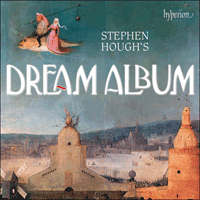
Stephen Hough’s Dream album

034571281766

A few years ago, I heard Stephen Hough in concert in a programme of “serious” music: the premiere of his ‘Trinity’ Piano Sonata III alongside Cèsar Franck’s mighty Prelude, Chorale & Fugue, plus works by Liszt and Schubert. And the encore? Eric Coates’ By the Sleepy Lagoon, which many will recognise as the theme tune from the BBC’s long running Desert Island Discs programme. Played with as much care and expression as the main programme, it was a delightfully witty and nostalgic close to the evening. This charming miniature appears on Stephen Hough’s latest release ‘Stephen Hough’s Dream Album’ and is given a lilting Chopinesque delicacy by Hough.

Dreaming – Isn’t this what we do when we listen to any kind of music? We suspend the reality of our ordinary lives, we long for spells to be cast, for phantoms to be grasped, to enter a state of ecstasy. (Stephen Hough).

Most of us go to concerts and listen to music to be taken to another place, and this album succeeds in this objective in spades, offering a varied selection of flights of fancy, erotic reveries, melancholy ponderings, and fleeting visions. All the works on the disc are transcriptions, by Hough himself and others (if you, like me, own Hough’s ‘Tributes and Transcriptions’ collection of piano music, you will be delighted to hear his mischievous Radetzky Waltz, the witty Niccolo’s Waltz with its nod to Paganini, Osmanthus Romp and Reverie, and Lullaby played by the composer/performer himself). Here, Hough the concert pianist is cast also as transcriber, interpreter and re-creator, and his own transcriptions are a testament to his musical insight, skill, and whimsy.

What makes this album so charming is Hough’s skilled programming, mixing high art with pieces, which in the hands of certain others, could sound schmaltzy and sentimental. Thus powerful performances of works Liszt and Dohnányi sit happily alongside Hough’s cheery Matilda’s Waltz (a reference to his father’s heritage and scored as a rumba) or amusing transcriptions of dances from Don Quixote. Hough avoids kitsch and brings to every piece his characteristic clarity, musical intelligence, wit, elegant phrasing, tasteful pedalling and an intoxicating kaleidoscope of expressive colours and moods to create an album which delights and surprises at every turn. It’s also deeply personal (two pieces were written for Hough’s partner), ending with “the piece I want to be the final piece I play in concert – the last encore of my last concert which I first heard on my first LP“. Nostalgic and bittersweet, redolent of “at homes” in Edwardian drawing rooms or pre-war cocktail hour, the music evokes a dreamy golden age tinged with poignancy. Hough’s magical soundworld brings an intense intimacy and elegance to every piece. Listen to it as an entire recital album or dip in and out of it: you will be utterly charmed and transported.


Stephen Hough’s Dream Album is available as a CD or download from Hyperion


A few years ago, I heard Stephen Hough in concert in a programme of “serious” music: the premiere of his ‘Trinity’ Piano Sonata III alongside Franck’s mighty Prelude, Chorale & Fugue, plus works by Liszt and Schubert. And the encore? Eric Coates’ By the Sleepy Lagoon, which many will recognise as the theme music from the BBC’s Desert Island Discs programme. Played with as much care and expression as the main programme, it was a delightfully witty and (for those of us of a certain age) a rather nostalgic close to the evening. This charming miniature appears on Stephen Hough’s latest release ‘Stephen Hough’s Dream Album’.

Dreaming – Isn’t this what we do when we listen to any kind of music? We suspend the reality of our ordinary lives, we long for spells to be cast, for phantoms to be grasped, to enter a state of ecstasy. (Stephen Hough).

Most of us go to concerts and listen to music to be taken to another place, and this album succeeds in this objective in spades, offering a varied selection of flights of fancy, erotic reveries, melancholy ponderings, and fleeting visions. All the works on the disc are transcriptions, by Hough himself and others (if you, like me, own Hough’s ‘Tributes and Transcriptions’ collection of piano music, you will be delighted to hear his Radetzky Waltz, Niccolo’s Waltz, Osmanthus Romp and Reverie, and Lullaby played by the composer/performer himself). Here, Hough the concert pianist is cast also as transcriber, interpreter and re-creator, and his own transcriptions are a testament to his musical insight, skill, and whimsy.

In others’ hands, this music could sound schmaltzy and sentimental, but Hough brings to it his characteristic clarity, wit and an intoxicating kaleidoscope of expressive colours and moods to create an album which delights and surprises at each turn. It’s deeply personal, ending with “the piece I want to be the final piece I play in concert – the last encore of my last concert which I first heard on my first LP“. Nostalgic and bittersweet, redolent of “at homes” in Edwardian drawing rooms or pre-war cocktail hour, the music evokes a dreamy golden age tinged with poignancy. Hough’s magical soundworld brings an intense intimacy and elegance to every piece. Listen to it as an entire recital album or dip in and out of it: I guarantee you will be utterly charmed and transported.

Stephen Hough’s Dream Album (Hyperion)