The following text is an article I wrote for the ABRSM’s conference on 3 November, for which my colleague and friend, Karen Marshall, a writer and piano teacher with a specialisation in music teaching for children with dyslexia, gave a presentation.

While not specifically relating to music, I think what my son’s and my experience of his dyslexia confirms is that children with learning difficulties such as dyslexia really do need not only specialist support in school to help them with reading, writing and processing information, but also the opportunity to explore subjects outside the narrow STEM-focussed curriculum. Practical and creative subjects such as product design, catering, art, drama and music give dyslexic students an important opportunity to demonstrate their talents, and a dyslexic child who may be struggling with reading and writing and falling behind in class as a consequence, can gain considerable confidence and self-esteem by finding another subject in which they excel – be it music or, in my son’s case, cooking (which led him into a career as a professional chef).  The erosion of my son’s confidence at school, due to his dyslexia and attitudes towards it from teachers and other parents, was very hard for him, and me, and when I started teaching piano, I realised that the single most important thing I could do for my students was build their confidence.

The gradual removal of creative subjects from our national curriculum is, in my opinion, an absolute disgrace, denying not only dyslexic children but all children the opportunity to express themselves, explore, broaden their horizons and acquire important life skills such as teamwork, collaboration, communication, confidence and self-determination which will serve them well as they enter adulthood.


My Child and Dyslexia: A Parent’s Perspective

For the parent of a dyslexic child so much is focused around the child’s (and parent’s) experience of the education system – a system which is supposed to be enjoyable and stimulating for children and which will broaden their horizons and equip them for entry into adulthood.

I suspected my son might be dyslexic almost as soon as he started at primary school. Dyslexia runs in my husband’s family and I knew the condition could be inherited. My son was an articulate child, had quite a sophisticated vocabulary in advance of his age and was even able to recognise quite complex words when written down, but he really struggled with reading from the outset. This was the first indicator that there was a problem and it remained a significant issue for my son until he was mid-way through secondary school. The ability to read and process written information is a key functional skill; without it, I worried that my son would struggle with straightforward everyday tasks such as completing forms or travelling – would he be able to read road signs or train station names? And if he couldn’t, would he get lost when travelling on his own?

Reading homework was always a trial, usually resulting in stress, tears and frustration. Written homework proved equally painful, as my son struggled to hold a pencil and form words. I saw no value in making him engage in an activity which was clearly upsetting him and gradually eroding his confidence: growing maturity and awareness meant that he knew he was far behind in class. My cheerful, bright (yes, bright) little boy had turned into a frustrated, uncertain child, and I an anxious parent who didn’t know where to turn. So much emphasis is placed on “attainment” in our education system and a child who falls below the set norms/targets is considered “educationally subnormal”. It was pretty devastating because I knew my son was bright – just not academically bright.

This for so many parents of dyslexic children is the difficult paradox that we face: our children often have average or above-average intelligence. Some are gifted or have a very high IQ, but there’s a discrepancy between their potential and their achievement as measured by standard school tests.

Throughout school, my son felt like a square peg in a round hole. Singled out for Special Educational Needs (SEN) support, he knew he was different, isolated in a school in an affluent, high-achieving suburb of south-west London. The school was reluctant to have him assessed, and hinted on more than one occasion that I should be doing more to support my son’s learning. Since I am neither a teacher nor a dyslexia specialist, this was an impossible task. In the end, after many meetings with the headmaster and head of SEN provision in the school, with me often in tears, begging the school to do something, they reluctantly agreed to have him assessed by an educational psychologist who identified the dyslexia and recommended that he be statemented for special educational needs. This came when my son was 10: I had been telling the school that dyslexia ran in the family since Year 1! The statementing had very little impact on my son’s progress in his final year at primary school, but by that time I didn’t really care about his STATS results. I was desperate for some improvement in his confidence and self-esteem.

Fortunately, his secondary school had a far more proactive attitude and good SEN provision was made ahead of his arrival at the school. The head of SEN was an intelligent young woman who was fully conversant with the most up-to-date research on dyslexia. She was sympathetic and kind and went out of her way to make my son feel included, where previously he had felt ex-cluded. She was also highly perceptive and quickly recognised that he was bright, but bored. The state education system, with its emphasis on regular testing as a measure of progress, is hard for dyslexic children because of the way they receive, decode and process information. Dyslexic children may be bright, but they take longer than other children to get through their schoolwork. The dyslexic brain is wired to do different things to the non-dyslexic brain, and while dyslexics tend to be very good at lateral thinking or “seeing the bigger picture”, these skills are not recognised or valued in an increasingly narrow education system where rote learning and The Three Rs rule. As a consequence, dyslexic children can grow bored and frustrated within the narrow confines of mainstream schooling.

For my son – and other dyslexics – reading and writing were laborious and tiring, and he would regularly come home from school exhausted and bad-tempered, yet unable to get to sleep at night because he was anxious about what the next day at school might bring. He was bullied by other students, including his former best friend who claimed that being dyslexic meant he could not skateboard or ski, and on one occasion a teacher called him “stupid” because of his lack of application in class (a teacher who later went on to give my son crucial support ahead of his GCSEs). Some days I would keep him off school so we could do pleasant relaxing things together (cooking and art, or a walk in the park), just to take the pressure off him. I found the effort of supporting and advocating for him equally exhausting. Frustrated, dismotivated and bored at school, by 15 my son’s behaviour had become particularly challenging. He fell in with a rather unpleasant group of boys and took to missing school and staying out at all hours, or not coming home at all, preferring to sleep over at a mate’s house. If we criticised his behaviour, he would become argumentative and on occasion aggressive.

Strangely, alongside this rather difficult scenario and a generally negative attitude to school, my son was now reading, though not at the expected level for his age. The breakthrough occurred a couple of years previously during a holiday in Italy, when we were confined to our apartment due to bad weather: he picked up a book and suddenly he was reading, unaided, reasonably fluently, and, more importantly, enjoying it. Perhaps it was because the pressure off: away from school he could choose to read, rather being expected to read. Other mini milestones followed, largely due to the support of two particular teachers who recognised and encouraged a bright spark of creativity in my son, and when previously he was scoring Ds and Es for tests, my son was now achieving Bs and Cs. As he approached his GCSEs there was a noticeable improvement in his confidence. He was offered a place at a local college to study professional cooking and he gained better-than-expected GCSE results, for which he received a special prize from the school. While he refused to return to the school to collect the prize (understandably, he wanted to put the negative experiences of school behind him), it was a significant moment and he entered his college course with a distinct spring in his step – and beautiful new chef’s “whites” in his rucksack. Within weeks of commencing his course, he was a different person. Regularly scoring Distinctions for his practical work, he was now top of the class where previously he had been consigned to the bottom. He had found his creative niche and a practical skill in which he could excel. He forged (and has retained) strong working relationships with his tutors, who treated him with respect (something often lacking in school), and went on to attain a Level 3 Diploma in Professional Cooking. He is now a chef at a top hotel in London’s Mayfair.

It can be tough, being the parent of a dyslexic child, and it’s all too easy to let the label define your child – and you. Other people can be very judgemental, often under the guise of being well-meaning; there were some who suggested my son was lazy or stupid or that I had failed as a parent because he didn’t read until he was at secondary school. Such attitudes reveal how much ignorance still surrounds learning difficulties like dyslexia – from both teachers and educators and other parents. As a consequence, my son and I had to develop higher levels of resilience and some days it was very hard to remain positive.

We all want the best for our children and as a parent I believe it is our job to support, encourage and advocate for our children as far as possible to enable them to achieve and thrive, and to instil in them confidence and a sense of self-worth. I was determined that my son understood his strengths, and differences, and that we celebrated them. We discussed dyslexia openly at home, citing the achievements of famous dyslexics such as Richard Branson and Albert Einstein. As it turned out, a subject such as professional cooking, which combines highly-skilled technical application with creativity, suited my son perfectly: lateral thinking, problem-solving and the ability to spot connections between different ideas, objects or points of view – all dyslexic “strengths” which my son possesses – proved an asset in a fast-paced professional kitchen, and he drew much inspiration from the achievements of Jamie Oliver, who is also dyslexic.

I never pushed my son while he was at school, because I recognised that this would be counter-productive. Instead, I did my best to support him to enable him to find his own way in this competitive world. Today my son, at 20, is a confident young man with a burgeoning professional career, mature-beyond-his years, and living in his own flat. He reads books by Noam Chomsky and George Orwell, and can articulately express his views on world politics, or current trends in food and the hospitality industry – and much more. I am immensely proud of him and respectful of the struggles he endured to get to where he is now. He knows he could walk back into his primary and secondary schools with his head held high and display his achievements. In that need to find one’s niche and true passion, and to celebrate one’s personal achievements lies the success of the dyslexia story.

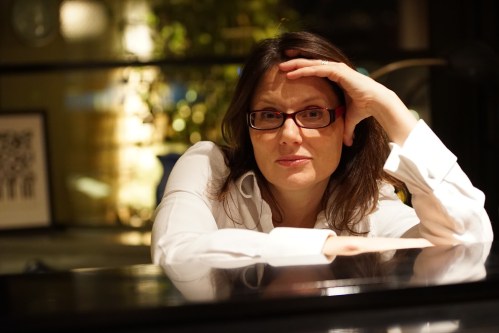
Frances Wilson is a pianist, piano teacher, music reviewer, writer and blogger on classical music and pianism as The Cross-Eyed Pianist. Her son, Max, is a Chef de Partie at The Connaught in Mayfair.

Dishes cooked by Max Wilson

Adapted from Jeanette Winterson’s 10 Rules for Writers (via Brain Pickings)


  1. Do your practising and turn up for work. Discipline and routine allows creative freedom.
  2. Don’t stop when you are stuck. You may not be able to solve the problem, but turn aside and practise something else. A shift of focus often reveals solutions.
  3. Love what you do.
  4. Rise to the challenge of the music, not other people’s expectations of what you should do and be
  5. Respect the music, but don’t revere it.
  6. Take no notice of anyone you don’t respect
  7. Don’t constantly compare yourself to others.
  8. Be ambitious for the work and not for the reward.
  9. Trust your creativity.
  10. Enjoy this work


Who or what inspired you to pursue a career in music?

As a young child there was a lot of music around the house and I listened to Jacqueline du Pré play Bach’s Cello Suites every night before bed. I am not sure how attentive a listener I was – I believe the aim was for me to drop off to sleep! – but I refused to accept any other interpretation of that music! As for my decision to make cello my career, I became accustomed to the life of a touring artist on a series of cruises starting when I was five years old, during which I had fantastic experiences performing amongst top professionals, signing autographs and even being interviewed by Richard Baker before rushing back to the swimming pool!

Who or what have been the most important influences on your musical life and career?

I grew up attending my father’s concerts with cellist Alexander Baillie and listening through the door to their rehearsals at home. Musicians were often guests at our house and I remember discussing the finer points of ‘Lord of the Rings’ with Dame Emma Kirkby, whose individual approach to singing has always seemed the most natural to me. Lately, I have been influenced more by ideas and principles of making music than by specific performers: I am not aiming to emulate any cellist in particular but to reach my own personal sound in ways I am discovering myself. There are cellists whom I greatly admire such as Mstislav Rostropovich and János Starker, but I have been more often inspired by musicians in other fields such as the conductors Claudio Abbado and Carlos Kleiber, the violinist Julia Fischer and pianists Claudio Arrau and Arthur Rubinstein.

What have been the greatest challenges of your career so far?

The greatest challenges have been projects that I embarked upon with a view to expanding the repertoire of the cello. In 2014 I performed Jan Vriend’s ‘Anatomy of Passion’, a 30 minute work for cello and piano composed in 2004. It was a formidable challenge, not only because of great technical demands and complex rhythms to coordinate with the piano, but also because I decided to perform the piece from memory which I believe made my performance more convincing. More recently, I arranged and performed Bach’s iconic ‘Ciaccona’ from the Violin Partita No. 2 in venues including London’s Wigmore Hall and King’s College Chapel. This was an enormous statement, to take a piece which means so much to people and adapt it to another instrument which made it essential for me to transcend the substantial technical difficulties of performing this on the cello and create a performance which was musically worthwhile and not just an impressive show of technique.

Which performances/recordings are you most proud of?

I try to make every performance better than the last, but rather than pride, I experience enjoyment when I play. My performances of the two pieces mentioned above have been some of the most rewarding concert experiences of my life. I am also happy that the recording I made at nineteen years old of the Chopin Cello Sonata still seems relevant to me despite the six years of development I have had since then.

Which particular works do you think you play/conduct best?

I play a wide range of repertoire, from Bach through to brand new pieces and I try to approach every type of music with the same philosophy – to take a fresh look at the score and try to interpret what that particular composer means in their notation. I then put one hundred percent of myself into every moment of the music, no matter what the style. Having said that, I think music by Benjamin Britten, Prokofiev and Shostakovich suits me well and I find the technical challenges of music from the 20th and 21st centuries to be the most fascinating. In terms of conducting my repertoire is smaller, but I have most enjoyed conducting 19th and 20th century music. In particular, I conducted Strauss’ Metamorphosen with the Seraphin Chamber Orchestra in 2017 and since I felt a particular affinity with the piece I found it very natural to memorise and perform.

How do you make your repertoire choices from season to season as a performer and also as conductor?

My repertoire choices are often taken in collaboration with musicians I am working with and I am very lucky to perform regularly with my father, pianist James Lisney. We both enjoy crafting programmes with a unifying theme and have toured several of these ‘project’ concerts with titles such as the Beethoven Grand Tour (the five Cello Sonatas), Cello Song and Russian Connections. I enjoy playing contemporary music so I make a particular effort to fit some new music into most of my recital programmes. As for concerti and chamber music that is often a little more out of my control but I am eager to play all sorts of music!

You are also a composer and conductor. How do these disciplines impact on your performing career and vice versa?

My work as a composer impacts directly on my cello career as I often perform my own music. My conducting contributes less obviously to the rest of my career (though I have conducted my own music) but I believe that the experience of leading an orchestra through various types of music has improved my concerto playing and opened my eyes to particular considerations in composition. My experiences as a cellist are central to everything I do and it is almost impossible to separate it out. Of course, the technical knowledge is crucial to composing for string instruments but also the experience of performing gives me a certain empathy with musicians I am writing for; I take great care to ensure that the music I compose is rewarding both to perform and to hear.

As a composer, how would you describe your compositional language?

This is a question we composers are asked very regularly and I am still struggling for an answer! The aspects of my music which might constitute a style or language are by nature the ones that recur in many of my pieces and as such, they are the very elements it is difficult to identify in one’s own music. My orchestration is often detailed and delicate, but I am not adverse to thicker symphonic textures. I do not write in a strictly tonal idiom but I think it is clear to listeners that I have a background in western classical music, and tonal direction is central to my music. I am very motivically-led and this is often the focus of my compositional process. I begin with one or two ideas which I develop, combine and transform in the same way Beethoven, Wagner and so many others have done before.

How do you work, as a composer?

Since I have never had my own piano I have become accustomed to working in silence at a desk. I tend to start out on manuscript paper and when I begin writing I usually have a significant portion of the piece mostly if not fully composed in my head. At some point in the process I will ‘run out’ of music and at that point I look back at what I have written so far and examine the possibilities. Later on I type everything into Sibelius [music notation software] but I do not use the playback function except for checking mistakes – I am much more likely to hear a typo than see one!

What are the special challenges/pleasures of working with particular musicians, ensembles and orchestras?

I find it very rewarding to write specifically for certain players or ensembles. For example, in 2017 I composed ‘Thread of the Infinite’ for the Cambridge University Chamber Orchestra in the knowledge that they would perform this piece unconducted, directed from the violin by Thomas Gould. In this case I made sure that the coordination between parts was clear enough not to require a visual cue from a conductor and inserted several soaring violin solos for the Leader. I have recently written a piece ‘Spiralen’ for Ensemble Recherche, who specialise in the highly complex music of composers such as Brian Ferneyhough and Helmut Lachenmann. My music is far removed from this idiom but I found it very rewarding to work out what new things these musicians were capable of and how I could absorb this into my own style.

What, for you, is the most challenging part of being a conductor? And the most fulfilling?

Many of the most challenging aspects of being a conductor are administrative! At this stage in my career I am running my own orchestra which involves a lot of non-musical tasks such as organising parts, venues and marketing. This means however that I have autonomy over the artistic direction the orchestra takes which I find very exciting. I love rehearsing with musicians and find it very interesting to think about how different musicians respond to words and visual cues. I often have to say something in two or three different ways to get all the players in a section to respond in one way. If I want a particular quiet sound, for example, some of the violinists might pick that up from my beat, others would benefit from some metaphorical suggestion and the final group might respond best to a specific technical instruction such as bow position and speed of vibrato.

How exactly do you see your role? Inspiring the players? Conveying the vision of the composer?

I see my role as a facilitator with a interpretative opinion… I wish to give the players both the framework and the freedom to perform, which involves bringing everyone together to a unified vision of the music. I hope that in a concert situation I can help inspire the players to find something magical and then very often as a conductor our work is done – less is more.

Is there one work which you would love to conduct?

There are many works I would love to conduct, particularly some works by George Benjamin such as ‘At First Light’.

ce599-jl-conducting-sco
Joy Lisney conducting Seraphin Chamber Orchestra

As a musician, what is your definition of success?

I feel entirely free when I am performing and my main motivation in pursuing a career in music is to get the opportunities to show people the music that I love and believe in.

What do you consider to be the most important ideas and concepts to impart to aspiring musicians/composers?

What I have learnt so far is to approach every work with humility and love; look at every work from a composer’s perspective, put one hundred per cent of yourself into it and value that input. I have also learnt that your understanding of something you take the time to discover by yourself is so much deeper than something given to you fully-formed. The journey is essential.

Where would you like to be in 10 years’ time?

10 years sounds an unimaginably long time and I cannot immediately see where my current trajectory will take me. I suppose that my ultimate goal is to be able to perform the music I want to perform to a willing audience(!) and I hope that I can combine the three strands of my career – cello, composition and conducting – to have a fulfilling musical life.


Joy Lisney is one of the most exciting young musicians to emerge in recent years. Her early promise as a cellist was highlighted by Carlton Television when they chose her, at the age of six, as a possible high achiever of the twenty first century.

She has since fulfilled expectations with a distinguished international career, launched by a debut series of two concerts at the Amsterdam Concertgebouw in 2012.

Joy has enjoyed collaborations with artists including Dame Emma Kirkby, Alexander Baillie, Howard Williams, Huw Watkins, the Allegri Quartet and the Wihan Quartet and also performs regularly in duo with her father James Lisney. Venues for duo recitals have included Amsterdam’s Concertgebouw, Queen’s Hall Edinburgh, St. George’s Bristol, the Leipzig Gewandhaus and St. John’s Smith Square. In 2014 she performed all five Beethoven cello sonatas in a single concert in a tour concluding with a sold-out performance at London’s Southbank Centre. Projects in 2017 have included a Schubert Quintet Tour with the Allegri Quartet, concerto performances by Prokofiev, Haydn and Turnage and the Cello Song recital tour.

As a passionate advocate of new music Joy has commissioned two new works from the Dutch composer Jan Vriend, the first of which she recorded on her debut CD in 2012. In 2014 she performed as a London Sinfonietta Emerging Artist at the BBC Proms in a concert broadcast on Radio 3 to celebrate the 80th birthday of Sir Peter Maxwell-Davies. In April 2017 Joy performed on the opening night of the Park Lane Group Recital Series at St. John’s Smith Square, giving a solo recital including two premieres, one of which was her own composition ScordaturA. Joy has also given European premieres of works by Judith Weir and Cecilia McDowall.

As a composer, Joy has won the Ralph Vaughan Williams and Sir Arthur Bliss Prizes and she was also Composer in Residence at Cambridge University Music Society for 2016-17. Joy is in the second year of her PhD in Composition at King’s College, Cambridge, supported by the AHRC, and is Honorary King’s College Vice-Chancellor’s Scholar. Her first string quartet was premiered by the Arditti Quartet and she has since had music performed at the King’s Lynn and Aldeburgh Festivals and the Park Lane Group Series.

Forthcoming performances this season include the Elgar Cello Concerto and the Brahms Double Concerto (with Emma Lisney), the premiere of her new work for chamber ensemble, and concerts at Temple Music Foundation, West Road Concert Hall in Cambridge, St George’s Bristol, the Purcell Room, and St John’s Smith Square.

Joy is also the founder and conductor of the Seraphin Chamber Orchestra, a string orchestra which combines the best players of Cambridge University with young professionals from the South of England.

joylisney.com

The accepted notion is that age confers a spirit of reconciliation and serenity on late works

Edward Said, ‘On Late Style’

What is ‘Late Style’? It’s a question that has preoccupied writers and thinkers, from Theodor Adorno, who coined the term in relation to Beethoven’s late music, to Edward Said, whose book ‘On Late Style’ explores the output of artists, writers and composers whose late work is often intransigent and contradictory.

Although not always concerned with valedictory thoughts, late style is also associated with an aesthetic mastery and a distillation of what matters most, as if an awareness that the end may be near has the effect of really concentrating the artistic focus. Beethoven, for example, reveals in his late piano sonatas an intense otherworldliness and non-conformity. For Adorno, Beethoven’s last works are an emphatic and triumphant assertion of his refusal to resolve life’s exigencies peacefully, a view which Edward Said endorses, regarding it as a strength in its own right, rather than a negative factor in Beethoven’s late music.

In a more long-lived composer such as Brahms, the combination of accumulated wisdom and the sense that time is limited produces music which is impeccably wrought and introspective, yet emotionally unleashed. The late piano works which form Brahms’ Opp 117, 118 and 119 contain serenity and vulnerability, and an acceptance that the end is near, yet these works are not valedictory. In these late piano works, there is greater spaciousness, more freedom of expression, and the sense of a composer who no longer has anything to prove.

Meanwhile, for Schubert and Schumann, who both died young (by today’s standards), lateness is relative, almost a philosophical construct. The “late” works of these composers demonstrate that lateness is not just about physical maturity but also an attitude of mind. In their music there is the sense of a life lived with intensity, that time is finite, and this seems to have focused composers’ imaginations in a very specific way.

In the Geistervariationen (Ghost Variations), composed in February 1854, just weeks before Robert Schumann’s irretrievable mental breakdown and his committal to a lunatic asylum, we find a composer who has turned inward, the “Eusebius” (sensitive, introverted) side of his personality very much to the fore. The music is poignantly pared down – a simple chorale-like theme opens the piece – but also full of intimate tenderness and expression. In the final variation, the theme dissolves into the textures of the music and simply fades away at the end.

Schubert’s last works, in contrast, suggest an “incompleteness”, as if he still had much more to say. The final year of Schubert’s life was one of extraordinary productivity, marked by increasing public acclaim and declining health, and the wealth of music he produced, including the two sets of Impromptus and the final three piano sonatas, displays a very high level of artistic maturity. Freed from the shadow of Beethoven, who died in 1827 and whom Schubert revered, the last three piano sonatas in particular reveal a remarkable assuredness in Schubert’s writing, in their structural organization and expansiveness, and the use of cyclic motifs to create a sense of “belonging” between the individual movements and across the three sonatas as a whole.

If ‘Winterreise’ is heartbreak, a study in unrelieved sorrow, the final three sonatas reveal, and revel in all of life: while the C minor Sonata D958 is the most serious of the triptych, its companions are never unremittingly melancholy nor heavy, but rather intoxicatingly bittersweet, nostalgic, and life-affirming.