To coincide with the release of her new album ‘Chopin: Voyage’, Russian pianist Yulianna Avdeeva talks about her life in music, balancing one’s artistic needs with the external pressures of a professional career, and how inspiration “can be found anywhere”.….


Who or what inspired you to pursue a career in music and who or what have been the most important influences on your musical life and career?

In my childhood I was surrounded by music. Although my parents are not professional musicians, they were great music lovers and had an upright piano at home, as well as a solid LP collection. At some point they realized that I was trying to play a melody that I had just heard with one finger on the piano, and took me to the Gnessin Special Music School. When I was 5 years old I entered the piano class of Elena Ivanova, with whom I studied for 13 years, until my graduation, and who became a family member for me. Thanks to her amazing admiration and approach to music, I was able to discover this magical world for me as well. However, the moment I remember so well, which was crucial to me, was my first public performance, when I was 6. I was supposed to play 2 Tchaikowsky pieces from his Children‘s album, and my parents and teacher were explaining that I shouldn‘t be scared by the light and people and the audience and should be concentrating on the music I’d play for them. I was not scared at all; on the contrary, I enjoyed very much communicating with the audience through the language of music! And I wished to perform again. So the solution for how to stay motivated for practice was found! I keep that feeling until today and am so grateful to be able to speak this universal language with people all over the world.  

What have been the greatest challenges of your career so far?

I think the greatest challenge is to find out what your mental and physical needs are in order to achieve the most satisfying artistic result. This result depends on many factors, which I had to recognize and acknowledge in my preparation work as well as in my stage performance. Time management is one of the most essential elements; it means that I must know how I should organize my practice, so that I give each piece I perform enough space not only in my daily practice but also in my soul, since I need to “live” with a piece for a while so that it becomes, in a way, my co-creation. On the other hand, I have to know my limits — for instance, if I have a very tight schedule, how many programmes can I really handle? And does it make sense, artistically? My personal goal is to be in the best shape when I walk onstage, and it is probably a never-ending process to understand myself.

Which performances/recordings are you most proud of? 

It is always very difficult for me to listen to my own recordings or the recordings of my own concerts. I almost always think, “Oh, now I would play that completely differently!”. This is the charm and challenge of music — it exists only in the moment when it is being performed, and it is not easy to capture this moment on any recording. So I very rarely listen to my own performances — with some exceptions, of course. For example, it is an amazing inspiration and joy to work with Bernhard Guettler, the sound producer I have worked with for my latest two recordings — Resilience, and Voyage, my new Chopin album, on the Pentatone label, featuring his late works, which has just been released. This particular recording experience was absolutely unique for me for two essential reasons: the location and the instrument. I was so lucky to make this recording at the one and only Tippet Rise Arts Center, in Fishtail, Montana, surrounded by nature and a wonderful team. And on top of that, I played the music on Vladimir Horowitz’s personal piano, which has an exceptionally long and warm sound that opens up like a flower.

When I first touched this piano in September 2022 at the TIppet Rise Arts Center, my first thought was, “This piano is my dream partner for Chopin’s music!”. So I am very thankful to Peter and Cathy Halstead and the entire team at Tippet Rise Arts Center for their most kind support; Mike Toya for his amazing care of the piano; Bernhard Guettler for his patience and his unlimited desire to explore the sound worlds; and the Pentatone team for bringing this recording to life.

Which particular works/composers do you think you perform best?

The moment I decide to play any piece, it becomes “the best and dearest piece” for me, otherwise I will not be able to find an authentic approach to it. Nevertheless, of course there are composers I admire so much, since they have an enormous emotional impact on me, such as Bach, Beethoven, Schubert, Schumann, Chopin, Liszt, Rachmaninoff, Mahler, Prokofiev, Shostakovich, and Bartok, to name just a few. A great discovery for me was Bernstein’s Second Symphony, “Age of anxiety,” in which the piano has a very important solo-like part. It was an exciting process to prepare this unique work, based on Auden’s poem, and I am so lucky to have performed it a couple of times in Spain and Italy and finally to play it in the United States with the Minnesota Orchestra and Robert Trevino on October 18th and 19th, 2024!

How do you make your repertoire choices from season to season?

The piano repertoire is just limitless, which is the pianist’s curse and blessing! My personal list of pieces I would love to play is getting longer every year, so I have to make decisions about what I would like to play next. Sometimes it takes a long while to decide on a recital programme; for me it is important that there is a certain concept, or at least a connecting idea between the pieces. The programme I am performing at Carnegie Hall on October 22, 2024 is a Chopin and Liszt recital. They were the two giants of the Romantic era, both unique performers, and both were trying out the most extreme ways of expression on the piano, even if they were moving on very different paths.

Next year I will be performing Shostakovich’s 24 Preludes and Fugues, op 87, which for me is one the greatest cycles for piano of all time. It was inspired by Bach’s The Well-Tempered Clavier, which I will be playing in 2027. These cycles require my entire concentration in the preparation. At the same time, for next year I also prepared a programme that connects two composers you wouldn’t expect to see together — Chopin and Shostakovich. But Shostakovich was a participant at the first Chopin Competition, in 1927, in Warsaw, and he played Chopin a lot in his younger years. So it is always kind of a work of investigation to create a recital programme.

Do you have a favourite concert venue to perform in and why?

There are many; I could not pick only one. Some of the halls are very inspiring because of their history and the musicians who have performed there — like Carnegie Hall, or the Musikverein in Vienna, but also some modern halls are amazing because of their acoustics and atmosphere — for example, Disney Hall in Los Angeles, or Elbphilharmonie in Hamburg. 

What do you do off stage that provides inspiration on stage?

I am convinced that inspiration can be found anywhere — it can be a color from the sky or of the leaves on a tree; it can be a conversation, or a great book, or even a smell — like the smell of the air in the autumn, or the aroma of a fantastic meal. I just have to be very open to be able to absorb it.

What is your most memorable concert experience?

It is difficult to say. In every concert I share a part of my soul, and my soul in turn keeps the memories of each single concert. And, as I mentioned, the music exists only in a moment when it is being performed and cannot be repeated — that is why each concert experience, even with the same repertoire, is always different.

As a musician, what is your definition of success?

Artistic success for me is probably when I am able to present an interpretation of a piece which on the one hand comes as close as possible to the composer’s will — though this criteria is very subjective — so, on the other hand, it is about my personal feelings about the music, which should be very strong and authentic. And the message of the music I perform should be acceptable for the audience, otherwise I have failed to translate the music score into human feelings. 

What do you feel needs to be done to grow classical music’s audiences?

It is essential to give access to music to the youngest. That can be through playing an instrument, singing, dancing, or any other kind of musical activity, because music also helps children to feel and articulate the emotions they experience. This is what makes human beings unique and irreplaceable. Later on, children who have been exposed to these experiences will decide whether they want to play or sing for their family, or go to concerts, or become a professional musician. Maybe they will not have any interest in it at all. But our goal should be to give them a chance to explore this magical world of music.

What advice would you give to young or aspiring musicians?

I would like to encourage young musicians to think, before they go on stage, about how lucky we are to be able to speak the language of music and share our passion with the audience. And it does not matter if their audience is big or small, or if it is a concert, an exam, or a competition — it is only music, which matters for the performer, and we should only focus on it. I am wishing you a long, happy life, full of wonderful sounds! 

Yulianna Avdeeva performs music by Chopin and Liszt at Carnegie Hall, New York, on 22nd October. Find out more here

Yulianna Avdeeva’s new recording ‘Chopin: Voyage’ is available now on the Pentatone label.


British-based composer Naresh Sohal was born on 18 September 1939 in Punjab in pre-Partition India, and was the first person of Indian origin to make his mark as a composer of western classical music. His family had no musical pedigree, nor any connection with western classical music; his musical tastes were formed by listening to music on All India Radio and Radio Ceylon. A broadcast of Beethoven’s Eroica symphony on All India Radio gave him his first taste of the full power of the orchestra and its ability to create complex soundworlds, and he was so overwhelmed by this experience that he begged his father to allow him to travel to Europe so that he could become a composer of western classical music.

He had no formal musical training, beyond a handful of uninspiring night school classes in composition and a brief stint as a student of teacher/composer Jeremy Dale Roberts, but he got a job as a copyist for music publisher Boosey & Hawkes, which gave him the opportunity to study scores in depth, absorb compositional techniques and gain important insights into the way contemporary music was developing in the 1960s.

He completed his first large-scale work, Asht Prahar for orchestra, in 1965, and from there enjoyed a busy and productive creative life, composing well over 60 works, including major pieces for orchestra, chorus and soloists; chamber works; a ballet score; two musical theatre pieces; and scores for several television programmes. Of his eight commissions from the BBC, two were for major Proms pieces, and he had more than forty broadcasts of his work. He was the first composer to receive a bursary from the Arts Council of Great Britain, he served on the BBC music committee for some years, and in 1987 was awarded a Padma Shree (Order of the Lotus) by the Government of India for his services to music.

Naresh Sohal composing (image by Janet Swinney)

Toccata Classics released a recording of Sohal’s complete piano music (and his piano trio) in 2023, commissioned by Sohal’s widow Janet Swinney and performed by pianist Konstantinos Destounis. Here are a handful of works, written between 1974 and 2018, which illuminate a defining characteristic of Sohal’s music – a mysticism which explores issues of perception and the basis of human existence, and seeks a connection with the divine. This is manifested not only through the titles of the pieces – A Mirage, Chakra, Prayer, Tsunami, for example – but the music itself, whose unfolding soundscapes, suggest sacred rituals, contemplation and transcendence.

‘I am fascinated by the ultimate human questions of who I am and where I come from, and therefore most of my music is dominated by philosophical answers that are nearest to Vedantic thought’  – Naresh Sohal (interview with Suddhaseel Sen)

Throughout, there is a sense of a composer completely at one with the piano’s sonic capabilities, from plangent, sombre notes deep in the bass to the bell-like clarity or delicacy of the high treble register. The piano is a percussive instrument and Sohal utilises this with arresting effect in, for example, the opening piece, A Mirage, a work of some 13 minutes in which notes tumble across the keyboard, each with its own dynamic and colour. It’s a work of complex textures and emotional profundity.

Unlike the other works on the disc which are single-movement pieces, Prayer is in two movements, Adagio and Allegretto. The first movement has tender, perfumed chords, somewhat reminiscent of Debussy, and a plaintive melody. With its descents and ascents, each time reaching a higher note and growing more intricate, Sohal evokes the overwhelming power of prayer and spiritual transcendence. The second movement is toccata-like, its scurrying contrapuntal passages, interrupted by off-beat chords, representing the act of ‘pranam’ (prostration) or bowing forward in prayer.

Sohal’s final piece for solo piano, Tsunami, uses eastern scales with low bass notes to suggest the depth and movement of an ocean tsunami. The work’s steady tempo suggests the ominous, unstoppable power of water.

Despite the fiercely virtuosic complexity of Sohal’s music, pianist Konstantinos Destounis rises to its physical and emotional challenges to bring persuasive colour and clarity, control and sensitivity to the pieces on this recording.

An ideal introduction to Naresh Sohal’s music, his Complete Piano Music is released on the Toccata Classics label.

Further releases are planned for later this year – Janet Swinney writes: “One of these is a new recording by The Piatti String Quartet, currently quartet in residence at King’s Place, London, of four of Naresh’s five string quartets . Two of these pieces have never been performed before, and one of them is dedicated to me. The recording will be released by Toccata Classics. The project received a small financial subsidy from the Ralph Vaughan Williams Foundation.

There will also be two releases of heritage recordings of some of Naresh’s orchestral works remastered by, appropriately enough, Heritage Records. 

CD1 comprises ‘The Wanderer’, Naresh’s first work for the Proms, based on the Anglo Saxon poem of that name. The work is for orchestra, chorus and bass-baritone soloist. The premiere was given at the 1982 Proms by the BBC Symphony Orchestra and Chorus, with the BBC Singers and David Wilson-Johnson as the soloist, all under the baton of Andrew Davis.. The second work is ‘Asht Prahar’, Naresh’s first publicly performed orchestral work, premiered in 1970 at the Royal Festival Hall by the London Philharmonic Orchestra under Norman del Mar. The work concerns the division of day and night into eight equal intervals, according to the Indian system of time-keeping. 

CD2 features ‘Lila’, a musical account of the process of meditation and the attainment of enlightenment. This was commissioned by the BBC Symphony Orchestra who gave the first performance at the Royal Festival Hall in 1996 conducted by Martyn Brabbins. Sarah Leonard, soprano, was the enlightened soul who appears at the very end of the piece.

This work is accompanied by Naresh’s Concerto for Violin and Orchestra, another BBC commission this time premiered in Glasgow in 1993 by the BBC Scottish Symphony Orchestra under Martyn Brabbins. Xue Wei was the soloist.

Find out more about Naresh Sohal’s life and music here

This article first appeared on sister site ArtMuseLondon.com


This site takes many hours each month to maintian and update. If you find value and pleasure in what I do, why not

Guest post by Dakota Gale. The latest article in Dakota’s series Notes from the Keyboard, aimed at adult pianists


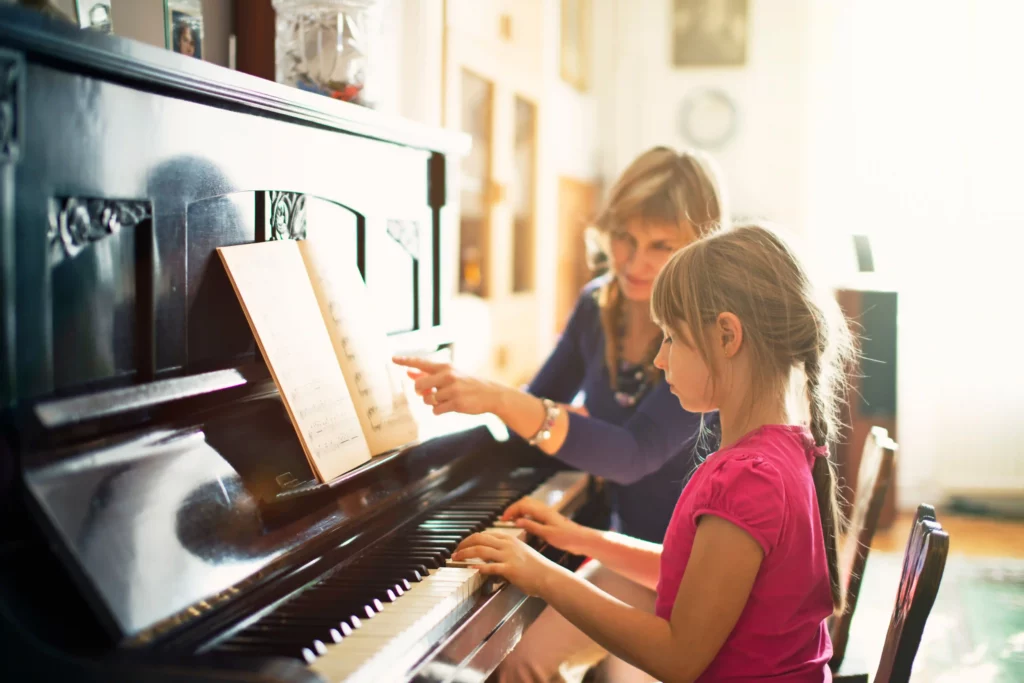
I recently attended a piano performance, during which I spoke with a 92 year old woman sitting next to me. She’d played and taught piano for decades. When I mentioned that I take lessons online, her eyes widened. “ONLINE lessons? But…that is the most amazing thing!”

She’s not the only one surprised. “Wow, you take lessons online?” is a common response from most people, even after the nuclear proliferation of pandemic Zoom meetings.

Yep, ever since I began taking lessons in spring of 2021, I’ve done them online. My teacher, Antonio, is located in southern Brazil; I’m in the Pacific NW in the U.S, thousands of miles away. And it’s not just me; plenty of people do it, including:

  • Those looking for specific expertise (e.g. Chopin etudes from a professional)
  • Those being careful while going through chemo or with a disease affecting their immune system.
  • Those who travel a lot (tougher if you’re flying, obviously)
  • If you have a favoured, dear teacher, but one of you moves, going online allow you to continue lessons.

Me and Online Lessons

For me, initially I took online lessons because of two things: to save money and to avoid COVID.

Since then, I’ve seen additional benefits. For one, they’re much more time efficient. No travel across town! For parents, I imagine this would be a huge benefit since you’d avoid shuttling kids around. (Actually, one of my friend’s kids is taking lessons with Antonio.)

I travel fairly often and like to keep lessons going. In fact, I’m currently rolling around the Pacific NW with my wife for three months in a Airstream travel trailer. Between mountain bike rides, hikes, and hanging with friends, I’m both continuing to play consistently and still taking my weekly lesson. Courtesy of Starlink satellite internet and a digital Kawaii piano, I’m not skipping a beat.

When my teacher is on vacation, I’ve also taken lessons with professionals such as Grzegorz (Greg) Niemczuk, who I found on YouTube. You might be surprised how many YouTubers offer lessons (a friend takes lessons with the popular Heart of the Keys YouTuber.)

You know what makes piano better? Playing outside!

Beyond all those boring logistical things, Antonio being Brazilian brings a fun perspective to my experience. (I’ve learned a few choice phrases in Portuguese, for one!) I’ve also learned about (and love!) Brazilian music that I would otherwise not know, including tangos, the music of Tom Jobim and Ernesto Nazareth, and folk songs arranged for piano.

It inspired me to start a listening quest of different genres and international composers that has deepened my relationship to piano. Perhaps a local teacher would have provided that, but certainly it would have been different.

The nuts and bolts of online lessons

For those wondering how this is possible, allow me to describe the situation:

  • Antonio uses a Yamaha grand piano to teach. On it, he has four cameras for his face, top down on his hands, sideways on his hands, and another on his pedal. He even uses software that allows the camera to track his hands (AI magic!).
  • The sound quality is quite good–the nuances he can hear and comment on astonish me.
  • For my setup, I use a different system depending where I am. At home, it’s my computer with a webcam plus my phone on a stand looking straight down at my hands. While traveling, I just go with my phone on a small tripod set up to the side and occasionally my laptop in front of me. It works great.

The benefit of all this: the only time I’ve missed a piano lesson is when I’ve taken bikepacking trips. I challenge you to carry a full-size digital piano through the mountains…no thanks. A pianist needs to take a break from the keyboard SOMEtimes!

Resources:

To find an instructor, just type “piano lessons online” into any search engine. A few popular services: Superprof or Wyzant; a fellow traveler I met on this trip used Preply to find her ukelele instructor. (If you want to work with Antonio, just ping him on Whatsapp at +55 48 9181-9164.)

Cheers to piano on the road!


This site takes many hours each month to maintian and update. If you find value and pleasure in what I do, why not

Guest post by TC

The score is the backbone of a film’s emotional landscape, serving as an integral element that enhances storytelling, deepens characters, and elevates or emphasises cinematic moments. Composed to underscore the narrative and visuals, a good score can transform the viewing experience from ordinary to extraordinary, subtly guiding audience reactions and infusing scenes with mood and meaning.

Good music can really make a film (and bad music can really harm a film), and is a very powerful tool. Music can be used to set the mood and move on, or delay, and inform the action. Some film scores enjoy iconic status: Brief Encounter uses Rachmaninov’s Second Piano Concerto, and the rich romanticism and pathos of this music truly enhances the narrative.

It’s no accident that some of the best modern and contemporary classical music (using the term loosely here) comes in the form of film scores (think composers like Erich Korngold, William Walton, Bernard Herrmann, Howard Shore, Maurice Jarre, John Williams, Ennio Morricone, Hans Zimmer, Yann Tiersen….) and is performed outside of the cinema by leading international orchestras. These programmes are enormously popular with audiences, not only because the scores are familiar from the films, but also because the music itself is so good that it can stand alone from the visuals.

The popularity of film music is regularly reiterated by radio stations such as ClassicFM, which regularly broadcast excerpts from the soundtracks of, for example, Lord of the Rings (Howard Shore), The Mission (Ennio Morricone), The Hours (Philip Glass) and more, and certain composers of film scores enjoy near-legendary status in the world of film and music

I’ve been to several film screenings with live score, an experience which can enhance one’s experience of both the film and the music, together and separately (and such performances do, I think, really highlight a good score).

The film Blade Runner (released in 1982) has an arresting score by Vangelis – considered by some to represent the very essence of Vangelis’ sound, with its shimmering synthesisers, sweeping orchestral passages, and haunting melodies. It has expansive majesty but also moments of tenderness, intimacy and poignancy. It is possibly one of the best film soundtracks ever.

Image credit: Paul Sanders

We went to a screening of Blade Runner: The Director’s Cut (2007) at the Bournemouth International Centre (BIC), a building of unrelieved dreariness, more used to hosting political party conferences than cult films with orchestra. Previously, we’ve seen films with live score at the Royal Festival Hall, which boasts comfy seats and pleasant social areas. The screen was perhaps too small, the film itself interrupted by subtitles (which as the action progressed fortunately became easier to ignore).

If you are familiar with Blade Runner, you will know that it is, on the surface at least, a science-fiction film, set in a dystopian future Los Angeles in which synthetic humans called Replicants are bio-engineered by the Tyrell Corporation. Renegade replicants are hunted down by ‘blade runners’. Harrison Ford plays Deckard, a disllusioned, world-weary policeman/blade runner. It’s based on a book by Philip K Dick, Do Androids Dream of Electric Sheep?, and it poses philosophical questions on the meaning and power of memories, lived experience, and, above all, what it means to be alive. This is most powerfully portrayed by the character Roy Batty (leader of the renegade Replicants, played by Rutger Hauer), who knows his time on earth is finite and his life is precious. He provides an important foil to the weary Deckard. In the closing scenes of the film, Roy’s touching death monologue reinforces the message of the entire film and expresses the fundamental experience of everyone who has ever lived. And it was here that the live score really highlighted the power and the poignancy of this message.

From the outset, despite the rather grim venue, performed live by the Avex Ensemble, the unsettling low-register rumbling, shimmering harp-like synthesiser lines and eerily descending scales set up what is to come. As the sound blooms and swells, it draws you in, placing you right in the heart of the film’s atmosphere, and you focus not just on the film itself, but also the shifting soundscapes of that transcendent, memorable and melancholic soundtrack. At times I found myself listening more intently than actually watching. The live score offered new nuances on the film, at times heightening and magnifying the action, intensifying emotion and intimacy, while also conjuring up the broad vista of a future world and worlds beyond our world.

Other notable highlights were the haunting solo saxophone in the love scene and live vocals in ‘Rachel’s Song’ from a female singer with a voice reminiscent of Beth Gibbons of Portishead.

Rutger Hauer as Roy Batty