Who or what inspired you to pursue a career in music?
As I was born into a family of musicians, I literally breathed music from my early childhood. It was just natural to me, and when I grew up that natural feeling turned into a passion that has not left me.
Who or what have been the most important influences on your musical life and career?
My father was my first mentor and definitely shaped my vision of music. Later on, I had the great luck to work with very inspiring pianists, each of them leaving their mark on my musical understanding. Today I feel that the great composers I listen to have shaped my musical world the most, and are virtually always on my mind: Bach, Mozart, Beethoven, Chopin and Liszt.
What have been the greatest challenges of your career so far?
To avoid distractions and focus all my efforts on my main goal: making music.
Which performances/recordings are you most proud of?
I do not like looking back so much and am always most excited about my next project rather than my last.
How do you make your repertoire choices from season to season?
I learn what I feel I have to learn, and nowadays I compose my concert programmes like a gastronomical menu, avoiding excess and trying to delight with the unexpected and surprise with the well-known.
Do you have a favourite concert venue to perform in and why?
I have been blessed to play in many wonderful venues, I liked many of them very much, however it is always the audience that makes a concert experience truly special.
What is your most memorable concert experience?
Whenever my excitement for the music reaches the audience, and people leave the concert noticeably happier then when they arrived, I am happy. As for anecdotes I definitely experienced a lot of funny and less funny situations, from being obliged to repair a pedal by crawling under the piano, to a member of the audience falling from his chair. Luckily it turned out it was only dehydration, and I came to meet him the next day and we shared a great laugh, making it a wonderful memory as well.
As a musician, what is your definition of success?
Making music an equally emotional, intellectual and spiritual experience.
What do you consider to be the most important ideas and concepts to impart to aspiring musicians?
Reflecting on Edwin Fischer’s quote: “Nicht ich spiele – es spielt” (I am not playing – it plays).
Jean Muller’s second volume of Mozart Piano Sonatas is released on 29 November on the Hãnssler Classic label.
Hailed as a “major talent“ by Gramophone, Jean Muller has shown exceptional musical talent since his earliest childhood. At age seven, he assembled his first Chopin Etude and has been performing on stage ever since. Following his initial training at the Conservatoire of Luxembourg in Marie-José Hengesch’s class, he was exposed to varied pianistic schools in Brussels, Munich, Paris and Riga under the guidance of, among others, Teofils Bikis, Eugen Indjic, Evgeny Moguilevsky, Gerhard Oppitz and Michael Schäfer. Having received further advice by distinguished artists Anne Queffélec, Leon Fleisher, Janos Starker and Fou T’song to quote but a few, Jean Muller became a master craftsmen who combines “savage technical voltage” (Gramophone) with a capacity for bold and interpretive risk. He thus achieved the rare stacked-deck of every pianist’s dreamed triple-threat ability: “Everything is there: fingers, head and heart” (Jean-Claude Pennetier).
a large keyboard musical instrument with a wooden case enclosing a soundboard and metal strings, which are struck by hammers when the keys are depressed
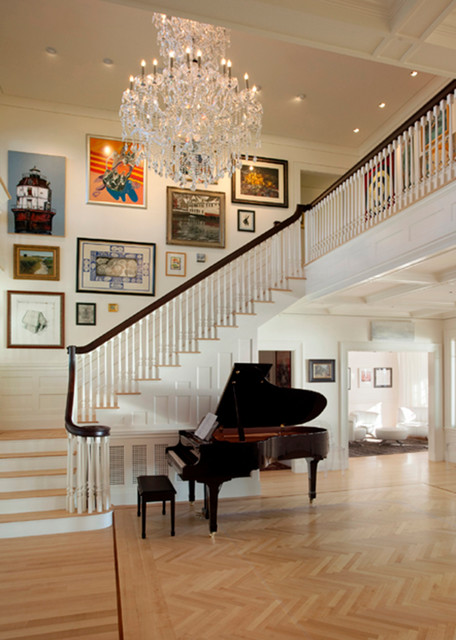
The pianist Ivo Pogorelich is right: the piano is “a piece of furniture”. Not simply a musical instrument, it’s fine furniture, often the most expensive piece in a home and the focal point of whatever room it’s in. Browse through glossy interiors magazines, Pinterest or sites like Houzz and you will find beautiful grand pianos in beautiful settings, the instrument not intended to be played, but to bring elegance, class and grandeur to a room. My 1913 Bechstein A, bought for a song (relatively-speaking), the most I could afford at the time, is a thing of beauty with a polished rosewood case, turned legs and a fretwork music desk. Visitors to the house gasp in admiration when I throw open the door to my office-cum-music room and there she crouches in burnished antique splendour.
Your wonderful Bechstein has afforded me great joy.
Sviatoslav Richter
While upright pianos were two-a-penny in Victorian and Edwardian homes, as ubiquitous as the smart tv is today, the grand piano has always been a status symbol. A Picasso on the wall and a Steinway on the floor, the grand piano is an indicator of wealth and cultural cachet, for the grandest, most desirable pianos are as sleek, highly-engineered and expensive as a Maserati, owned, but not necessarily played, by those who value image and exclusivity above ultimate usability
The piano is also a machine, a miracle of invention, this contraption of metal, wood and wires capable of sustaining twenty-two tons of tension on its strings. Despite its industrial, apparently inaminate, construction, one is regularly reminded that this instrument is, like a violin or clarinet, created from materials which were once living: the slightest fluctuation in humidity will send my antique Bechstein into a stroppy fit of out-of-tune-ness as wood and ivory contract and expand.
You become elated, invigorated, and inspired….all through something built by a factory
– Menahem Pressler
The piano is a machine but it usually has soul, and a history too….. My Bechstein is Edwardian drawing rooms, overstuffed sofas, looking glasses, brocade and lace. It might have been sold out of the Bechstein piano showroom on Wigmore Street, next to Bechstein – now Wigmore – Hall, in that golden year when a carefree generation was teetering on the abyss of the First World War. A few years ago, I played a Steinway D with a special heritage. Formerly owned by the Hallé Orchestra in Manchester, it had been played by Sviatoslav Richter and Daniel Barenboim, amongst others – “and now you are playing it!” said its owner, for whose music society I was performing. I’ve also played a square piano owned and autographed by Edward Elgar, and a Pleyel said to have been played by Chopin, but one can invest too much in these associations, believing that the spirit of former owners and players haunts the keys and strings, and can influence the player. In fact, it is whoever is playing the piano now which sparks the soul of the instrument and brings it to life in sound.
As a pianist, one has a special relationship with the instrument one plays most often (usually the piano one owns), but unlike other instrumentalists, the pianist cannot carry his/her own instrument to concerts (though in the old days concert artists might travel with their piano, taking it across the ocean to a concert at Carnegie Hall, New York). Thus, while it is true that most concert instruments are pretty much the same across the international venues and halls, one must also be adaptable or lower one’s expectations – not all pianos as are well looked after and cossetted as a concert Steinway…..In such situations, a true professional will accept the situation and work with the instrument they are given. The pianist Gary Graffman, in his bookI Really Should be Practising, relates an occasion where he arrived at a concert to find that one of the notes on the piano when depressed sounded with all the subtlety of a gunshot: to remedy this, Graffman simply replaced the action of that note with one seldom-used from the top of the register.
The piano ceases to be a piece of furniture, or a machine, when it is played. The player brings it to life, and the great thing about the piano is that even the most novice player can get a pleasant sound out of it (unlike the violin for which students (and their long-suffering parents and teachers) must endure years of scraping and screeching before a beautiful sound is mastered).
Enter a caption
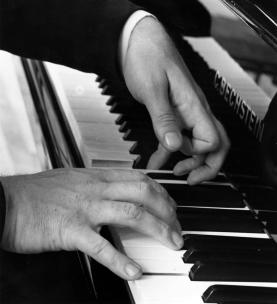
The sound the pianist produces is determined by touch, by the finger’s contact with key. We call this “attack”, a curious descriptive word which suggests an aggressive connection with the instrument, when in fact the type of touch employed is often subtle, controlled, refined. Every pianist has a personal sound associated with their individual touch. Other instrumentalists, and physicists, may scoff at this, claiming that the only factor that determines the tone intensity and timbre is the speed of the hammer hitting the piano string, but studies have demonstrated that the subtleties of individual touch do influence timbre and quality of sound: pianists use a vast palette of timbral nuances to colour their performances and, importantly, to create a distinctly personal sound. Why else do we seek out the performances of certain pianists – Cortot, Lipatti, Gould, Lupu, Hough, Uchida – and can identify these pianists from a blind listening?
Arm weight, wrist flexibility and suppleness, lack of bodily tension – all these effect the sound, the mood and interpretation of every note and passage. A tense body creates a tense sound, for the music one produces inevitably imitates the state of the body. And the body responds to the mood of the music too: during passages of raging fury (Beethoven at his most declamatory), the heartbeat quickens and the body tenses.
A kind of synaesthesia comes into play (forgive the pun) in the most expressive and compelling performances. Timbre, an essential factor in the expressivity of performance, combined with touch and the pianist’s own temperament, their musicianship and intelligence – that is where the true magic occurs, a potent reminder that the production of sound is not simply mechanical nor technical. This is the great power of the pianist – to conjure sounds, and images, from that machine, that box of wood and wires, that piece of furniture.
And when the music is over, the lid is closed, and the piano returns to its somnolent position, silently crouching in a corner of the room, once again a piece of furniture.
Oh, but what a marvellous, magical piece of furniture!
Who or what inspired you to pursue a career in music?
I had played the piano for some years, and was playing occasional concerts by my early-teens, but for me the epiphanic moment was watching Jorge Bolet giving masterclasses and performing on BBC television. I suppose it came at just the right point in my musical and personal development, but suddenly I was obsessed, and pretty much every waking moment became about playing, listening to and reading about music – rather to the detriment of my school work.
Who or what have been the most important influences on your musical life and career?
Here I have to mention my first teacher, June Luck (who died recently). She was my local piano teacher in Ipswich, and had certainly never had a performing career, but she instilled one truly great maxim that has shaped my life and career: you can be anything you want as long as you’re willing to work hard enough. Then there were two teachers at the Royal College where I studied for my undergraduate and master’s degrees – John Barstow, who was really responsible not only for teaching me how to really control the instrument but also how to make friends with it, and the composer Edwin Roxburgh, who really opened my ears to contemporary music for the first time. After college, of course, there were many other teachers and mentors including Lev Naumov in Moscow, David Dubal in New York and Martino Tirimo in London, but special mention must be made of Ronald Stevenson. By the time we met at the end of my 20s I had established a performing and academic/lecturing career and was fairly well-known for my passion for Busoni. Ronald, who was the preeminent authority on Busoni and his circle made me understand the much larger perspective around early Modernism and its relationship to the piano, and led me along so many ‘paths less travelled’ in our epically long days in his music room and library which he called his den of musiquity!
What have been the greatest challenges of your career so far?
Of course, the early years, establishing a career are always difficult, but my particular career as a pianist-lecturer seemed to baffle friends, colleagues and promoters alike – I suppose, back then before the internet and the portfolio career as a norm, it seemed strange that I didn’t fit into an easy pigeon-hole. Fortunately, the Royal College of Music awarded me a fellowship for two years during which time I was able to show how such a career could and did work, and indeed it set me on my third, rather unexpected path as an academic professor.
Which performances/recordings are you most proud of?
I’m soon to be performing the Busoni piano concerto in London. I’ll never forget the day when I discovered John Ogdon’s recording of it in a second-hand record shop, and then a few weeks later, listened through to it with a score borrowed from Westminster Library. It was simply overwhelming, and as I started to pick my way through the score’s complexities, I couldn’t really begin to imagine how I could ever learn it. Eventually, about ten years ago, I gave a series of performances of it in the UK and New York with my amazing friend and colleague, Aleksander Szram playing the orchestral parts at a second piano (although we also had a live choir for the last movement). A couple of those performances are up on YouTube and although I certainly play it differently now, I am inordinately proud of the journey I made with that music.
Which particular works do you think you perform best?
I’m very influenced by the idea of ‘Sprezzatura’ which was a term used by 16th-century courtiers to refer to a noble disdain. The idea is that you have to study every detail of your task, and then throw away the rulebook. I think I probably perform best those compositions which respond to such an approach – certainly Liszt, Busoni and Enescu amongst them.
How do you make your repertoire choices from season to season?
Of course, I’m still influenced by promoters and venues, so for instance I recently gave some Medtner recitals in Bengaluru to celebrate the life of the Maharajah of Mysore, and a little while back was asked to give the premiere of the Edwin Roxburgh Piano Concerto. However, for the last few years I have also ensured that each season I include a work or two from my ‘bucket list’ which I’ve kept since my teens. This year it was the Schulz-Evler transcription of the Blue Danube, whilst previous offerings have included the Godowsky Passacaglia and Sorabji’s Jardin Parfumée. I realise I’ll never complete the list, but it’s really important to still treat myself to works I’ve always wanted to learn.
What is your most memorable concert experience?
For the last few years I have been living in India (my family home) for a few months each year, partly trying to offer educational opportunities to young musicians and teachers and partly giving concerts in my capacity as the first Indian Steinway artist. The concerts are sometimes quite traditional, but the really memorable ones have been where audiences have literally never seen a piano or knowingly heard Western music before. That’s a real privilege and responsibility, but it also sometimes reminds me of the memoirs I’ve read of the early years of the piano recital – the piano circus life as Liszt called it. So, I’ve headlined music festivals (even had a review in Rolling Stone magazine for performing Liszt!), given recitals to with brand tie-ins from wine to sports cars, and played for royalty (and was given the snuff-box to prove it!).
As a musician, what is your definition of success?
Leading others (students and audiences) away from the increasing mundanity of our everyday lives to see the truly extraordinary in our world, ourselves and one another – whether just for a few minutes in a concert, or as an inspiration for future living.
What do you consider to be the most important ideas and concepts to impart to aspiring musicians?
To have an imagination, and then to work hard in order to turn into a reality both for themselves and their audiences, whilst at the same time trying to avoid the perils of narcissism (especially in the age of the selfie).
Where would you like to be in 10 years’ time?
I’d like to have helped to create the first degree-awarding conservatoire in India, and have my own den of musicquity by the sea on the south coast of England, with a Great Dane by my side.
Karl Lutchmayer performs Busoni’s Piano Concerto in C at St John’s Smith Square on 30 November, with Seraphin Orchestra, conducted by Joy Lisney. This concert is the culmination of his 3-day concert series ‘Busoni – The Romantic Modernist’ which explores Busoni’s music beyond his well-known transcriptions of J S Bach.
Karl Lutchmayer is equally renowned as a concert pianist and a lecturer. A Steinway Artist, Karl performs across the globe, and has worked with conductors including Lorin Maazel and Sir Andrew Davis, and performed at all the major London concert halls. He has broadcast on BBC Radio 3, All India Radio and Classic FM, and is a regular chamber performer. A passionate advocate of contemporary music, Karl has also given over 90 world premieres and had many works written especially for him.
Schubert’s penultimate piano sonata, No. 20 in A, D959, is my sonata. Never mind that I’ve heard Imogen Cooper, Daniel Barenboim, Piers Lane, Andras Schiff and Richard Goode, amongst others, perform the sonata, and have listened to countless recordings (including Shera Cherkassy, Radu Lupu, Mitsuko Uchida, Elisabeth Leonskaja, Inon Barnatan and Krystian Zimerman), all of whom might claim that it is their sonata. Schubert’s D959 is my sonata.
Why is it ‘my’ sonata? Because I spent many hours, days and months studying, learning and eventually performing this work, and through that meticulous process I acquired a sense of “ownership” of the music.
Taking ownership of one’s music, literally making it one’s “own piece”, is something that musicians strive for. A strong sense of ownership connects one to one’s music, and also creates a special communication with the audience.
Ownership is hard won, however, and comes from close study and deep knowledge of the score to fully acquaint oneself with the composer’s message and intentions. All the explicit information contained within the score must be processed, understood and acted upon – the notes, dynamic, rhythmic and articulation markings, tempo, expression and character directions, and all the technical aspects of the music; in addition, implicit directions need to be considered and factored in: a rising passage may suggest a slight crescendo or stringendo, rests and fermatas suggests breathing space, a doubling of octaves may indicate a more orchestral sound or texture. The ability to process and interpret implicit directions comes from the musician’s own musical knowledge, training, an understanding of historical contexts and performance practice (in, for example, Baroque music), experience, maturity and personality.
Such disciplined learning and study gives one the confidence to play the music convincingly and to create one’s own personal vision of the music. I have been to concerts where it is evident that the music is well learnt, all the details taken care of, but it doesn’t communicate, or touch one’s emotions. A non-committal performer may tread the middle road, providing an inoffensive range of dynamics, expression and so on, but without a real sense of conviction which robs the performance of that special edge of excitement. Audiences can certainly feel this and may leave the concert satisfied but unmoved.
So, ownership is about having done the detailed work on the score to give one the confidence to perform the music convincingly. But there’s more: ownership also creates spontaneity, freedom, originality and sprezzatura in performance – the impression that everything one does is effortless. As a performer, one does not want to show the audience what one cannot do; instead, the performer reveals, through their ownership of the music, not only mastery, but also freedom, ease and delight, playing ‘in the moment’…. Performers who have these qualities, and who have complete ownership of their music, are prepared to take risks in performance, secure in the knowledge that one never plays the same piece of music the same way twice. Such performances are thrilling and memorable.
The Cross-Eyed Pianist is free to access and ad-free, and takes many hours every month to research, write, and maintain.
If you find joy and value in what I do, please consider making a donation to support the continuance of the site






 The Cross-Eyed Pianist