Who or what inspired you to pursue a career in music?
I was naturally good at music (I could play by ear from a very young age) but did not come from a musical family so I was a bit of an oddity. I started the clarinet aged around 10, having lessons at my local comprehensive school. We didn’t go to many concerts or arts events when I was young, but my parents were very supportive and I loved the local North East Derbyshire Music Service and my County Wind Band. They were very ‘happy places’, run by passionate, dedicated and inspirational musicians. I didn’t really know much about a career in music and I sort of vaguely drifted into music college (Royal Northern College of Music) – which was a bit of a shock. What had been ‘fun’ suddenly felt super-competitive and I think this was the point when I really started working very hard indeed.
But something wasn’t quite right. I soon realised I didn’t get the same buzz from playing in an orchestra as many of my fellow students did. But I did love the theatres, the museums, the art galleries, the urban architecture of Manchester. I used to wander around the abandoned Hulme Crescents (the largest public housing development in Europe, described as ‘Europe’s worst housing stock’ – demolished 1994) feeling sad for it, and I think my fascination with the way that people (audiences) ‘consume’ art and design stems from these days. I started composing (lessons with the wonderful Tony Gilbert) and doubled up my course – two simultaneous programmes of study as a clarinetist and composer. I also loved chamber music and really enjoyed playing contemporary music – it felt more ‘theatrical’. The more unconventional and challenging it was, the better – I was a bit of a thrill seeker. The year I played Max’s Eight Songs For A Mad King was a real turning point. Alan Hacker used to come and give us clarinet masterclasses. He would bring his reed knife and whittle all our reeds down until they were paper-thin. It was like playing a kazoo after he’d finished and we soon learned not to bring our best reeds along! But I really enjoyed his classes and, through him, having what felt like a close connection with the incredible composers he worked with.
I pursued music as a clarinetist for decades, playing lots of new repertoire and chamber music, mixing it up with composition and academia – but still not feeling it was 100% ‘right’. It was only when I was in my late 30s that the penny finally dropped. A colleague pointed out how ‘theatrically’ I described things – and I suddenly realised what was missing from my purely musical life – theatre. It was a peculiar light-bulb moment as I’m certainly no actor and the desire was to MAKE theatrical events rather than be in them. I started to create shows and, a few years later, I resigned from my senior academic post at Guildhall to set up my own company. Goldfield Productions make ‘adventures in sound’. We work with composers, puppeteers, writers, artists, animators, inventors etc to create extraordinary touring cross-arts shows but we always have the highest quality chamber music at the heart of what we do. Everything I do now seems to be connected in some way to both music and theatre and I love it! Goldfield’s work with young people is really important to me too – I’m very passionate about that.
Who or what have been the most important influences on your creative life and career?
I’m inspired by artists in other fields – which I think I like to apply or ‘translate’ into musical ideas. The ones I couldn’t imagine life without – John Berger, Susan Sontag, Roland Barthes…the breath-taking imagination of Italo Calvino, Angela Carter….I have many books of fairy-story collections, on design & architecture (especially ‘ways of living’) and amateur music making (past and present). I am often inspired by museum and gallery curators and how they tell narrative through objects and in a space. I love what Paola Antonelli (senior curator of architecture and design) did with MOMA (making design relevant to everyone) and what Paul Holdengraber did with the New York Public Library (turning it into a huge conversation for the City and beyond) – he calls himself a ‘curator of Public Curiosity’. Art and music doesn’t exists in a vacuum for me – its always in a dynamic relationship with those who ‘consume’ it. The things that inspire me the most are those that have engaged people with art in extraordinary ways.
What have been the greatest challenges of your career so far?
I juggle a LOT now. In addition to running Goldfield as Artistic Director (and being the sole fund-raiser), I also work as a freelance producer for many other companies and venues. Writing (words) has also become a rather big thing. I’ve written 5 children’s productions and, since 2017, I’ve written and presented stories for BBC Radio 3 – a most unexpected outlet for exploration and discovery which I absolutely love. I’ve written around 140 stories so far – each on a topic that I research from scratch. My shelves are rammed with fascinating books that I may never have otherwise bought! I try to play the clarinet every day – even if I don’t have a run of concerts coming up. Playing the clarinet is still very much part of my identity and although I do so many other things that compete for time, I’d hate to give up performing and making music with my chamber music friends. I probably ought to have more sleep and exercise regularly – fitting those in would be a genuine challenge!
So there is the on-going personal challenge of keeping all the balls in the air, and combining this with the kids and family life. But there are also the wider challenges of sustainability for Goldfield and the arts in general, short and long-term funding, trying to ensure that funders are not entirely shaping the art we make, how we can tackle the reduction of music education in schools, how we can possibly do justice to the huge volume of new music being created …I guess these are everybody’s challenges, but they are constantly on my mind.
Which performance/recordings are you most proud of?
I’m very proud of Goldfield’s recent Erika Fox CD for NMC Records. We (Goldfield Productions) often work with composers over a long period of time in a bespoke way (‘what do they need that we can provide?’) and we aim to have a transformative impact on their development / careers. But the relationship with Erika and her music exceeded all expectations! She was a true ‘neglected’ voice. Two years ago, the only way to listen to her music was to go round to her house and put on one of the cassette recordings she had salvaged from the 70s and 80s when her music was often played and won numerous awards. With huge support from funders, trustees and NMC records, Goldfield set out to record six of Fox’s chamber works on what would be the very first album of her music, released in June 2019 in her 82nd year. Press and public response has been overwhelmingly positive and Erika’s composition career has literally taken off again with new commissions coming in and high profile recognition and performances in the UK and abroad. Its amazing that this sort of change is possible. Its a privilege to be part of it but the credit is due to Erika – she is a genuine, remarkable and unique voice. We just had to get the music out there.
Which particular works do you think you play best?
I still love playing new music and I’m definitely happiest in a chamber music setting. I’ve got a super-flexible embouchure so anything that involves lots of colours, multi-phonics, endurance and generally finding non-clarinetty type sounds is good. I like to discover and learn new musical languages – learning Erika Fox’s language last year was fascinating. That said, I also think I play Brahms well and I do a cracking good Copland concerto. For sheer pleasure, I play unaccompanied Bach on the clarinet….but only in private.
How do you make your production choices from year to year?
I seem to have an inexhaustible number of ideas (kept in scrap books, note-pads, on my phone, in my head….) but they don’t all come to fruition. I’ll think about stuff for ages – playing with it, developing it in my mind, testing it out in different imaginary contexts…is it a piece of theatre… radio..a site-specific work? I don’t think ‘I’m going to make an opera’. I think ‘I’ve got an idea– what will it become?’ I’m really careful about what I invest time in. It has to be right. ‘Right’ means – a great artistic idea expressed in the most succinct way, with the best people to deliver it, something that is wanted or needed right now (even if people don’t know it yet!), a wholly balanced proposition (budget, aims, outcomes, reach, partners, people, venues etc). There is something beautifully satisfying about a production blueprint that is ‘right’. I do a lot of brutal self-culling and whittling down of ideas to make sure that they are truly the best they can be and I’m constantly looking at how we are communicating art and ideas to audiences.
Here’s what happens when you make a show: initial idea and brainstorming (‘OMG this is going to be amazing’); long period of fund-raising and work going into development (‘OMG this is really hard’): period of intense challenges (‘OMG this is going to be awful’): finally, the home straight as it all comes together (‘OMG this is going to be amazing!’) Four stages. Every. Single. Time.
Do you have a favourite venue to perform in and why?
I’ve put shows into all sorts of venues – museums, tiny churches, vast warehouses, concert halls, theatres, schools, outdoor spaces, galleries… but the Parabola Theatre at Cheltenham Music Festival stands out as special because it was the first venue that gave me a shot at being a producer. I am forever indebted to Leksi Patterson and Meurig Bowen who – for reasons best known to themselves! – believed me when I strode over to their table in the Barbican café in 2012, waving a small book of poems, proclaiming ‘I’m going to make an opera!’ I had literally NO idea how to do it. And – even worse – I didn’t know that I didn’t know! (Hey – how hard can it be? It’s just like chamber music with some singers, right?) What a learning curve. I raised a budget of c. £170,000 (how? Fear of failure and gritty determination), put together an opera company and an 8-date tour for what was going to become Nicola LeFanu’s Tokaido Road. After that, I DID know how to make an opera. It nearly killed me, but I loved it and it set me off in a new direction. Cheltenham Festival gave me was the venue for the world premiere and we’ve been back many times since with other shows. I always feel very happy in the Parabola. I’ve played on the stage a lot too – sometimes in my own shows, sometimes in other peoples’ productions.
Who are your favourite musicians?
I really do have an enormous amount of empathy for a lot of music. Recently I’ve been listening to a lot of lesser-known, lesser-loved music from the 1960s. Thanks to some brilliant listening-lists from friends, I have discovered and re-discovered works by Lumsdaine, Dale Roberts, Bacewicz, Ustvolskaya, Bedford, Jolas, Subotnick, Gilbert to name but a few. Its an often neglected and overlooked decade, yet the music is beautiful, well-crafted, shocking, surprising, fun, funny and wonderful. I am pondering what to do with a lot of this repertoire …. I’m very driven to play and programme the brilliant music we already have.
What is your definition of success?
For me, I think that ‘success’ is often to do with facilitating things and usually connected to making what I consider to be positive change. For example, someone telling you that they enjoyed contemporary music / opera / classical music for the first time because of something you did… when a young person says that the project they have taken part in has been a total game-changer for them… when you can bring the music of a composer to a new generation of listeners… when an artist you have commissioned has been able to push themselves in a new creative direction…
What do you consider to be the most important ideas and concepts to impart to young aspiring musicians?
Be nice and be kind. Be polite and courteous to everyone (even…especially…more ‘challenging’ people…we’ve all got our own problems and these can surface in all sorts of ways). Never forget that making performance art / music takes a whole team and the person that books the venue / fetches the coffee etc is as much an essential part of that team as the director or leading singer. Be yourself and have fun, but always do your job and follow your passion with total professionalism. Be the sort of person you would want to work with…smart, hard-working, reliable, calm, generous, open-minded, honest, cheerful, considerate, efficient etc No one is perfect (I very much include myself in that), but try your best.
Listen to your instincts. If I had paid more attention to my love of art, galleries, theatre and architecture in my 20s (rather than trying to suppress it and be a ‘proper’ musician) I might have set up my company years earlier!
Be open to change. Sometimes, the path you think is ahead of you veers off in a new direction. Another door opens, you meet someone or see something which becomes a catalyst to dramatically change the way you think about things. The arts are volatile – be good at adapting to change within organisations and also within yourself.
Love what you do. That’s really important because working in the arts in the UK is tough. There is a lot of competitiveness and not enough money. But on the plus side you will get to work with some of the most extraordinary, talented and marvelous people that ever existed, your life will be rich with culture and you will – hopefully – enhance the lives of others too. That’s not a bad way to live 🙂
Build up strategies for resilience. At some point, things will get tough but its part of what makes you successful. You learn far more when things don’t quite work out than when everything is smooth sailing. You learn about yourself, your attitude to risk, your own definition of ‘success’. You don’t really know just how resilient, strong and determined you are until you have to be. Patience is important too – it can sometimes take a long time to get things off the ground.
Stay curious and keep questioning things. Don’t be afraid to keep challenging yourself and the world around you and asking how you can you best express the things you want to say.
Where would you like to be in 10 years’ time?
I’d like Goldfield to still be flourishing, growing and evolving. I’d like to push myself more as a writer. I would only return to composition if I felt I had something to say, but I wouldn’t rule it out. I would like to have made great strides in my thinking about how audiences ‘consume’ music and how this understanding feeds into the art and events we make. I would like to be as curious, as energised, buzzy and optimistic as I feel now.
What are your most treasured possessions?
1. My books.
2. A necklace with a plaster cast of an ammonite that my parents made in the late 1970s. I wear it a lot.
3. The things the kids made for me when they were little – there is so much unconditional love embodied in these tiny, wonky, honest objects and each one tells a story.
What is your present state of mind?
Curious, energised, buzzy, optimistic.
Kate Romano is the founder and Artistic Director of Goldfield Productions. She is also an independent producer of opera and music theatre and is passionate about story-telling and cross-arts productions.
Kate is a writer for the BBC Orchestras and the Proms. A regular BBC Radio 3 presenter, she has written and narrated around 150 short stories for Essential Classics and the 2019 Our Classical Century season leading up to the Proms. She has written and directed Goldfield’s five acclaimed children’s productions which have been seen by over 9000 children in 60 primary schools. In June 2019, Kate took up the post of Director of Aspire! at the Lichfield Music & Literature Festivals, developing a new outreach and participation programme for the festival.
As a clarinetist (chamber musician and soloist), she has performed at most major UK venues and festivals. Kate has given over 70 premieres and has recorded for NMC, Metier and Minabel. Her debut solo CD was awarded 5* reviews from Gramophone and ‘Pick of the Month’ in the chamber music section for the BBC Music Magazine. Kate studied at the Royal Northern College of Music where she graduated with first class honours, she holds an MPhil from Cambridge University and a doctorate in composition from Kings College London. From 2003 – 2016 she held a senior academic post at the Guildhall School of Music and Drama and co-founded the schools’ flagship doctoral programme. In 2014, Kate was awarded a Fellowship from the School.
kateromano.co.uk
(photo: Chris Frazer Smith)

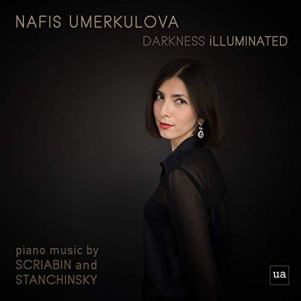 Russians Alexey Stanchinsky and Alexander Scriabin are featured on Darkness Illuminated, a new disc on the Ulysses Arts label by Uzbek pianist Nafis Umerkulova. Here she seeks to put the obscure Stanchinsky in the spotlight alongside his far more famous contemporary, Scriabin, and the album comprises works by both composers written over a 17-year time period from 1894/5 until 1912, allowing the listener to appreciate how each composer’s oeuvre developed over time while also comparing and contrasting their music.



 The Cross-Eyed Pianist