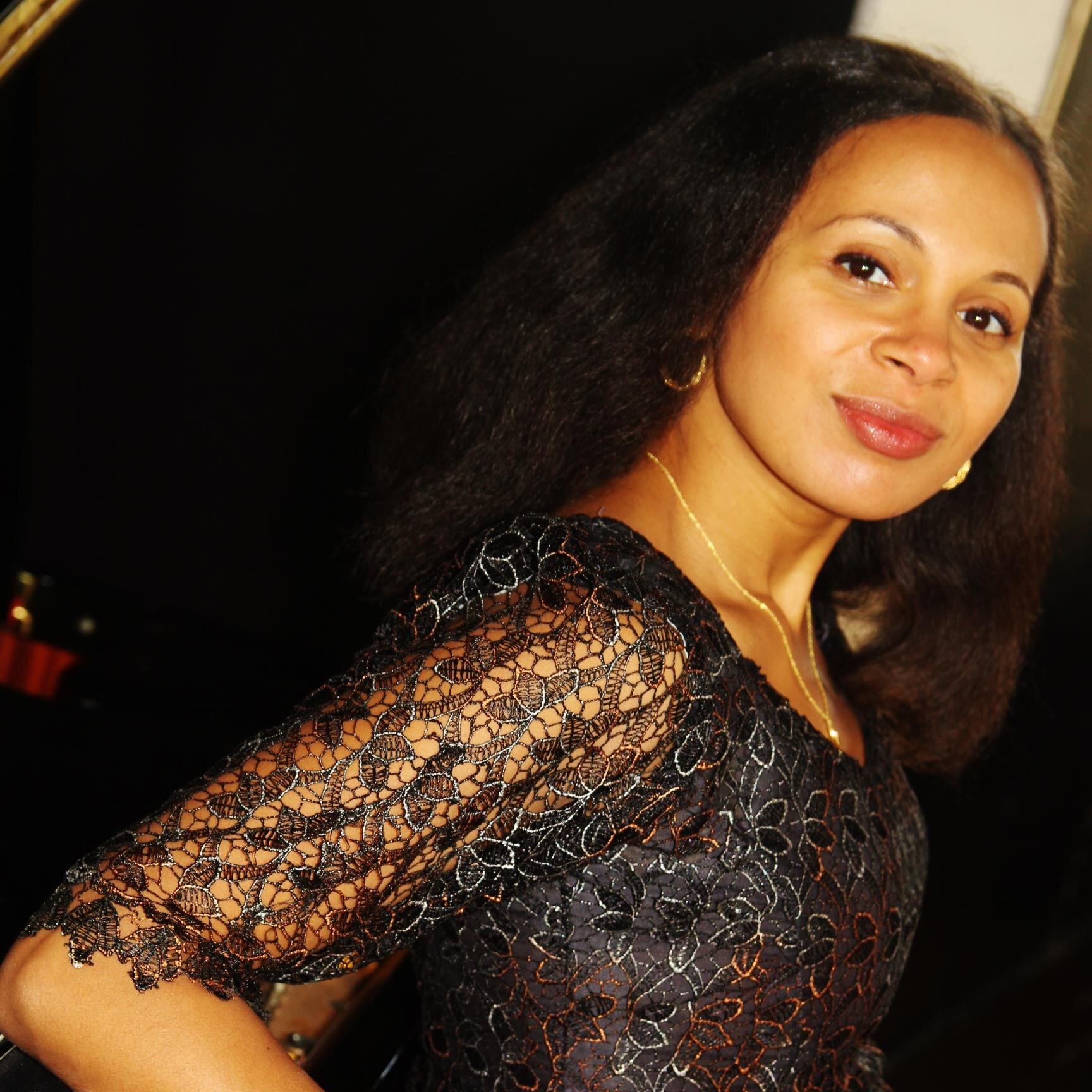
Who or what inspired you to pursue a career in music?

I grew up in a strict religious household, so when an upright piano – a gift from a church member – arrived at our house it was just a large and welcome new toy to play with. My parents had somewhat draconian views on children’s entertainment; consequently we had no television and only really listened to classical music. There are of course pros as well as cons in this approach but…

Thus, at the age of four years old, I (apparently) began to pick out tunes with one finger and it was quickly decided I should have lessons. These were kindly donated at no charge by the church organist, one Marion Mills. Although I had many kind and patient teachers over the years, Peter Crozier at Pimlico Saturday school, Peter Jacobs at Latymer Upper School and lastly John Irving and Danielle Salomon at Sheffield University, what truly inspired me to take up a career in music was being allowed to arrange for and direct the band in school shows.

Our school Christmas spectaculars, essentially lavish pantomimes, really were worthy of the ‘spectacular’ tag, played out to a paying audience of several hundred in our large school hall, brilliantly converted into a theatre. To allow a 16-year-old to run a 20 piece band for the shows while he sat in the audience was quite a display of faith from our brilliant head of music – Shane Fletcher; so if I had to nominate one person as an inspiration it would be that light touch teaching that secured my fate!

Who or what have been the most important influences on your musical life and career?

I’ve already mentioned many of the teachers who mostly looked kindly on my endless desire to improvise and managed in spite of that to instil the rudiments of a proper musical education into me! Being raised with the perpetual backdrop of classical music gave me a sound knowledge of most of the repertoire but a seminal moment was when my parents finally yielded to my sister’s and my cajolings and bought a small portable black-and-white TV when I was thirteen. One of the first things I watched entranced, after my parents had gone to bed, was a late night BBC2 show with Canadian jazz pianist Oscar Peterson. I was literally open mouthed (and eared). I had never known a piano could make sounds like this, much less that somebody could forge a career playing music other than Chopin! I obsessively hunted down all the jazz I could find and along the way discovered the cabaret genius of musical comedians such as Dudley Moore and Victor Borge (who also showed me that it was possible to make people howl with laughter using classical references). I can’t miss out other names such as Richard Rodgers, Bill Evans, Art Tatum and Fats Waller and the wit of French impressionists such as Satie and Milhaud.

Lastly, although not directly musical influences, I must also mention two performers that I worked with for over a decade. A large part of being a cabaret artist is one’s ability to recount stories and give context to the music on stage, an area in which I was resoundingly absent of talent. A brilliant performer I accompanied for fifteen years was a singer called James Biddlecombe (Biddie). Described as the uncrowned king of the cabaret scene in London, he championed obscure old songs that nobody had heard of and to this day I have never witnessed an audience in such paroxysms of tearful mirth as he managed to regularly engender. Watching him and another act, larger than life magician Fay Presto, beloved of royals and celebrities, whom I also accompanied for many many years, I slowly and painfully learnt how to communicate on stage.

What have been the greatest challenges of your career so far?

Being an improviser with a classical sensibility, I often find myself on the same programme as truly jaw-dropping international concert talent. Keeping one’s self together in such exalted company is a trick in itself. They are without exception always kind and express admiration for what I do but knowing just enough to know quite how brilliant they are really can be enough to freeze the blood in one’s veins. The first time I went on Radio 3 taking live requests to play anything in any composer’s style, I was literally shaking. Recounting this to a friend afterwards he asked innocently “Why were you so worried? There’s only one man and his dog listening to Radio 3 at any given time.” Patiently I had to explain to him “Yes, but even the dog has a doctorate in ethno-musicology”.

Which performances/recordings are you most proud of?

I have recorded two albums – ‘In the wrong key’ and ‘All the way through’ – both of which I regard reasonably proudly, but my output will never be judged by recordings. My proudest moments are getting on a really good roll in an improvised Bach invention or during something very silly like Postman Pat in the style of Rachmaninov, hearing the audience reaction change from laughter to engagement as you fuse low and high art and for a few glorious seconds it comes off and becomes an entity of its own. Audiences always know those rare and special moments when you channel something perfectly in a composer’s style for a brief moment. You don’t have to explain it.

Which particular works do you think you perform best?

How do you make your repertoire choices from season to season?

Do you have a favourite concert venue to perform in and why?

What is your most memorable concert experience?

If I may take the liberty of combining these four questions… To explain: these questions fall into a different category for myself compared to a classical performer. Performances with Alexander Armstrong where I was musical director and arranger linger fondly in the memory, particularly one at the Palladium. Also an end of year review playing solo cabaret to a packed Birmingham Symphony Hall for Raymond Gubbay was a wonderful experience. My favourite performance and venue are probably one and the same – a charity gala at the Royal Albert Hall for SOS villages, an organisation working against the spread of AIDS in Africa. That venue is a seminal one for me – redolent with so many memories from my introductions to the Proms with my parents. The fact that they were sat in the front row whilst I took the host’s Aled Jones request to play Kylie Minogue ‘I should be so lucky’ in the style of Wagner (only request I can remember) and the consequent laughter echoing around the Albert Hall is something I shall never forget.

As a musician, what is your definition of success?

Ultimately, music is all about communicating emotion. There are many different ways of doing this – interpreting the works of geniuses who have gone before in a respectful yet original way and profoundly moving all those that hear it is of course the most prevalent. However, I feel there is a space to play with all those references that audiences know so well and juxtapose them in a comical fashion. Although this is light entertainment, most of the time people sense when the fun is borne of a true love of the music and in amongst the laughter and silliness there is beauty too. So my definition of success is simply to bring joy to as many people as possible.

What do you consider to be the most important ideas and concepts to impart to aspiring musicians?

To show young students that improvisation is not a modern phenomenon or something to be scared of. It should absolutely be taught alongside all other musical knowledge – the principles therein are as old as the hills; Bach, Mozart and Beethoven were all serial improvisers. It is my life’s mission to get some aspect of improvising onto the national curriculum as I passionately believe it improves listening skills, time, arranging and composing and the relation with one’s instrument!

What is your idea of perfect happiness?

It’s a toss up between one of these three (if you can have a three sided coin…!)

1. Walking around the Borghese gallery in Rome.

2. Watching James Anderson destroy an Australian batting lineup at Lord’s.

3. Tucking into a particularly juicy Times cryptic crossword with Eugenie Onegin on in the background.


Harry’s extraordinary talent and breathtaking creativity have earned him a reputation as one of the most gifted improvising pianists in the world. Celebrities and critics alike have lined up to shower him with praise often smacking of astonishment. No other musician can spontaneously reinvent Michael Jackson in the style of Mozart, recreate a night at the Groucho club through the TV themes of its actor members, and improvise a seamless medley of audience requests ranging from James Bond to Shostakovich via West Side Story.

Read more

Horse races run on empty courses, Premier League football matches played in cavernous deserted stadia, tennis tournaments “behind closed doors”, concerts performed into a void of silence. Without the roar of the crowd, the cheering and the applause, the collective experience of these activities is severely diminished, the punters, the fans and the audiences forced by social distancing in these times of coronavirus to engage via a TV set or computer from their sofas, living rooms and kitchens.

The people, the crowd, create atmosphere. At football and rugby matches, closely-packed bodies and loud unison chanting and singing produce a heady atmosphere that’s hard to resist. While football matches are being played behind closed doors due to the coronavirus pandemic, TV companies are using technology to create “atmosphere”, with recordings of the roars and cheers of the crowd from earlier live matches. Fortunately, at the Wigmore Hall’s lunchtime livestreamed concerts, “canned” applause is omitted; instead at the end of each piece, the performers are greeted with silence.

In live classical music performances – and indeed in nail-biting tennis matches – the silence of the audience indicates intense collective concentration. There is an almost inexplicable silence which occurs during a particularly absorbing performance, when it seems as if the audience is listening and breathing as one, or that special quiet at the end of a particularly arresting performance before the applause comes. It’s as if there is a universal exhale as tense bodies held in suspended stillness by the power of the music, gradually relax and unwind. This is particularly potent at very large venues, such as the Royal Albert Hall, home to the Proms, and the performer or performers who can hold an audience of some 5500 in rapt attention, or shrink a concert hall such as the Royal Festival Hall (capacity c2000) to the size of an intimate salon, is surely a powerful and charismatic one.

Not only does a hall full of people have a different acoustic, but a living, breathing audience creates “a very active involvement in the music, and I think a performer senses this, the energy…and that quietness, when people are listening and attentive, and you feel an electricity there that you cannot replicate” (Stephen Hough, concert pianist).

Performers are very aware of the atmosphere in a concert hall and many would agree that the it enables them to play better, while also creating a special bond of communication with the audience, who then become complicit in the performance as active participants. Playing in a recording studio can be sterile and limiting, requiring the performer to attempt to recreate the atmosphere of a live performance through the power of their imagination.

While concert halls (and sports stadia) remain empty for the time being, audiences and performers must create their own atmosphere. Livestream performances cannot replace “the real thing”, but there is something powerful, and also profoundly poignant, in watching a live performance from an empty auditorium. The Wigmore Hall livestream lunchtime concerts have received huge acclaim, both from critics and reviewers, and also audiences sharing their reactions (often very thoughtful, honest and emotional) on social media. We have enjoyed exceptionally fine performances, in which musicians still give their all despite or perhaps because of the circumstances, and there has, via the networks, been a palpable sense of people listening appreciatively and attentively. In addition, there is a sense of quenching a great thirst after a long period of drought and also an certain optimism in the hope that we can soon return to our beloved concert halls and enjoy music collectively once again.


Pianist Emmanual Vass was one of the first interviewees in the Meet the Artist series, back in 2012. Now, 8 years on, to coincide with the release of his third album, Manny has updated his interview to reflect on his influences and inspirations, and his career path to date and beyond…


Who or what inspired you to pursue a career in music and who or what have been the most important influences on your musical life and career?

All my life, I wanted to connect with people, and be creative. As mentioned in my first interview 8 years ago, I started playing piano by complete chance, and it has always been my outlet and my joy. Pursuing a musical career made complete sense; it still does now, aged 31!

What have been the greatest challenges of your career so far?

Picking myself up, and getting back on my horse after having been knocked off yet again. I wasn’t quite prepared for how much rejection, “no” answers, and unsuccessful attempts I’d face as an artist. It’s definitely easier as I get older, thankfully. Perspective is important.

Which performances/recordings are you most proud of?

My third album, “The Naked Pianist” released 19th June 2020 is by far my best recording to date. I’m really proud of it because I sound the best I have ever sounded, and the mix of pieces are very well suited to me: you’ve got the big guns from composers such as Chopin and Rachmaninov; popular classics by Beethoven and Debussy, and I’ve also included 3 of my original compositions which I’m sure listeners will love.

Which particular works do you think you perform best?

Bach and Debussy, but for opposing reasons! Funnily, I’ve just seen that I answered Bach 8 years ago, too. I’m clearly obsessed with him.

What do you do off stage that provides inspiration on stage?

I’ve become fascinated by cosmology and astronomy; it’s absolutely mind-boggling! There are at least 50 billion Earth-like planets in our galaxy, the Milky Way, then at least one hundred billion galaxies in the observable Universe! Here we are, little old earth, with intelligent, sentient life that wants to create and express. Utterly inspirational!

How do you make your repertoire choices from season to season?

“What do I want to play, and what might audiences like to hear from me?”

Do you have a favourite concert venue to perform in and why?

No – as per my original answer 8 years ago: anywhere with a half-decent piano.

What do you feel needs to be done to grow classical music audiences/listeners?

In 6 words: continue spreading the joy and love.

What is your most memorable concert experience?

I love watching amateur concerts; they really inspire me. The word “amateur” comes from the verb “to love”, and it’s always a joy to watch other human beings be creative purely for the love of the music and the instrument.

As a musician, what is your definition of success?

To feel happy and fulfilled.

What do you consider to be the most important ideas and concepts to impart to aspiring musicians?

I say this regularly as part of my role as a lecturer: being a 21st Century musician is incredibly different and contrasting to past generations of musicians. We no longer live in the, “Beethoven sonata + tailcoat = money”, or the, “Orchestral excerpts + audition = job for life” age. Arguably, we never really did!

Did I ever imagine myself doing two UK reality TV shows as part of my career? No. Did I think I’d own a record label, from which I am to self-release my 3rd album? Certainly not. Did I ever envisage discussions with talent executives about some potential TV/radio presenting opportunities? Never. But alas, welcome to life as a 21st Century musician! I tell you what though, I’m happy, thriving, and thoroughly enjoying my life. I can’t ask for much more!

Where would you like to be in 10 years’ time?

This is a particularly poignant question for me right now! I’m 31, and incredibly happy with where I am in life overall. I’ve recently appeared in two huge reality TV shows here in the UK: Britain’s Got Talent and First Dates Hotel both aired in May 2020. There’s a bigger picture/purpose for me doing these shows.

All I’ll say is dear Emmanuel Vass, aged 41, I hope it’s all worked out in the end, dude! And if it hasn’t worked out, it’s not the end, is it…?!

Emmanuel Vass’ third album The Naked Pianist is released on 19 June.

More information


A Yorkshire lad who has performed for the Prince of Monaco; crowdfunded a #1 album, broadcast on ClassicFM, BBC World Service, and BBC Radio 3, and featured extensively across 30 countries. He became a senior lecturer at just 28 years old…

Named as ‘one to watch’ by The Independent newspaper, ‘rising star’ by BBC Music magazine, and ‘unsigned artist of the month’ by Yamaha, thirty year old Emmanuel Vass has established himself as, ‘one of the most charismatic pianists on the contemporary scene’, according to the Mail on Sunday.

Following a successful crowd funding campaign which ended at 165%, Manny self-released his 2nd album, Sonic Waves, an album of water themed classical music, and his own arrangements of traditional, British sea shanties. Following broadcasts on ClassicFM, BBC Radio 3, and BBC World Service, the album reached #1 in the UK specialist classical charts; spent a month within the top 10, and featured across national print media in Attitude magazine, and Cheshire Life magazine.

His first CD, From Bach to Bond, and Sonic Waves CDs and tour titles reflect both Manny’s eclectic taste in music and his versatility as a pianist. He is as at ease with the challenges of Bach as with the demanding pianistic technique required for his own arrangements – in the manner of Liszt – of the James Bond theme, traditional sea shanties, and Bohemian Rhapsody.

This supreme versatility is also revealed in the calibre and variety of his recent engagements. Manny’s busy performance diary has included The Bridgewater Hall (Manchester); Edinburgh Fringe, Sheffield Cathedral, the Welcome to Asia festival, Castle Howard, and Hexham Abbey, as well as at the prestigious London venues Steinway Hall, Queen’s Theatre West End, Kensington Palace Gardens, 1901 Arts Club Waterloo, St Lawrence Jewry, and St James’s Piccadilly.

He has performed for Lord Levy and the Russian ambassador in the Golden Room in Kensington Palace Gardens, for the Filipino ambassador at St. Sepulchre’s Church London, and for the French ambassador at The Lowry Theatre in Salford. At the Variety Club Jubilee Ball he played for the Prince and Princess of Monaco on the same programme as international artists The Manfreds, the boy band Blake, and Lulu.

Manny is a qualified, award-winning educator. He was a senior lecturer at Leeds College of Music in music business; marketing, and e-commerce. Here, he was nominated for “most innovative”, and “best feedback” awards, and won “most inspirational” in 2017.

Emmanuel now lectures at both the University of Liverpool, and BIMM Manchester. He frequently gives guest lectures and talks across the UK and internationally; most recently at Music and Drama Expo 2017 (London), the BSME Arts conference (Dubai), Reeperbahn Hamburg, and the Norwegian Academy of Music (Oslo).

Emmanuel Vass was born in Manila, Philippines and grew up in East Yorkshire. Having passed Grade 8 piano with distinction at the age of 15, he subsequently studied with Robert Markham at Yorkshire Young Musicians, a centre for the advanced training for gifted young musicians. This was followed by four years at the Royal Northern College of Music, where Manny studied with John Gough, and was supported by scholarships from the Leverhulme Scholarship Trust and the Sir John Manduell Scholarship Trust. He graduated in 2011

One of my best friends is a published author. With two popular and successful books under her belt, she gave up her day job to write full time. When we meet, she and I often end up discussing creativity, for the life of the writer and the musician are not dissimilar. We share similar processes – for example, the need to keep to a regular routine, as this fosters more consistent creativity and output –  and we both appreciate the need to feed the muse: as my friend would say “what comes out must be put back”, and when our creative forces are depleted, we must stoke up further reserves of inspiration. She and I both also see value in accumulating experience and wisdom as we progress through our daily lives.

Just as writers have days when the creative juices seem to dry up, so too do musicians. We may rail against an unproductive practice session, frustrated that nothing seems to go right, the brain willing but the fingers sluggish and unresponsive – or vice versa. This can be seen as “wasted time”, pointless because you achieved nothing but, apparently, a slew of errors. It can be disheartening and demoralising to walk away from the instrument with the feeling that you have achieved very little.

In fact, nothing is wasted, and if we treat each practice session with curiosity and an open mind, it is possible to find useful nuggets in everything we do. Reflection is a significant aspect of deep practising, and it is important to consider why a practice session didn’t go as planned and to explore ways in which it could go better the next time. All errors should be regarded as learning opportunities (I used to tell my students “there’s no such thing as a wrong note”) and should be examined carefully: maybe that slip was due to a poor or improperly-learnt fingering scheme.

Students in particular also believe that they should only be practising the music they have been assigned to practice by their teacher. Wrong. Any time spent at the piano is useful, even if you’re just noodling, messing around with some chords, improvising, or simply playing through some pieces which you enjoy playing. One of my students actually apologised to me for having learnt the first section of Debussy’s Clair de Lune during the Christmas break. “Why are you apologising?” I asked her. She said she thought I would be “angry” that she had practised something I hadn’t assigned to her. What she hadn’t realised was that by taking the initiative to learn some music without me, she had taken a first step towards a goal which is imperative for a musician: autonomy.

Time spent away from the instrument is also beneficial. Our daily lives feed the musical temperament and contribute to our music making, and it is simply unhealthy, and often unproductive, to spend hours locked away in the practice room. We draw on life experience to inform our artistry and activities which may seem divorced from our musical lives can actually inspire and inform. Don’t feel guilty about spending time reading a book or watching a movie: this is not “wasted time” for the musician, and nor is “down time”, for body and mind need time to rest and unwind to be ready for the next practice session or performance.

As musicians we should cultivate curiosity, not only in practicing and performance, but in our daily lives, and just as the writer may squirrel thoughts away in a notebook, so we too should store ideas. This way we ensure that nothing is wasted, and everything contributes to the richness and variety of our musical lives.

notebook-master-slim-a4-with-staves-hardcover-121-numbered-pages-black-3_2048x