I meet many piano teachers, at courses, workshops and masterclasses. It is always good to meet other piano teachers, to exchange ideas and discuss aspects of our work. Many of the teachers whom I meet are also performing musicians, professional or otherwise, and many regard performing as a necessary, indeed crucial, part of the job as a teacher.

I also meet many teachers who do not perform, for one reason or another. Some cite lack of time, others anxiety or lack of confidence. I actually met one teacher who claimed she was “too afraid” to perform for her students in case she made a mistake.

As teachers, performing is, in my opinion, a necessary part of the job. An exam is a performance, and we need to be able to guide and advise our students on how to present themselves in a “performance situation” (exam, festival, competition, audition), and to prepare them physically and emotionally for the experience. A whole new and different range of skills are required as a performer, and it is important to stress to students the difference between practising and performing. We also need to be able to offer support for issues such as nerves and performance anxiety, and to offer coping strategies to counteract the negative thoughts and feelings that can arise from anxiety. How can you train others to perform if you have never done it yourself?

A successful performance demonstrates that you have practised correctly, deeply and thoughtfully, instead of simply note-bashing. Preparing music for performance teaches us how to complete a real task and to understand what is meant by “music making”. It encourages us to “play through”, glossing over errors rather than being thrown off course by them, and eradicates “stop-start” playing which prevents proper flow. You never really demonstrate your technique properly until you can demonstrate it in a performance. Performing also teaches us how to communicate a sense of the music, to “tell the story”, and to understand what the composer is trying to say. It adds to our credibility and artistic integrity as musicians. And if you haven’t performed a piece, how can you say it is truly “finished”?

I always perform in my student concerts, not to show off, but to demonstrate to my students (and their parents, who pay my bills!) that I can actually do it, that I too am continuing my piano studies by preparing repertoire for performance, and that I have managed my performance anxiety properly. I also feel that by performing with my students, we transform our concerts into a shared music-making experience.

I hope that by hearing and watching me playing, my students can better grasp aspects of technique or interpretation we might have discussed in lessons, as well as enjoying the sheer pleasure of listening to piano music, and perhaps drawing inspiration from it. I also get ideas when I am performing which inform my teaching.

For the teacher who is nervous about performing, one can start in a very low-key way by hosting an informal concert at home, or by joining a piano group, which provides a supportive and friendly environment where people can perform for one another. Choose repertoire with which you feel comfortable, and practise performing it a few times (at least three) to friends, family and pets before putting it before an audience. I guarantee your students will be dead impressed by anything you can play as a teacher!

Resources

Music from the Inside Out by Charlotte Tomlinson. A clear and well-written book on coping with performance anxiety, with tried and trusted techniques for dealing with nerves and improving self-confidence.

All 32 Piano Sonatas in a day? Read on……

Celebrated pianist Julian Jacobson, acclaimed for the vitality, colour and insight he brings to his performances, celebrates the 10th anniversary of his first all-Beethoven charity piano marathon by staging this amazing event once more. The event will run from 9.15am-10pm on 15th October 2013 at St Martin-in-the-Fields, Trafalgar Square, London, with the aim of raising money for WaterAid and St Martin-in-the-Fields’ The Connection at St Martin’s which gives crisis grants to people in need across the UK.  Donate here.

Julian Jacobson (photo credit: Roger Harris)

Julian will perform all 32 Beethoven Piano Sonatas from memory in chronological order with the exception of Op. 106 ‘Hammerklavier’, prefaced by the Sonata in E minor, Op 90, which together will form a special lunchtime concert from 1-2pm within the marathon event itself. Likewise there will be a special ‘Total Beethoven’ concert at 7pm that evening which will conclude the day’s marathon. During this outstanding feat of endurance – undertaken by only two other pianists – he plans to take just 2 longer breaks of 30 minutes each on the day and a few shorter breaks of just 5 minutes each. The event will be live-streamed with a button for people to donate during the webcast.

This will be a very special event indeed. Aside from the sheer Herculean task of learning, absorbing and reproducing all those notes, and sustaining a performance for over twelve hours, to hear Beethoven’s complete piano sonatas in (almost) chronological order offers a far-reaching overview of Beethoven’s musical style, the development of the piano sonata as a genre in the late eighteenth- and early nineteenth-century, and a glimpse into the inner workings of Beethoven’s compositional life and personality.

I asked Julian about the special challenges of preparing for such a musical marathon

CEP: How do you prepare, mentally and physically, for such a performance? What are the particular challenges of presenting all 32 Sonatas in one day?

JJ: Just attempt not to drown. An insane project. Go through all the sonatas in decreasing circles (revision over two months, then again over one month, two weeks, one week, three days…..). Try and keep fit, or get a bit fitter.

Admission to the event during the day is free, with a donation. Book tickets for the evening concert ‘Total Beethoven’ (7pm) via the Box Office: 020 7766 1100 or online from the St Martin-in-the-Fields website.

Read Julian Jacobson’s blog about the project

www.julianjacobson.com

This week I had the pleasure and privilege of attending a piano seminar with acclaimed Italian pianist and pedagogue Carlo Grante. Held over two days (I attended the first day only), the seminar focussed on a number of topics, drawn from Carlo’s book Fundamentals of Piano Methodology and his new book, currently in preparation, including:

  • “Chunking up and down”: the Lisztian legacy of problem-solving in piano writing
  • Identifying structures in seemingly complex music
  • Voicing and tone production
  • Mind-mapping and memorisation

Presented in the form of a lecture with musical examples, student participation and demonstrations at the piano by Carlo himself, the seminar offered stimulating and interesting food for thought for piano students, teachers and professional musicians.

In the first lecture of the day on “chunking up and down”, Carlo demonstrated how apparently very complex music can be reduced into small units or motifs, enabling one to simplify the music for learning. This practice also has benefits for memory work, as well as musical analysis.

Using Liszt’s ‘Mazeppa’ (the fourth Transcendental Etude) as an example, a work that on first sight appears highly complex and virtuosic, Carlo highlighted recurrent patterns, both thematic and harmonic, and showed how Liszt manipulates and expands this material, while never really deviating from the opening statements.

This approach encourages one to:

      • Simplify the structure of a seemingly highly complex piece of music
      • Looking at harmonic progression to help fingering
      • Learning the shape of the harmonic “chunks” to learn appropriate/most comfortable/efficient hand shapes
      • Looking for predictable/familiar devices, such as chromatic scales, arpeggios or triads
      • Putting all these “chunks” together to create a whole

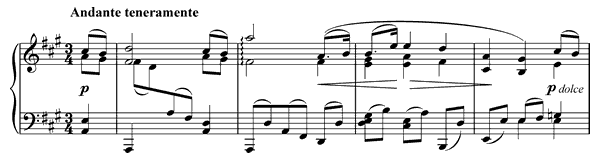
The second morning session used Brahm’s Intermezzo in A, Op 118 as the example for a discussion of how music can be divided into smaller elements, “zooming in” on these constituent parts to achieve more focussed practising.

For example, the right hand part divides into two distinct “voices”, upper and lower: practising each part or “voice” separately enables deeper learning. Much of this seems quite obvious, but it is surprising how many piano who play and study piano music do not use these kinds of learning tools.

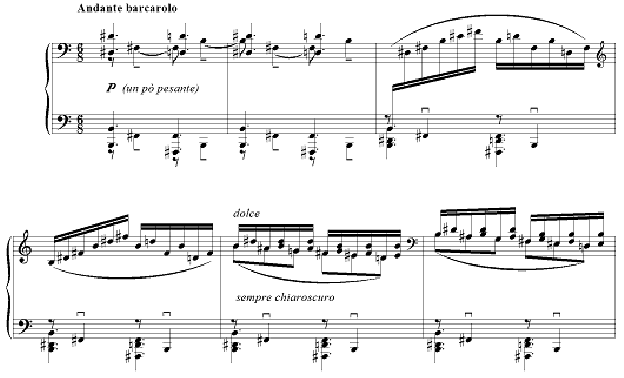
After lunch, during which I enjoyed talking about concerts and piano repertoire with some of the other participants, Carlo presented a session on memory work, demonstrating once again how reducing the music into small sections and patterns can facilitate memorisation. The musical example was Busoni’s elegaic barcarolle All’Italia.

Busoni

The session finished with some discussion on expressive grammar, the study of which is necessary for a truly coherent reading of a piece: by this, Carlo means not only the obvious dynamic, tempo and articulation markings, but other aspects such as the “stretching” intervals (in the manner of a singer), masculine and feminine endings and cadences, different types of accents and so forth.

Throughout the seminar, Carlo stressed that these aspects of piano study and method should not be seen in isolation and that the ultimate goal is to encourage deep, thoughtful practise resulting in an profound understanding of the music and the ability to play with expression. He also stressed the need to be a “curious learner”. All in all, it was an extremely valuable and thought-provoking seminar and I left full of new ideas for my own piano study and my teaching.

Carlo’s book Fundamentals of Piano Methodology is available in English (publisher Rugginenti)