Who or what inspired you to take up composing, and make it your career? 

My grandfather was a composer, so he definitely inspired me. My mum did a music degree when I was about 9 years old so we had a small music studio at home where I learnt to use Cubase. It was around then that I remember writing my first composition, a Morris dance that was used in a local production of A Midsummer Night’s Dream (my mum wrote the rest of the music for the production).

As for making it my career, I actually came to it fairly late – 8 years after completing my degree. At the time, I didn’t think it was possible to make a living from composing and I didn’t want to teach, so I took an office job to bring the pennies in. It’s only since getting married and having a baby that I’ve been able to stay at home and write music, but it’s been the best decision I ever made!

Who or what were the most important influences on your composing? 

I consider myself to be a self-taught composer, as I don’t recall ever receiving much direct feedback on my work. Even at university, our composing sessions consisted of listening to new music rather than learning compositional techniques and tips. This is my memory of it anyway! So my composing hasn’t been directly influenced by any teachers.

Instead, I would say that my main influence initially was music I had played in orchestras. I used to say that I wanted my music to have the harmonies of Debussy, the rhythms of Stravinsky, the Englishness of Vaughan-Williams, and the passion of Rachmaninov. However, since returning to composition in 2011, I’ve opened my ears to the wealth of new music that has been written since the time of those composers, right up to music being created in the present. As a result, my style has changed a little, I have learned a lot, and my ideas are more creative. I’ve started to look outside of music to find influences, for example ancient history and nature.

What have been the greatest challenges of your career so far? 

As I left it so long after university, I didn’t have any tutors to promote me, enter me for competitions, or show me how to turn this from a passion into a career. I have had to do a lot of research into how composers get paid, how to be noticed, how to get my music performed, etc. I have also had to find the performers for myself, something which would have been a lot easier had I still been at university and surrounded by musicians. This has actually been a good thing though, as I have made connections with a lot of fantastic performers.

Which performances/compositions/recordings are you most proud of?  

I’m extremely proud of winning the Yorkshire Late Starters Strings composing competition 2011/12 with my 15 minute piece “Battle of the Winwaed”. The piece was written for the YLSS, who comprise adult string players of grades 2-8. To get round the challenge of writing for mixed abilities, I split the cellos into parts 1 and 2, along with the usual 1st and 2nd violins, violas and basses. I also wrote parts for a solo violin and solo cello, to add more complexity for those players of the highest standard. The orchestra performed the piece twice in 2012.

I’m also very proud of my third string quartet, “Cross Quarter Days”, which was recorded in 2012 and has been released on iTunes, Amazon, and on my website. The piece is in 4 movements, each representing one of the four key dates in the Pagan calendar that divide the year into quarters. It represents a big leap in terms of my development since the second quartet, written just a year earlier, and I feel it’s the work that best represents me as a composer.

Favourite pieces to listen to? 

One of my favourite pieces to listen to is Michael Torke’s July for saxophone quartet. It’s so funky, I don’t think I could ever get tired of it! Other favourites include the Rite of Spring, Turangalîla, the Planets, Ravel and Debussy’s string quartets, White Man Sleeps by Kevin Volans, Gabriel Prokofiev’s Jerk Driver… I also listen to a lot of 80s pop music and Steely Dan!

What is your most memorable concert experience? 

Performing Turangalîla with the County Youth Orchestra at Snape Maltings, I think it was in 2003. Such an overwhelming piece to perform, and in such a fantastic venue. I feel very privileged to have had that experience. I remember walking off stage with my cello at the end and saying to the conductor, “wow, that was amazing!”.

Regarding performances of my own work, the most memorable is probably when I performed my own concerto for cello and string orchestra at university in 2002. Having my Christmas carol “On A Gentle Winter’s Night” performed in Guildford cathedral in front of 1000 people in 2001, and then its second performance in New Zealand last year, are also very memorable occasions!

What do you consider to be the most important ideas and concepts to impart to aspiring musicians? 

Be true to yourself. Don’t give up. Have an open mind. Listen. Network. Take criticism constructively. Make things happen, don’t sit around waiting to be noticed.

What are you working on at the moment? 

I’m currently about halfway through my largest commission so far – a 25 minute suite for full symphony orchestra entitled “Legends of the Tor”. The work will be in 5 movements, each referencing a different legend relating to Glastonbury Tor in Somerset. The piece has been commissioned by my local symphony orchestra, after they successfully applied for a highly competitive “Community Music” grant from the BBC Performing Arts Fund. The community element will be the involvement of 5 local schools, who will each have a group of children composing their own music on the theme of “Myth and Legends”, with the help of workshops led by myself and members of the orchestra. The children will perform their pieces at the concert in June when the orchestra will premiere my piece.

Where would you like to be in 10 years’ time? 

My goal is a commission for the BBC Proms! I’ve set myself a 10 year target, so we’ll see what happens! Failing that, I’d be happy to have my music performed regularly and to continue receiving commissions so that I can carry on writing.

Alison Wrenn’s new work for piano trio Between the Mountains and the Sea receives its premiere at the Halstatt Classics Music and Literature Festival on 17th August. Further details here


Alison Wrenn (b.1981) is a British composer, whose style brings together influences from the English Pastoral Tradition, elements of popular music and media music as well as strains of Celtic and some aspects of American minimalist music.

Full biography

“One should only write piano music for the Bechstein”

Claude Debussy

This week I finally took delivery of my Bechstein grand piano, a 1913 Model A. I had to wait four months before she could move in (and she is most definitely a “she”, because she is so pretty! And a friend named her “Bechy” in advance of her arrival), because of building work in my home. As the “due date” drew nearer, I put a large Indian rug down in the space where Bechy would be going and began to visualise my remodelled and redecorated living room with a 6′ grand piano in it.
I suppose every pianist dreams of owning a grand piano. It has certainly been a long-held wish of mine (along with being able to play Beethoven’s Piano Sonata, Op 110 – not such a pipe dream any more now that I have started a serious study of this work). I used to gaze longingly into the window of the Steinway showroom on Marylebone Lane on my way to the Wigmore Hall, but for a long time I never imagined I would ever be able to afford a grand, nor fit one into my home. But when I passed my ATCL with Distinction I began to think about the possibility of owning a grand piano as I felt my upright was limiting. I started looking at modern grands: at the more affordable end of the market, nearly all of these are now made in the Far East, with varying degrees of quality. A friend recommended sticking with what I knew and purchasing a Yamaha, but I began to crave a warmer, more “European” sound. My tuner knew I was on the hunt for a grand and began to make excited plans for us to attend the London Piano Auctions at Conway Hall but I was wary about purchasing a piano at auction, even with my knowledgeable and experienced tuner to help and advise me. And then my tuner mentioned an old Bechstein which had come into his workshop for restoration. He urged me to come and try it, praising its range of sound – “like a string quartet, or a choir!” – and its superior condition, despite its age. In the end, I weakened, and on a cold afternoon in late March, after a sushi lunch on Clerkenwell Road with my husband, I played the piano in Rolf’s workshop. And I knew it was the piano I had to buy. We retired to a small cafe over the road with Rolf’s business partner Klaus, and there, over mugs of tea and Portuguese custard tarts, the deal was sealed. On the bus back to Waterloo, I texted my husband “I’ve bought a grand piano!”. He replied “have you got it with you, on the bus?!”.

There followed several months of getting the money together to pay the for piano. My husband generously (foolishly?!) agreed to give me the equivalent of what he would have spent on a mountain bike (a not inconsiderable sum, as it turned out!), and the person for whom I work on Mondays as a secretary and companion, very kindly made a contribution to the “grand piano fund”. On 1st August 2013, the piano was mine. She arrived at my house on 6th August.

The C Bechstein Pianofortefabrik AG was established in 1853 in Berlin. Prior to setting up the factory, Carl Bechstein studied and work in France and England as a piano craftsman, making pianos for other people. When he established his own factory, he was determined to manufacture pianos which could withstand the greater demands imposed on the instrument by the virtuosi of the day, such as Franz Liszt and Hans von Bulow (who gave the first public performance on a Bechstein, performing Liszt’s Sonata in B minor). The pianos were endorsed by both Liszt and von Bulow, and by the 1870s were staples in many concert halls and private houses. Together with Bluthner and Steinway, Bechstein was, and remains today, a pre-eminent manufacturer of superior-quality pianos.

Bechstein piano showroom on London’s Wigmore Street.

In 1885, Bechstein opened a branch in London, which grew to be the largest branch and dealership in western Europe, and on 31st May 1901, Bechstein Hall, built at a cost of £100,000, opened next to the company’s showroom on London’s Wigmore Street. Bechstein Hall was built to provide London with a venue that was impressive yet intimate for recitals of chamber music. With near-perfect acoustics, the hall quickly became celebrated across Europe and featured many of the great artists of the 20th century. The pianos for the hall were supplied from the adjacent Bechstein showroom.

The company suffered huge property losses in London, Paris and St Petersburg during the First World War; this and rampant anti-German sentiment forced the closure of the London showroom. Following the passing of the Trading with the Enemy Amendment Act in 1916, the British arm of the company was wound-up,and all Bechstein property, including the concert hall and showrooms full of pianos, were seized as “enemy property”. In 1917, the concert hall reopened, renamed Wigmore Hall, and the pianos from the next door showroom were confiscated and became the property of the new owners of the concert hall. Wigmore Hall remains London’s top venue for chamber music and solo recitals, but today its pianos are supplied and maintained by Steinway.

Bechstein pianos are still manufactured in Germany, under the ownership of Karl Schulze, a German entrepreneur and master piano maker. Bechstein pianos have been favoured by some of the greatest concert pianists and recording artists, including Leonard Bernstein, Wilhelm Kempff, Dinu Lipatti, Shura Cherkassy, Sviatoslav Richter, Oscar Peterson and Tatiana Nikolayeva.

This slideshow requires JavaScript.

I feel privileged to own such a beautiful instrument, and one which has such a fine pedigree. From the opening measures of Debussy’s Prelude Les sons et les parfums tournent dans l’air du soir, it was obvious that the piano has a far greater range of tonal possibilities and colours than my modern Yamaha upright. And when a friend came to play the piano in the afternoon, and I was able to appreciate its voice from the sofa, even more was revealed about it. I am very much looking forward to getting to know the piano.

London Pianos – restoration, tuning, repairs, concert hire and removals

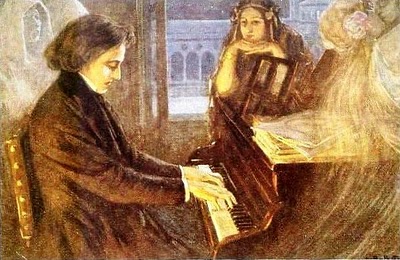
The story of composer Fryderyk Chopin and writer George Sand is one of the most compelling, romantic and passionate, a nine-year love affair which continues to fascinate and grip the imagination. It is a story of creative union and artistic inspiration, of a relationship severed by ugly jealousy and recrimination, and one which ended tragically with the untimely death of Chopin in October 1839.

For many, the relationship between Chopin and Sand is an attraction of opposites: she with her fiery, mercurial, outspoken personality, her penchant for men’s clothes and cigars contrasted with Chopin’s fastidiousness, his delicacy and shyness (particularly in performing in public). Yet during the nine years of their relationship, Chopin produced some of his finest piano music, including the 24 Preludes Op 28 and the B minor Piano Sonata. Despite her reputation for taking up with and then discarding lovers with the casualness one might discard a dirty chemise, Sand gave Chopin love and affection, and a settled home life, divided between Paris and her house at Nohant, that enabled him to compose. She nursed him when he was ill and offered solace and support when he felt his muse had deserted him. Added to this, their circle of friends comprising artists (the painter Eugene Delacroix, amongst others), musicians (Pauline Viardot, Auguste Franchomme), writers and composers (Franz Liszt) provided Chopin and Sand with a supportive and inspirational background against which they could create music and words.

‘Divine fire’ was Sand’s own description of the intensity of her attraction to Chopin, suggesting a love that transcended the purely physical to a more spiritual plane, a meeting of bodies and minds. It is also the title of a words and music presentation conceived and written by actress Susan Porrett with music performed by pianist Viv McLean.


The narrative runs chronologically, picking up the story of Chopin and Sand from their first meeting in Paris (at which Chopin initially found Sand “repulsive”) through their ill-starred winter in Majorca, contentment at Nohant, Chopin’s acclaimed recital at Salle Pleyel to their stormy parting and Chopin’s tragic death. The narrative is interspersed with music, selected by Viv to complement the text, and comprising some of Chopin’s loveliest works. The opening piece, the fleeting Prelude in A, Op 28 No. 7, set the tone for the evening – played with an ethereal delicacy, the last note was no more than a whisper.

The great strength of this format is the subtle interweaving of words and music. Susan’s text brings to life the personalities of Chopin and Sand through letters between them and their friends, and contemporary accounts. The readings set the tone, and the music reflects it, each piece sensitively rendered by Viv with expression and commitment, from the tenderest, most intimate Nocturnes (Op 9, No. 2, Op post. In C sharp minor) to an intensely poignant Mazurka (Op 17 No 4). Two Ballades (A major and G minor) illustrate Chopin’s contrasting textures and moods, while the Scherzo in C sharp minor is a heroic declamation, shot through with a contrasting motif combining a chorale-like figure with sound showers high in the treble register. Viv’s understated, modest delivery always allows the music to speak for itself, while Susan’s words lend greater focus, encouraging us to listen to the music even more attentively.

Viv expressed some concerns about the piano (an Estonia) to me afterwards, but I and several other audience members assured him that the range of sound was absolutely appropriate for the size of the venue (Bridport Arts Centre is a converted chapel, with cinema-style seating for c200), from the sweetest, most lyrical cantabile (in the Nocturnes, Prelude and Mazurka) to the thunderous, dramatic Presto con fuoco coda of the G minor Ballade. At times the music was accompanied by the faint, plaintive wailing of seagulls (Bridport is close to Dorset’s Jurassic coast), which lent even greater pathos to the music and narrative.

The concert closed with a poignant account of Chopin’s death, and an intense and emotional performance of the Polonaise Fantasie in A flat, Op 61, bringing to an end an absorbing, moving and beautifully presented evening of words and music.

www.vivmclean.com

More about 7 Star Arts

Further reading:

Chopin’s Funeral – Benita Eisler

Chopin: Prince of the Romantics – Adam Zamoyski

Chopin in Paris – Tad Szulc

Chopin’s Letters (Dover)

A Winter in Mallorca – George Sand

Nadav Hertzka

Who or what inspired you to take up the piano and make it your career?

There was always music in my family, my father played the cello as a boy and my sister played piano for a few years. It was never a conscious decision to make it a career, more of a realisation that this is what I wanted to do with my life. I don’t want to sound too naïve, but I still view it that way.

Who or what are the most important influences on your playing?

In a way, the early influences are the most important ones, so I still consider the first recording I’ve heard of Murray Perahia as the single most powerful influence on my playing.

What have been the greatest challenges of your career so far?

There are lots of imperfect pianos out there, flight delays, last minute repertoire changes, etc. The main challenge is to have the right approach and try to make the best out of every situation.

Tell me about your new recording. How did you find the recording experience?

I feel very lucky, I’ve had a gorgeous Fazioli and an incredible team to work with. I’ve been in a studio many times before, but Henry Wood Hall felt different of course, a place with such rich history of recordings. At first you’re very aware of the situation, but once you let go it’s really just you and the music, and that’s a beautiful feeling.

I hear there is a second recording coming up in 2014?

Yes, I’m already hard at work. Very exciting repertoire, and it also gives me a chance to work with both my teachers again, Arie Vardi and Christopher Elton, so I’m very happy about that as well.

Do you have a favourite concert venue to perform in?

I’ve performed several times in Wigmore Hall now and each time is special. So that’s probably my favourite.

Favourite pieces to perform? Listen to?

Anything by Schubert, really. I hope that doesn’t sound too simplistic.

Which performances/compositions/recordings are you most proud of?

Well, I don’t compose, but I did write a few Cadenzas to some Mozart Concerti. Not proud enough I guess, in the end I’ve always played the original Mozart cadenza.

What is your most memorable concert experience?

Playing Mozart’s “Coronation” Concerto, and from the first note everything just clicked, it all fell into place straight away. That’s very rare.

What do you consider to be the most important ideas and concepts to impart to aspiring musicians?

I think the most important thing is to understand the language, how music is written. There’s a strange Schenkerian consensus among too many people I think, that no one seems to question. To impose this method on every piece, every composer, is precisely to miss the point. It also goes without saying that one should be familiar with as much repertoire as possible, especially the kind you don’t find appealing at first.

What are you working on at the moment?

I’m preparing for some concerts, playing Prokofiev’s Romeo and Juliet for the first time, as well as some new Liszt and Debussy. I’m also premièring a new work by Freya Waley-Cohen, titled “Five Breaths”.

What is your idea of perfect happiness?

I don’t know about “perfect”, but in one way or another it would include a David Aaronovitch piece, defending free expression and democratic values, a Mahler Symphony and most likely some Baklavas to go with my Turkish coffee.

Nadav Hertzka performs in the “Pietre Che Cantano” international Festival in Rocca di Mezzo, Italy.

Nadav’s Tchaikovsky disc (Skarbo) is available now from Amazon, iTunes and other retailers.

Israeli pianist Nadav Hertzka has performed throughout the United States, Europe and Asia in major venues such as Carnegie Weill Hall, Wigmore Hall, Kings Place, Shanghai Conservatory, and Avery Fisher Hall. His festival appearances include the Mostly Mozart Festival in Lincoln Center, the Beethoven Festival in Israel and the Mozart Festival in Malta, as well as engagements in China, Russia, Czech Republic, Switzerland, Austria, Belgium, England and Scotland.

Mr. Hertzka made his orchestral debut at age 14 with the Haifa Symphony Orchestra, and has since worked with conductors Trevor Pinnock, Yi-An Xu, Mendi Rodan, Ishay Steckler, Eliezer Hachiti and Talia Ilan among others. He was featured on Radio and Television, including BBC3 and BBC Scotland. Winner of many international prizes and awards, including the Pinault Society International Piano Competition in New-York, the Frank Peleg and Ben-Haim competitions in Israel, the Rubin Academy Piano Prize, The Daniel Howard Trust Award, the Carlton House Award, and Howard de Walden Award. He is also a winner of the America-Israel Cultural Foundation Scholarship Competition, and has won scholarships in both Piano and Chamber Music.

Born in Tel-Aviv in 1986, Mr. Hertzka began his studies at age seven with Mrs. Nina Tansky. In 1996, he continued his studies with Mrs. Hadassah Gonen at the Israeli Conservatory of Music. He received his BMus Degree from the Tel-Aviv Rubin Academy as a student of Prof. Arie Vardi, and his MA Degree with Mr. Christopher Elton at the Royal Academy of Music, London.
